
Yes. Uncharacteristic vocabulary changes are one of the most reliable initial signals of AI use—specifically when an essay exhibits a sudden leap to collegiate Tier 3 terminology, an influx of formulaic AI transition markers ("delve into," "tapestry," "testament to"), and dense academic phrasing that contradicts the student's in-class speech and prior writing.
When reviewing student papers, experienced educators often notice when a sentence "doesn't sound like the student." A high school sophomore who normally writes in straightforward, active prose suddenly submits paragraphs filled with phrases like "serves as a poignant testament to the multifaceted tapestry of human resilience." While students can and do learn new words, generative AI models exhibit distinct statistical vocabulary distributions that differ sharply from organic human language acquisition. Checkmark Plagiarism quantifies lexical shifts to provide teachers with objective evidence.
Below is a comprehensive guide on diagnosing vocabulary changes and evaluating their authenticity.
Checkmark Plagiarism analyzes lexical shifts by pairing AI detection with essay writing playback, plagiarism detection, autograding, and integrations with Canvas and Google Classroom.
The 4 Vocabulary Signatures of Generative AI Writing
1. High-Frequency AI Discourse Clichés
Heavy reliance on signature LLM vocabulary: "delve into," "multifaceted tapestry," "crucial nuance," "beacon of hope," "in essence," and "furthermore."
2. Sudden Tier 3 Lexical Inflation
The sudden, unprompted appearance of dense academic terminology (e.g., "juxtaposition," "paradigm," "dichotomy") with zero intermediate usage in drafts or class discussions.
3. Thesaurus Swapping & Lexical Distortion
When students use AI humanizers or paraphrasers (like QuillBot), everyday words are replaced with awkward synonyms that disrupt semantic flow.
4. The "Comprehension Gap" in Oral Defense
When asked in person to define the advanced vocabulary used in their paper, the student is unable to provide accurate meanings or explain their context.
How Human Vocabulary Growth Differs from AI Influx
Understanding the cognitive reality of language acquisition:
- Organic Human Acquisition: When a student learns a new word (e.g., "authoritarian"), they typically use it once or twice in a paper, often experimenting with its placement.
- Synthetic AI Influx: AI models generate text using statistical token probability, saturating every paragraph with dense, hyper-formal collegiate terminology uniformly.
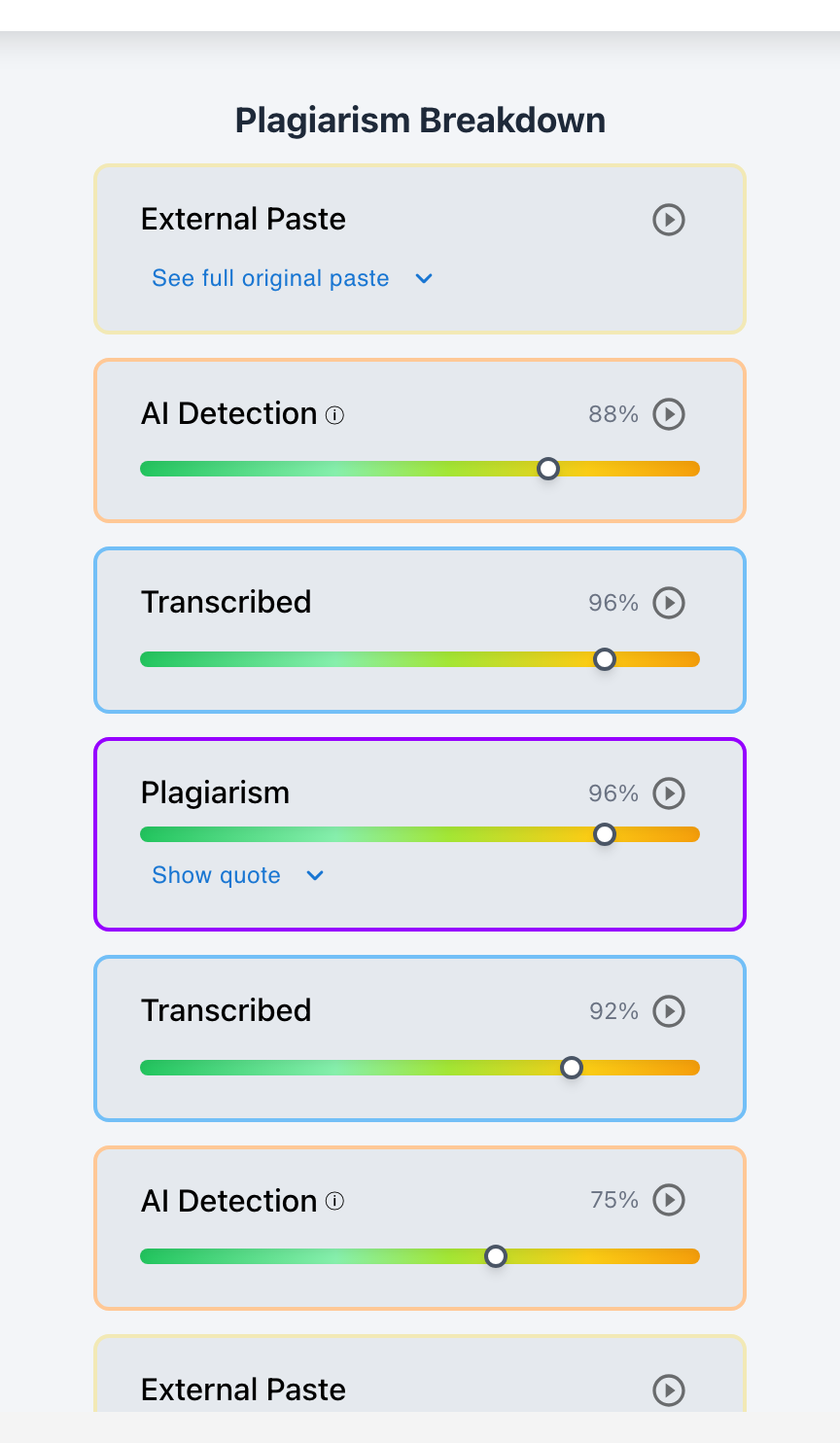
- The Telemetry Mismatch: In Checkmark Playback, an authentic student typing a new complex word pauses for 5 to 15 seconds to check spelling. In AI transcription or pasting, complex words appear in milliseconds with zero pauses.
Read more in how Checkmark writing process analysis works.
Comparison: Organic Vocabulary Growth vs. Synthetic AI Influx
Organic Student Growth (Authentic Learning)
- New words cluster around taught curriculum concepts.
- Occasional minor grammatical missteps with new terms.
- Active typing pauses on new vocabulary in Playback.
- Student can explain word meanings comfortably in person.
Synthetic AI Influx (Machine-Generated)
- Saturated with formulaic AI transition clichés.
- Flawless collegiate syntax with zero experimentation.
- Typed at uniform high speed or pasted instantly.
- Student cannot define words when asked orally.
A 5-Step Educator Protocol for Vocabulary Shift Audits
Vocabulary Audit Checklist:
- 1. Open the student's submission in Checkmark Playback inside Canvas SpeedGrader.
- 2. Review the Lexical Density Index and AI Cliché phrase heatmap.
- 3. Compare the vocabulary complexity against the student's Week 1 In-Class Diagnostic Baseline.
- 4. Inspect the Writing Playback telemetry: verify if advanced words were typed with pauses or pasted.
- 5. Hold a supportive 2-minute check-in: "You used the word 'anachronistic' here—can you tell me what that means in this context?"
How Checkmark Plagiarism Powers Lexical Forensics
Checkmark Plagiarism combines **AI detection, essay writing playback, static AI detection, plagiarism detection, autograding, and Canvas/Google Classroom integrations** to automatically highlight AI vocabulary clichés and measure lexical baseline disparities.
Frequently Asked Questions
Why does AI writing use such distinctive vocabulary?
Because Large Language Models are trained on vast web corpora and optimized for polite, formal discourse—naturally favoring words like "tapestry," "multifaceted," and "delve."
Can a student learn big words without using AI?
Yes. Students acquire vocabulary through reading and instruction, but organic acquisition is accompanied by active drafting time and the ability to define the words orally.
What are the most common ChatGPT words in student essays?
Common AI words include: "delve," "tapestry," "testament," "foster," "pivotal," "holistic," "intricacies," "crucial," "beacon," and "furthermore."
How does writing playback prove vocabulary authenticity?
Playback shows whether a student struggled, paused, and backspaced while typing complex words, proving genuine cognitive drafting effort.
What if a student used a thesaurus tool on their own writing?
Thesaurus usage shows up in Playback as words being highlighted, deleted, and replaced individually, whereas AI produces whole pre-formed clauses.
How does Checkmark Plagiarism integrate with Canvas LMS?
Checkmark provides certified LTI 1.3 integration, SpeedGrader sidebar embeds, two-way grade passback, and single sign-on (SSO).
What should a teacher do if a student cannot define a word from their essay?
Use the opportunity for a supportive teaching conference about intellectual ownership, integrity, and revising work into their authentic voice.
Can AI humanizers hide AI vocabulary patterns?
Humanizers swap words but often create awkward, unnatural phrasing that triggers high lexical distortion scores in Checkmark.
Does Checkmark highlight specific AI words in the text?
Yes. Checkmark's Lexical Heatmap highlights known AI transition clichés and low-perplexity phrases directly in the essay text.
Why is multi-signal proof essential for vocabulary investigations?
Because combining lexical shift analysis with keystroke playback and oral check-ins provides definitive, fair proof of authorship.
Evaluating Words with Scientific Precision
Vocabulary is the window into a student's developing mind. By analyzing lexical shifts and keystroke telemetry with Checkmark Plagiarism, educators can celebrate genuine vocabulary growth while identifying artificial machine text with complete confidence.
Checkmark Plagiarism supports this comprehensive approach with AI detection, essay writing playback, static AI detection, plagiarism detection, autograding, and integrations with Canvas and Google Classroom.
See how Checkmark pairs lexical shift forensics with keystroke playback to evaluate student vocabulary. View a sample report or request a demonstration.