
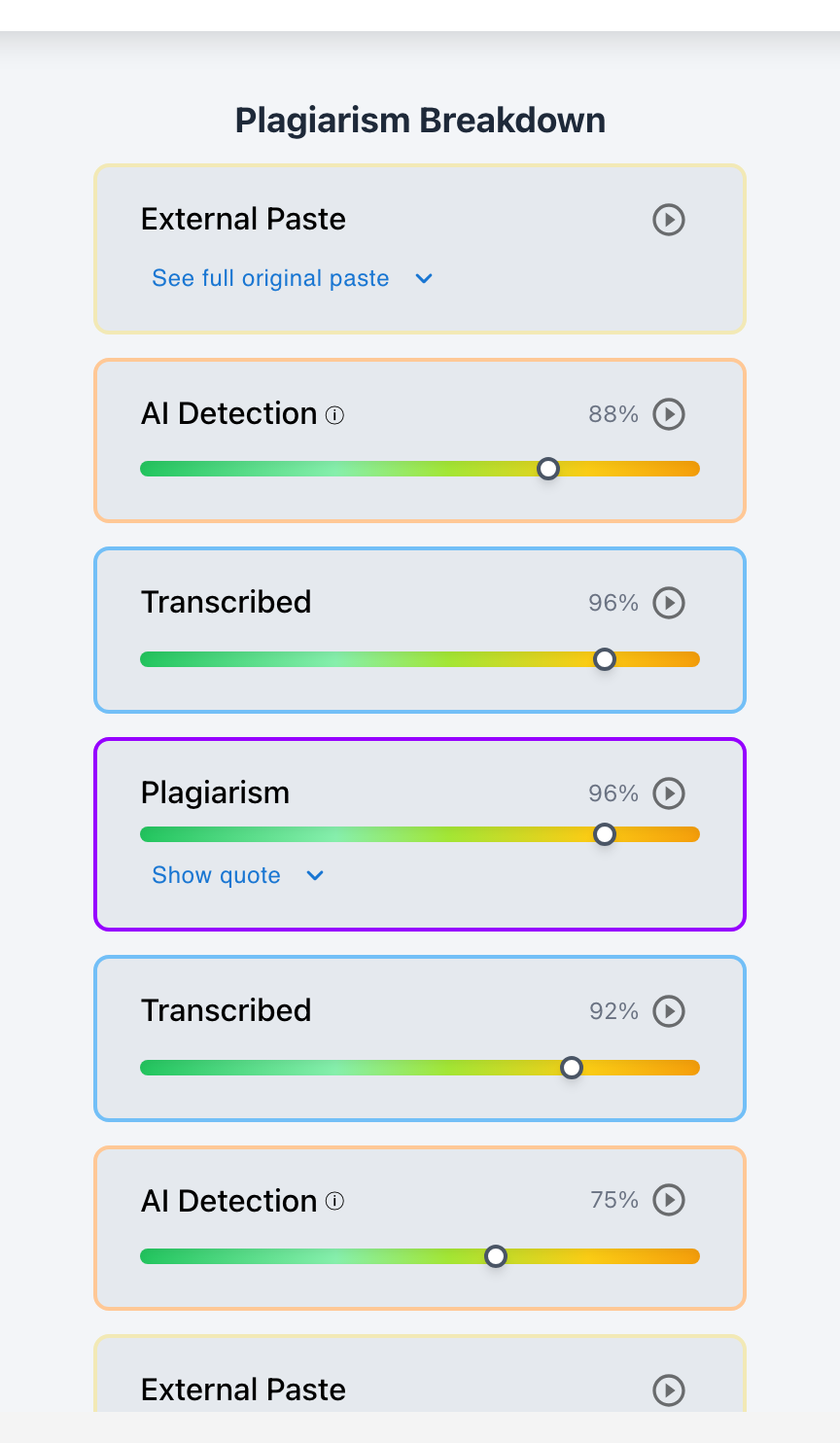
Yes. Teachers can easily tell if an essay was composed in another program (such as Microsoft Word, Apple Pages, Scrivener, or handwritten on paper) by checking Checkmark's Writing Playback—which flags large clipboard paste events, zero in-browser typing hours, and hidden formatting metadata artifacts.
Many students prefer drafting in specialized desktop applications, working offline without internet distractions, or writing longhand in physical notebooks before typing their final submission into Google Docs or Canvas. While offline drafting is a valid personal workflow, it produces a document creation signature that looks identical to a direct paste from an AI generator: 1,500 words appearing in a single instant. To distinguish legitimate external drafting from unauthorized AI shortcuts, educators need clear forensic tools and a structured verification protocol.
Below is a comprehensive guide on identifying and verifying externally composed student essays.
Checkmark Plagiarism powers external composition analysis by pairing essay writing playback with AI detection, plagiarism detection, autograding, and integrations with Canvas and Google Classroom.
The 4 Forensic Signs of External Composition
1. 0.05-Second Document Influx
The full document word count appears in version snapshot 1 within milliseconds of opening the LMS submission window.
2. Clipboard Paste Telemetry Flag
Checkmark logs an external clipboard insertion event, capturing the exact timestamp and character count of the pasted block.
3. Formatting & Typography Artifacts
Pasting from Word, Pages, or web tools often carries invisible rich-text tags: non-breaking spaces, curly smart quotes, or unusual default font sizes (Calibri/Times New Roman).
4. Zero In-Browser Drafting Hours
Total active typing duration in the LMS word processor is under 3 minutes, showing zero real-time backspaces or typing pauses.
How to Verify Legitimate External Drafting in 2 Minutes
When an essay appears all at once, teachers can quickly verify authentic offline creation:
- Request the Original Document File: If drafted in Microsoft Word, Apple Pages, or Scrivener, ask the student to email their original .docx or .pages file. These files contain rich internal metadata: creation dates, total editing time, and author usernames.
- Inspect Handwritten Drafts: If drafted longhand, ask the student to present their notebook during class for a quick visual confirmation.
- Conduct a 2-Minute Oral Check-In: Ask the student to define specialized vocabulary and summarize their main thesis argument to confirm cognitive ownership.
Read more in how Checkmark writing process analysis works.
Comparison: Legitimate Offline Drafting vs. AI Generation Influx
Legitimate Offline Composition (Word/Pages/Paper)
- Student can immediately produce original source file.
- Original file exhibits multi-day timestamps and edits.
- Student speaks fluently about thesis and citations.
- AI probability score remains low or moderate.
Unauthorized AI Generation (ChatGPT Paste)
- Student claims they "wrote it in Word but deleted the file."
- Zero rough notes, outlines, or drafts can be produced.
- Student struggles to explain vocabulary or arguments.
- AI probability score and paragraph heatmaps trigger high.
A 5-Step Educator Protocol for External Composition Audits
External Drafting Verification Protocol:
- 1. Open the student's submission in Checkmark Playback to inspect the paste event log.
- 2. Review the Plagiarism similarity matches and AI probability heatmaps.
- 3. If an external paste is flagged, ask supportively: "I see this was pasted from another program. Can you forward me your original Word file or show your notes?"
- 4. Check the original file's metadata: verify creation timestamps and editing duration.
- 5. If verified, dismiss the alert and grade the paper on merit; if no proof exists, proceed with academic review.
How Checkmark Plagiarism Powers Offline Verification
Checkmark Plagiarism combines **AI detection, essay writing playback, static AI detection, plagiarism detection, autograding, and Canvas/Google Classroom integrations** to make verifying external drafting fast, objective, and supportive.
Frequently Asked Questions
Can teachers tell what software a student used before pasting?
Formatting tags, font families, and smart quotes often reveal whether text originated from Word, Apple Pages, or a web browser.
Is it against the rules for students to write in Microsoft Word instead of Google Docs?
Unless the instructor explicitly required in-browser drafting for process monitoring, writing offline is completely permissible provided the work is authentic.
What metadata is stored in a Microsoft Word file?
Word (.docx) files store total editing time, creation date, revision numbers, last modified timestamps, and author profile names.
What if a student claims their offline draft was lost or deleted?
Hold a brief 2-minute oral check-in asking the student to define key vocabulary, explain their thesis, and walk through their primary sources.
How does Checkmark capture the raw pasted text?
Original Paste Preservation captures the unedited text snippet at the moment of insertion, preserving the original payload even if edited later.
How does Checkmark Plagiarism integrate with Canvas LMS?
Checkmark provides certified LTI 1.3 integration, SpeedGrader sidebar embeds, two-way grade passback, and single sign-on (SSO).
How can teachers prevent external paste confusion in the future?
Instruct students on syllabus expectations: requiring drafting directly in Google Docs or requiring rough drafts to be uploaded alongside final papers.
Does pasting from Word trigger a high AI score?
Pasting alone does not trigger a high AI score—AI scores are based on perplexity and burstiness. However, pasting removes keystroke playback exoneration data.
Can writing playback verify student handwriting?
If a student handwrote their paper, a quick in-person glance at their notebook immediately corroborates their authentic drafting process.
Why is supportive inquiry better than immediate accusation?
Because innocent students with unique drafting workflows should not be penalized; structured verification protects honest scholarship.
Transparent Evidence for Diverse Writing Workflows
Every student drafts differently. By pairing writing playback with supportive verification protocols in Checkmark Plagiarism, teachers can respect diverse drafting habits while maintaining unshakeable academic standards across every classroom.
Checkmark Plagiarism supports this comprehensive approach with AI detection, essay writing playback, static AI detection, plagiarism detection, autograding, and integrations with Canvas and Google Classroom.
See how Checkmark pairs external paste forensics with multi-signal detection to verify student drafting inside your LMS. View a sample report or request a demonstration.