
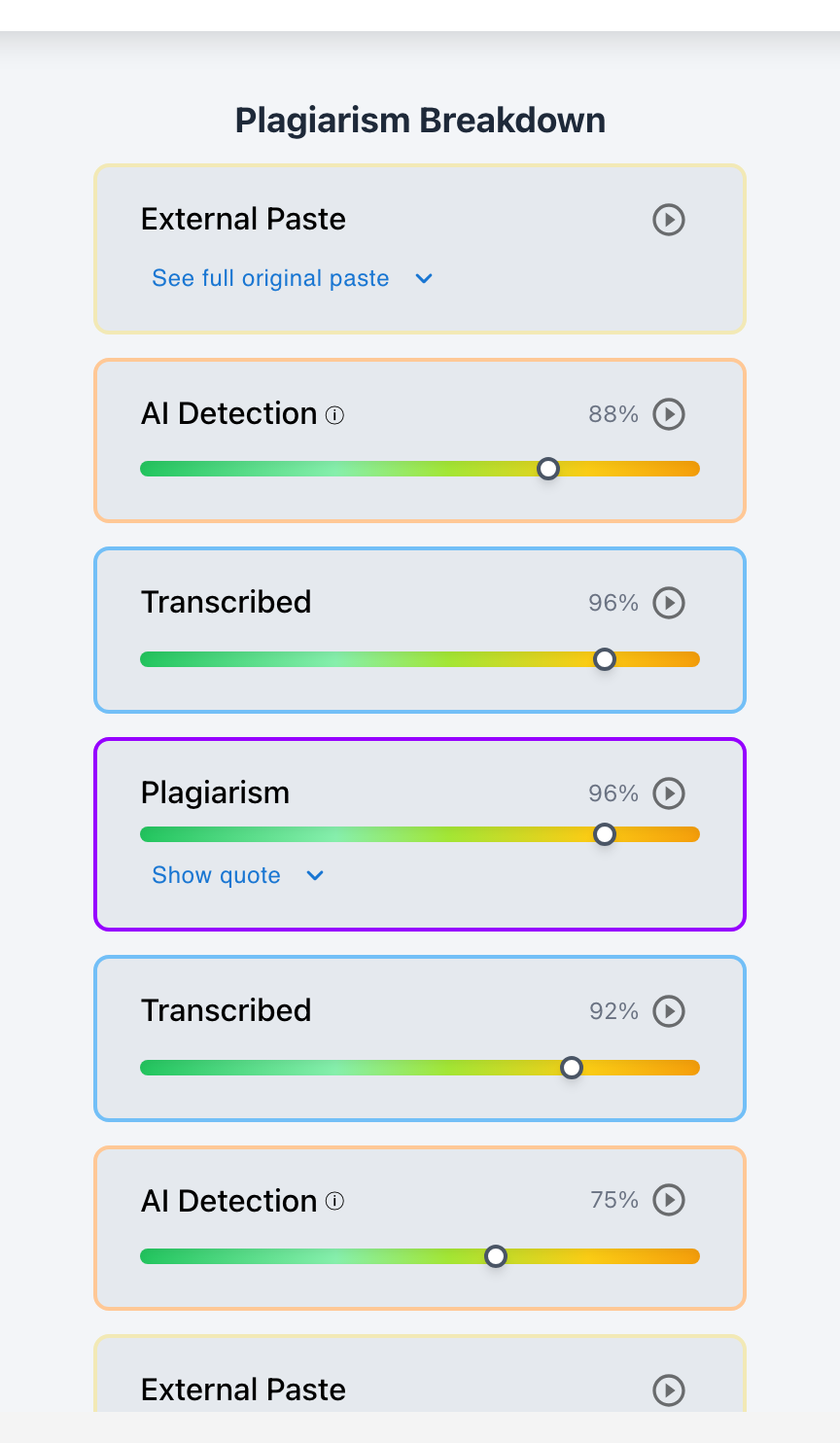
Yes. Teachers can easily detect manipulated Google Docs revision history—because artificial manipulation tactics (such as using automated auto-typer browser extensions, manually retyping AI text from a phone, or intentionally inserting fake typos after pasting) leave distinct, non-human biometric anomalies. While native Google Docs version history may look active at a glance, Checkmark Plagiarism's Keystroke Cadence Engine instantly detects the rigid, unvarying typing velocity and reverse-order editing logs typical of manipulated documents.
As awareness of revision history tracking has grown, a cottage industry of online evasion tactics has emerged. Students use Chrome auto-typer scripts to simulate typing, spend an hour manually copying ChatGPT answers from their smartphones, or paste an essay and go back to randomly delete and re-type words to create the illusion of authentic editing. However, genuine human composition follows unmistakable neurological and motor patterns: variable bursts, pause-before-clause thinking intervals, and natural backspace ratios. Checkmark Plagiarism analyzes these biometric signals to expose manipulated history with mathematical certainty.
Below is a comprehensive guide on how revision history manipulation is executed and how educators detect it.
Checkmark Plagiarism exposes manipulated history by pairing essay writing playback with AI detection, plagiarism detection, autograding, and integrations with Google Classroom and Canvas.
The 3 Common History Manipulation Tactics (and How They Are Exposed)
1. Auto-Typer Extensions
The Tactic: A browser script types pasted text at a fixed speed (e.g., exactly 65 WPM).
The Detection: Checkmark flags zero keystroke jitter (uniform 120ms intervals between all keys).
2. Manual Transcription
The Tactic: The student manually types ChatGPT text from a phone screen.
The Detection: Linear, uninterrupted forward typing with 0% backspaces and zero cognitive formulation pauses.
3. Artificial Typo Injections
The Tactic: Pasting finished text, then randomly deleting letters to fake revisions.
The Detection: Telemetry shows deletions occurring *after* the complete text was already inserted.
The Biomechanics of Authentic Human Writing vs. Manipulation
Understanding the mathematical differences between genuine typing and simulated history:
- Keystroke Inter-Arrival Variance (Jitter): Human fingers strike keys with organic variation (e.g., 80ms for common digrams like "th," 250ms for uncommon reach keys like "q" or "z"). Scripted auto-typers produce robotic, flat intervals across every character.
- Cognitive Boundary Pauses: Authentic authors pause for 2–8 seconds before starting a new sentence or paragraph to mentally organize thoughts. Transcribing or scripted text exhibits zero boundary pauses.
- Chronological Structural Dependency: In real writing, outlines and rough sentences precede finished prose. In manipulated documents, complex prose appears first, followed by superficial cosmetic edits.
Read more in how Checkmark writing process analysis works.
Comparison: Authentic Drafting Telemetry vs. Manipulated History
Authentic Drafting Telemetry (Organic Human Work)
- High keystroke variance (bursts & pauses).
- 15–25% backspace and deletion ratio.
- Frequent pauses at paragraph and clause boundaries.
- Revisions restructure arguments from the inside out.
Manipulated History (Scripted or Transcribed)
- Robotic, uniform inter-keystroke timing.
- Near-zero organic backspaces (<3%).
- Zero cognitive thinking pauses between complex clauses.
- Edits are superficial character swaps on pre-formed text.
A 5-Step Educator Protocol for Detecting Manipulation
History Manipulation Audit Checklist:
- 1. Open the student's submission in Canvas SpeedGrader or Google Classroom with Checkmark.
- 2. Launch Checkmark Writing Playback to inspect the Keystroke Cadence graph.
- 3. Look for flat-line velocity anomalies: check if typing speed remained identical across 1,000 words.
- 4. Inspect the Backspace Ratio: verify if deletion percentage is abnormally low (<5%).
- 5. Hold a 2-minute oral check-in: ask the student to explain the ideas in the transcribed sections.
How Checkmark Plagiarism Powers Manipulation Detection
Checkmark Plagiarism combines **AI detection, essay writing playback, static AI detection, plagiarism detection, autograding, and Canvas/Google Classroom integrations** to automatically analyze keystroke cadence and flag automated scripts or manual transcription in real time.
Frequently Asked Questions
Can Chrome auto-typer extensions fool writing playback?
No. Auto-typer extensions inject characters with mathematical regularity; Checkmark's Keystroke Variance Classifier detects this robotic cadence in seconds.
What does manual transcription from a phone look like in Playback?
Transcription appears as a continuous, flat typing stream without the natural pauses, false starts, or structural deletions typical of genuine composition.
Can a student fake backspaces by typing and deleting random letters?
Artificial deletions stand out clearly in Checkmark Playback because they occur *after* the full text was already pasted, creating an unnatural reverse editing signature.
How does Checkmark measure keystroke jitter?
Checkmark calculates the standard deviation of time intervals between consecutive keystrokes, flagging documents with unnaturally low variance.
How does Checkmark Plagiarism integrate with Google Classroom?
Checkmark integrates directly via LTI, screening Google Docs submissions for manipulation flags and embedding playback reports in the grading view.
Why do students try to manipulate revision history?
Students often believe that generating any revision history—even fake history—will satisfy the teacher and bypass automated AI detection.
What if a student naturally types very fast with few errors?
Fast human typists still exhibit natural cadence variance, digram speed differences, and cognitive pauses at sentence boundaries, easily distinguishing them from scripts.
How does Checkmark protect against false accusations of manipulation?
Checkmark benchmarks typing cadence against verified human distribution models, ensuring only statistically anomalous, script-like streams are flagged.
Can teachers export manipulation evidence for administrative hearings?
Yes. Checkmark exports standardized PDF dossiers containing cadence graphs, inter-arrival variance scores, and time-lapse video links.
Why is cadence analysis the ultimate defense against AI cheating?
Because while AI can generate human-like words, it cannot replicate the physical human neurological process of typing and thinking simultaneously.
Unmasking Artificial Shortcuts with Biometric Truth
Authentic writing cannot be simulated by a script. By leveraging keystroke cadence analysis and writing playback with Checkmark Plagiarism, educators look past superficial manipulation tactics to reward genuine intellectual effort and protect academic integrity.
Checkmark Plagiarism supports this comprehensive approach with AI detection, essay writing playback, static AI detection, plagiarism detection, autograding, and integrations with Google Classroom and Canvas.
See how Checkmark exposes auto-typers and manipulated history with keystroke cadence analytics. View a sample report or request a demonstration.