
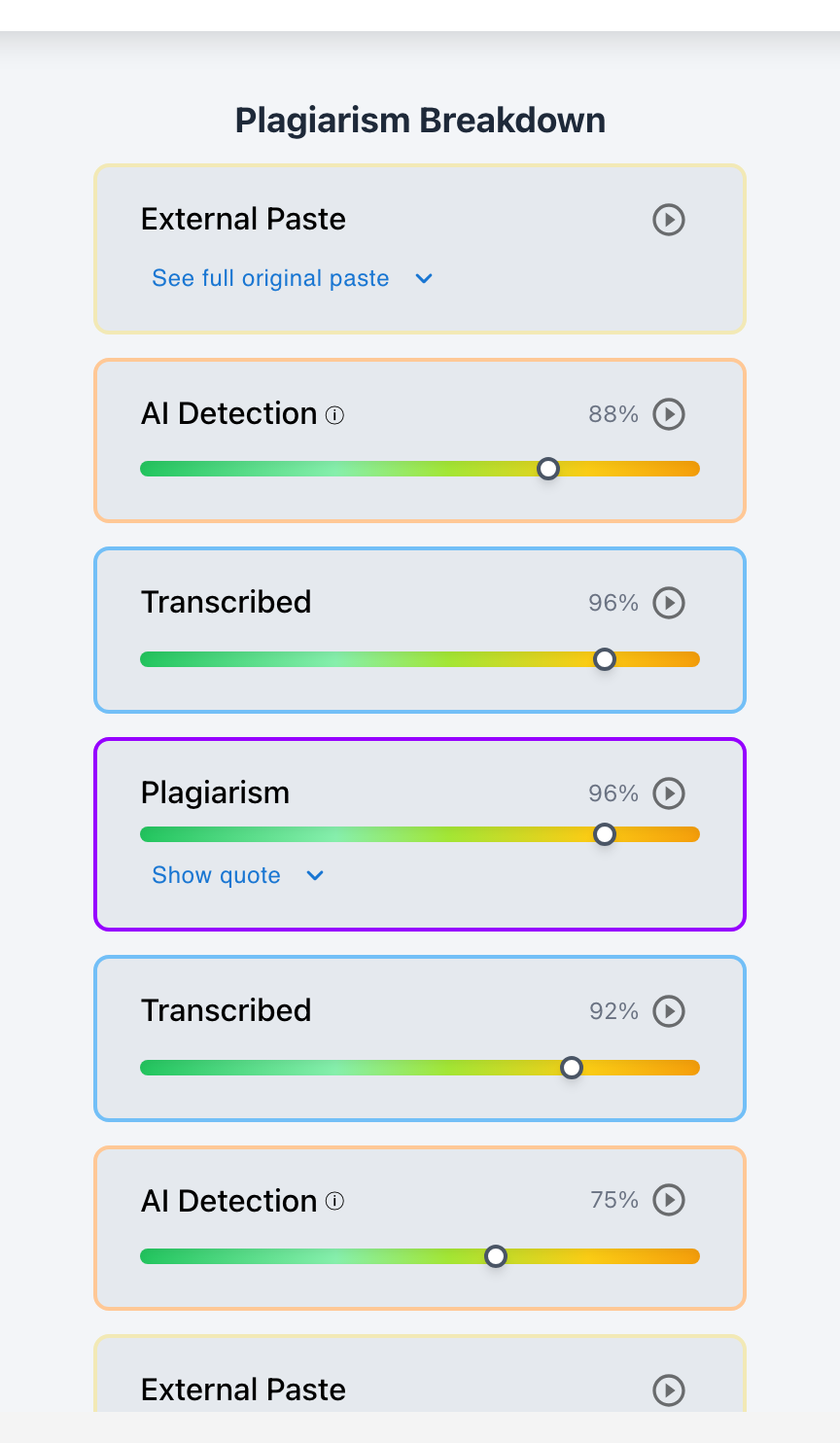
Yes. Teachers utilizing advanced writing analytics can identify when a student is drafting directly on a mobile device or manually copying text displayed on their smartphone screen.
In modern student workflows, smartphones are frequently involved in two distinct ways: (1) authentic drafting directly on the mobile Google Docs or Canvas app, and (2) deceptive transcription, where a student opens ChatGPT or an external website on their phone and manually types the words onto their laptop keyboard to avoid a copy-paste flag. Both behaviors leave unmistakable typing-pattern signatures in the document audit trail.
Through Checkmark Plagiarism's Typing-Pattern Analysis, educators can distinguish between legitimate mobile drafting, authentic laptop composition, and deceptive phone transcription.
Checkmark Plagiarism powers typing analysis by pairing essay writing playback with AI detection, plagiarism detection, autograding, and integrations with Canvas and Google Classroom.
The Two Phone Typing Scenarios & Their Forensic Signatures
Scenario A: Drafting on a Mobile Phone
Characteristics: Auto-capitalization after periods, predictive text insertions (whole words appearing at once), mobile browser user-agent strings, and thumb typing speeds (20–40 WPM).
Scenario B: Transcribing from a Phone Screen
Characteristics: Gaze-shift pauses (type 5 words → pause 2 sec → type 5 words), 0% structural revisions, near-zero backspaces, and high direct text matches.
How Gaze-Shift Analysis Identifies Phone Copying
When a student transcribes text from a phone lying next to their keyboard, they engage in a repetitive mechanical cycle called the Gaze-Shift Cadence:
- Read Phase (1.5–3.0 seconds): The student glances at the phone screen to memorize the next 4–7 words. During this window, 0 keystrokes are recorded.
- Type Phase (1.0–2.0 seconds): The student looks back at their keyboard and rapidly types the memorized phrase without stopping.
- Zero Cognitive Pause: Unlike genuine composition—where writers pause for 20–60 seconds to formulate an argument—the gaze-shift pause is strictly rhythmic and metronomic.
- Zero Structural Editing: Because the text is already formulated on the phone, the student almost never backspaces or reorganizes sentences.
Read more in how Checkmark writing process analysis works.
Comparison: Mobile Drafting vs. Phone Transcription vs. Laptop Writing
Legitimate Mobile Drafting
- Predictive text word insertions.
- Auto-correct capitalization.
- Mobile user-agent metadata.
- Authentic student voice & errors.
Phone Transcription (Cheating)
- Rhythmic 2-sec gaze-shift pauses.
- Near-zero backspace rate (<2%).
- Linear typing with 0% edits.
- Text matches AI or web sources.
Authentic Laptop Writing
- Variable thinking pauses (10–60s).
- High backspace rate (15–30%).
- Frequent paragraph restructuring.
- 0% direct database match.
A 5-Step Educator Protocol for Investigating Phone Typing
Educator Phone Typing Audit Checklist:
- 1. Open the Checkmark writing playback report to observe typing cadence.
- 2. Check for rhythmic gaze-shift pauses (bursts of 5 words separated by 2-second gaps).
- 3. Review the backspace and deletion rate: authentic writing exceeds 15% edits.
- 4. Cross-reference the submitted text with dual AI and plagiarism detection engines.
- 5. Hold a brief conference asking the student to explain and defend their thesis orally.
How Checkmark Plagiarism Powers Typing-Pattern Analysis
Checkmark Plagiarism combines **AI detection, essay writing playback, static AI detection, plagiarism detection, autograding, and Canvas/Google Classroom integrations** to analyze keystroke dynamics automatically, giving teachers clear visual evidence of writing behavior.
Frequently Asked Questions
Is it against the rules to type my essay on my phone?
Writing your essay authentically on a mobile device is usually permitted. Using your phone to read ChatGPT or a website while retyping the text onto your laptop is cheating.
Can teachers tell if I am looking at my phone while typing?
Yes. The physical act of reading a phone and typing creates a distinctive, metronomic "gaze-shift" pause rhythm with zero sentence revisions.
What if I use voice-to-text on my phone to write my essay?
Voice-to-text generates large chunks of text with auto-punctuation. Reviewing the playback log and conducting a quick oral check-in will easily confirm genuine authorship.
Can plagiarism checkers catch text copied from a phone?
Yes. Plagiarism algorithms compare the submitted words against global databases, detecting matching text regardless of whether it was typed from a phone.
How does writing playback distinguish genuine mobile typing from transcription?
Genuine mobile typing has natural typos, auto-corrections, and revisions. Phone transcription produces robotic linear typing without edits.
What should a teacher do if gaze-shift typing is detected?
Share the playback timeline showing the rhythmic typing cadence, review matching sources, and hold an objective academic integrity conference.
How does Checkmark Plagiarism integrate with Canvas LMS?
Checkmark Plagiarism embeds visual writing playback timelines, cadence metrics, and source match links directly inside Canvas SpeedGrader.
Does typing-pattern analysis track my phone's camera?
No. It analyzes only keystroke timing and editing intervals within the assignment document, maintaining complete student privacy.
How does typing-pattern analysis protect honest students?
Honest students exhibit natural thinking pauses and authentic revision habits, providing undeniable proof of genuine human authorship.
Why is typing from a phone ineffective as a shortcut?
It takes just as long as writing an authentic paper, leaves identifiable keystroke anomalies, and is immediately caught by plagiarism and AI detection engines.
Behavioral Evidence Ensures Fair Evaluation
Keystroke dynamics provide objective, physical insight into how documents are created. By analyzing typing patterns and pairing playback with student dialogue, Checkmark Plagiarism ensures academic evaluation is transparent, accurate, and fair.
Checkmark Plagiarism supports this comprehensive approach with AI detection, essay writing playback, static AI detection, plagiarism detection, autograding, and integrations with Canvas and Google Classroom.
See how Checkmark pairs essay writing playback with multi-signal detection to analyze typing-pattern evidence inside your LMS. View a sample report or request a demonstration.