
Yes. Advanced writing analytics and learning management systems record the exact date, timestamp, and active drafting session for every character, word, and paragraph added to an assignment.
Gone are the days when an essay submission was evaluated solely as a static, finished document. In the modern AI-integrated classroom, the creation timeline is just as visible as the final words on the page. Through timestamped writing history, educators can see whether an essay was drafted thoughtfully across multiple sessions over two weeks, or whether 1,500 words appeared in a single midnight burst minutes before the deadline.
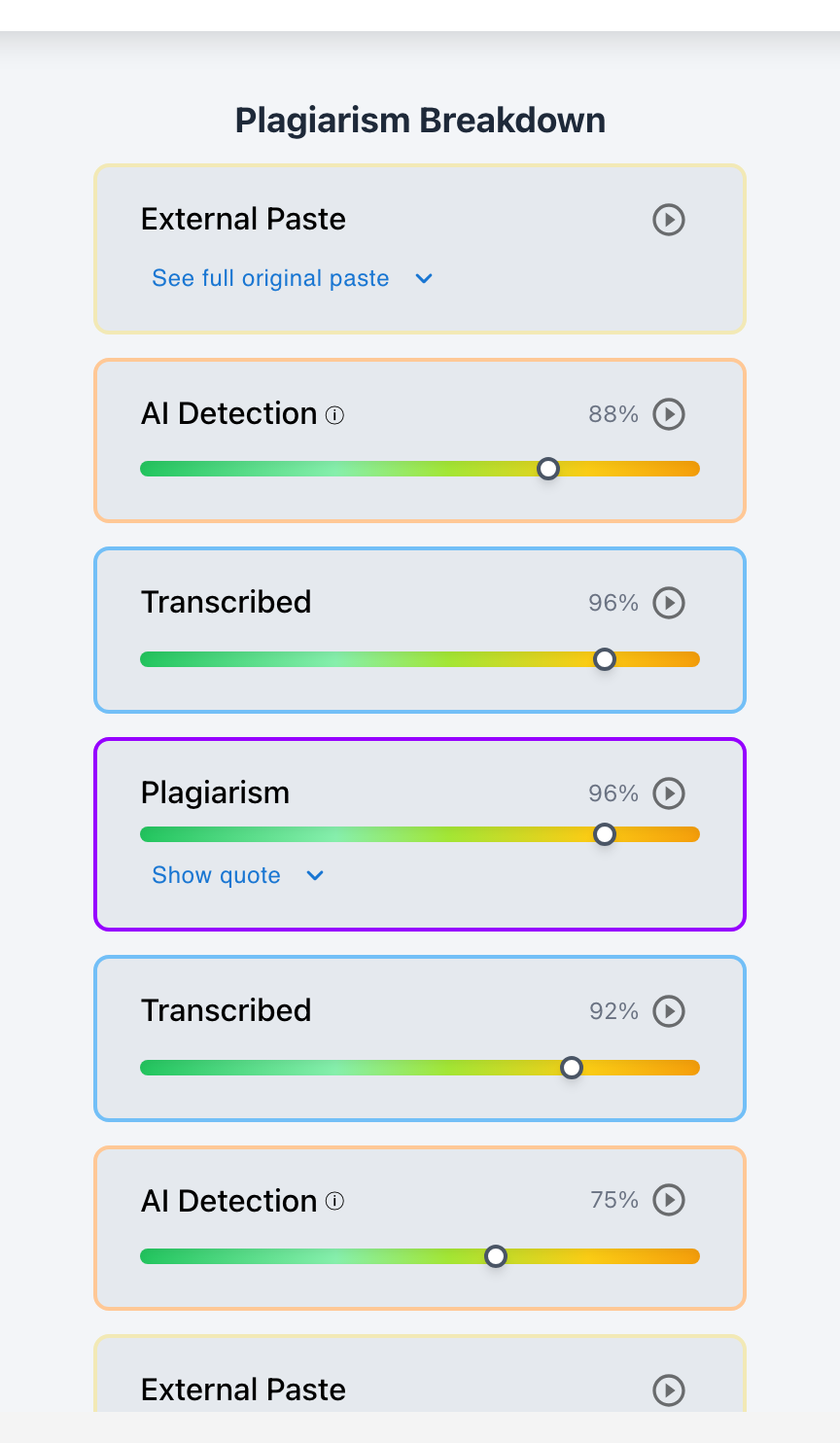
Through Checkmark Plagiarism's Timestamped Writing History and Essay Writing Playback, instructors gain complete chronological transparency, transforming document auditing into an automated, visual review.
Checkmark Plagiarism powers timestamp analysis by pairing essay writing playback with AI detection, plagiarism detection, autograding, and integrations with Canvas and Google Classroom.
The 4 Key Dimensions of Timestamped Writing History
1. Multi-Session Date Distribution
Logs the exact calendar dates of each writing session, confirming whether work began on Day 3 or 30 minutes before the midnight deadline.
2. Active Drafting vs. Idle Duration
Calculates precise active keystroke hours, filtering out periods where the document tab was left open and unattended in the background.
3. Incremental Keystroke Progression
Records the chronological sequence of writing: outline → introduction → body paragraphs → bibliography, proving human pacing.
4. Millisecond Paste Event Logging
Captures the exact microsecond timestamp, paragraph location, and character volume of any external text paste event.
What Teachers See in the Checkmark Playback Timeline
When an instructor opens a submission in Canvas SpeedGrader or Google Classroom, Checkmark presents an intuitive, interactive Timestamped Timeline Bar:
- Scrubbable Time Slider: Drag the timeline slider to view the document state at any specific date or time during the drafting process.
- Session Breakdown Charts: Visual graphs show daily word count additions, active typing minutes, and pause frequencies.
- Color-Coded Event Highlights: Green indicates authentic keystrokes, blue highlights human revisions and deletions, and amber flags external paste events.
Read more in how Checkmark writing process analysis works.
Comparison: Multi-Session Authentic Writing vs. Single-Burst AI Paste
Multi-Session Authentic Writing (Healthy Habits)
- Session 1 (Oct 12, 45 min): Thesis & working outline.
- Session 2 (Oct 15, 60 min): Drafted paragraphs 1–3.
- Session 3 (Oct 18, 90 min): Added evidence, revised conclusion.
- Session 4 (Oct 20, 30 min): Proofreading and source checks.
- Total Active Typing Time: 3 hours, 45 minutes.
Single-Burst AI Generation (Integrity Flag)
- Oct 20, 11:42 PM: Document created (0 words).
- Oct 20, 11:43 PM: External paste event (+1,450 words).
- Oct 20, 11:45 PM: Document submitted via LMS.
- Total Active Typing Time: 3 minutes.
- Zero draft history or keystroke evolution recorded.
A 5-Step Educator Protocol for Reviewing Timestamped History
Educator Timeline Review Checklist:
- 1. Open the Checkmark writing playback timeline directly in Canvas SpeedGrader.
- 2. Check the session breakdown to verify work occurred across multiple days.
- 3. Confirm that total active typing time aligns with the assignment's length (e.g., 3+ hours for 1,500 words).
- 4. Scrub the timeline slider to observe natural keystroke cadence and revision flow.
- 5. Verify that any large paste events correspond to legitimate quoted citations.
How Checkmark Plagiarism Powers Timestamped History
Checkmark Plagiarism combines **AI detection, essay writing playback, static AI detection, plagiarism detection, autograding, and Canvas/Google Classroom integrations** to turn timestamped writing history into an automated, visual, and indisputable record of student authorship.
Frequently Asked Questions
Can teachers see the exact time I worked on my essay?
Yes. Document revision histories and Checkmark writing playback log the exact dates, minutes, and session durations of every writing session.
Can teachers see when text was deleted or revised?
Yes. Timestamps record every backspace, text cut, and paragraph restructuring, providing a complete chronological record of revisions.
What if I write my essay late at night in one sitting?
Writing in one sitting is acceptable as long as writing playback logs hours of continuous human keystrokes (30–60 WPM) rather than an instant 1,500-word paste.
How does timestamped history distinguish active typing from idle time?
Checkmark tracks active keystroke activity, pausing the drafting timer when the user stops typing or navigates away from the window.
Can students manipulate or edit their timestamped writing history?
No. When drafting in an integrated LMS environment with Checkmark enabled, timestamp logs are recorded server-side and cannot be modified by students.
How does timestamped history protect honest students?
A multi-day timestamped history showing active typing and iterative revisions is undeniable proof of authentic student labor, clearing students of false AI accusations.
What should a teacher do if an essay has only 3 minutes of total session time?
Check for an external paste event, review cited sources in academic databases, and invite the student to discuss where and how the essay was drafted.
How does Checkmark Plagiarism integrate with Canvas LMS?
Checkmark Plagiarism embeds scrubbable timeline sliders, session graphs, and dual AI/plagiarism reports directly inside Canvas SpeedGrader.
Can teachers see timestamped history on Google Docs submissions?
Yes. Google Docs records revision timestamps, and Checkmark provides granular, accelerated video playback with active typing metrics.
Why is timestamped history better than an AI detector score?
Detectors provide probabilistic estimates, whereas timestamped history provides objective physical proof of human typing and revision timelines.
Chronological Evidence Upholds Academic Truth
Timestamped writing history elevates writing assessment from subjective guesswork into objective, chronological reality. By pairing timestamped playback with multi-signal detection and student dialogue, educators celebrate authentic writing habits while defending academic integrity with absolute confidence.
Checkmark Plagiarism supports this comprehensive approach with AI detection, essay writing playback, static AI detection, plagiarism detection, autograding, and integrations with Canvas and Google Classroom.
See how Checkmark pairs essay writing playback with multi-signal detection to provide scrubbable timestamped writing history inside your LMS. View a sample report or request a demonstration.