
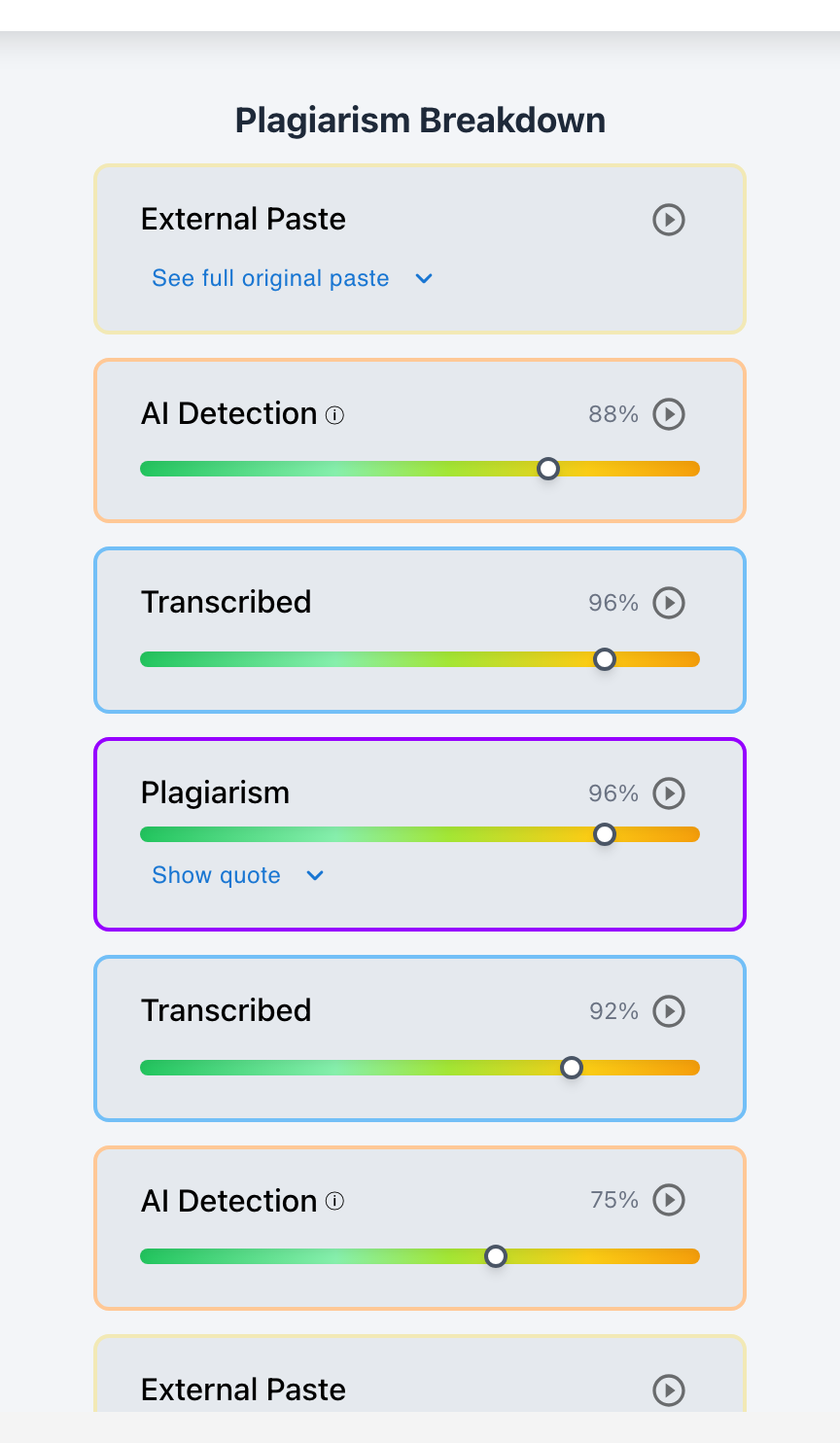
Yes. Teachers can see deleted text in Google Docs by opening Version History (File > Version History > See Version History) and checking the "Show Changes" box. Google Docs displays deleted text with strikethrough formatting color-coded by the collaborator who deleted it. Furthermore, Checkmark Plagiarism's Writing Playback animates all deletions in real time, calculating exact backspace percentages and uncovering deleted AI introductory prompts or pasted text blocks.
A frequent assumption among students is that hitting "Backspace" or deleting a paragraph permanently erases it from existence: "If I accidentally pasted ChatGPT's intro saying 'As an AI language model,' I can just delete that sentence and no one will ever know." In cloud document editors, deletions are additive digital events—every character removed is stored permanently in the version history delta log. To an experienced educator, deleted text is often the most revealing evidence of authentic cognitive struggle—or accidental disclosure of AI shortcuts.
Below is a comprehensive guide on how teachers access and analyze deleted text in Google Docs.
Checkmark Plagiarism analyzes deletion telemetry by pairing essay writing playback with AI detection, plagiarism detection, autograding, and integrations with Google Classroom and Canvas.
The 4 Critical Insights Revealed by Deleted Text
1. Proof of Authentic Self-Revision
Authentic student writers delete 15–25% of the total characters they type, rewriting clumsy sentences and refining thesis arguments as they write.
2. Uncovering Deleted AI Artifacts
Teachers frequently find deleted chatbot greetings ("Certainly! Here is an essay...") in earlier version history snapshots.
3. Wholesale Paragraph Replacement
Version history reveals when a student deleted an entire rough human paragraph and immediately replaced it with a polished synthetic block.
4. Tracking Peer and Tutor Edits
Strikethrough highlights show exactly which words were removed by outside collaborator accounts (such as peer editors or parents).
How Google Docs Renders Deleted Text in Version History
Understanding the visual markup in Google Docs and Checkmark Playback:
- Strikethrough Styling: In native Google Docs version history, text deleted between snapshot A and snapshot B appears crossed out in the color of the user who deleted it.
- Restoring Earlier Versions: Teachers can click on any previous version snapshot to view the entire document exactly as it existed before text was deleted.
- Checkmark Keystroke Animation: In Checkmark Playback, deletions flash in red as the video plays, showing the exact speed and pattern of backspaces.
Read more in how Checkmark writing process analysis works.
Comparison: Healthy Human Deletion vs. Suspicious Deletion Signatures
Healthy Human Deletion (Authentic Work)
- 15–25% backspace-to-keystroke ratio.
- Deletions occur word-by-word during typing.
- Sentences reworked and rephrased organically.
- Zero chatbot introductory text found in history.
Suspicious Deletion Signatures (AI / Cheating)
- Near-zero backspaces (<3%) during composition.
- Entire human sections deleted and replaced by AI paste.
- Deleted chatbot prompts ("Here is your essay") in history.
- Artificial deletion of random letters after full paste.
A 5-Step Educator Protocol for Auditing Deleted Text
Deleted Text Audit Checklist:
- 1. Open the student's submission in Google Classroom or Canvas SpeedGrader.
- 2. Launch Checkmark Writing Playback: check the Deletion / Backspace Ratio badge.
- 3. If the deletion ratio is under 5%, review the time-lapse video for linear transcription.
- 4. Open native Version History: inspect the first 2 snapshots for deleted chatbot introductory text.
- 5. If deleted AI artifacts are found, export the timestamped snapshot as part of the audit dossier.
How Checkmark Plagiarism Powers Deletion Forensics
Checkmark Plagiarism combines **AI detection, essay writing playback, static AI detection, plagiarism detection, autograding, and Canvas/Google Classroom integrations** to track every deleted character and calculate authentic self-revision benchmarks automatically.
Frequently Asked Questions
Can a student permanently erase deleted text from version history?
No. In Google Docs, all deleted text remains permanently accessible in version history snapshots unless the entire document is deleted and replaced with a new file.
What does a normal student deletion ratio look like?
Authentic human writers produce between 15% and 28% deletions (15 to 28 backspaces for every 100 characters typed), reflecting real-time thinking and self-editing.
Can teachers search for specific deleted words in Google Docs?
In native Google Docs, teachers must manually click through snapshots; Checkmark automatically indexes all deleted text and flags suspicious prompt keywords.
What if a student deleted an outline after writing the essay?
Deleting outline bullet points as you finish drafting is a common, healthy writing habit that version history visually confirms.
How does Checkmark Plagiarism integrate with Google Classroom?
Checkmark integrates directly with Google Classroom, displaying deletion rates and animated backspaces inside the assignment grading view.
Can students see what teachers deleted in feedback comments?
Yes. If teachers make direct edits or deletions in suggesting mode, those changes are visible in version history.
What if a student has a 0% deletion rate on an essay?
A 0% deletion rate is virtually impossible for genuine human composition, strongly indicating that the text was pasted or transcribed from an external source.
How does Checkmark Autograder use deletion data?
Autograder analyzes deletion depth to evaluate student revision effort, rewarding essays that underwent substantive self-editing.
Can deleted text protect a student from a false accusation?
Yes. Showing extensive rough drafts, deleted false starts, and reworked paragraphs in version history proves authentic human authorship beyond doubt.
Why is deletion tracking essential for modern grading?
Because examining what was deleted reveals the student's authentic cognitive journey, separating genuine revision from superficial copy-paste shortcuts.
Valuing the Invisible Labor of Revision
Writing is rewriting. By inspecting deleted text and analyzing backspace ratios with Checkmark Plagiarism, educators gain a true appreciation for the hidden cognitive labor of student self-revision, ensuring fair evaluations and celebrating genuine growth.
Checkmark Plagiarism supports this comprehensive approach with AI detection, essay writing playback, static AI detection, plagiarism detection, autograding, and integrations with Google Classroom and Canvas.
See how Checkmark tracks deletions and writing playback in Google Docs assignments. View a sample report or request a demonstration.