
Yes. Teachers have complete, unrestricted authority to edit, override, or replace AI-generated grades and feedback in Checkmark Autograder. Every suggested rubric score is a fully interactive proposal in Canvas SpeedGrader or Google Classroom: teachers can adjust individual criterion points with a single click, rewrite or append feedback comments, apply IEP/504 accommodations, or discard automated suggestions entirely to grade manually.
A primary concern among educators when considering automated grading is the loss of professional autonomy: "What if the AI misses a subtle contextual joke or fails to account for a student's individual learning disability? Am I locked into the score the algorithm generates?" In Checkmark Autograder, AI-generated evaluations are strictly editable drafts designed to serve the teacher. The educator retains sovereign pedagogical authority over every final mark, ensuring that grades reflect the full human context of classroom instruction, growth, and equity.
Below is a comprehensive guide on editing, overriding, and customizing AI-generated grades.
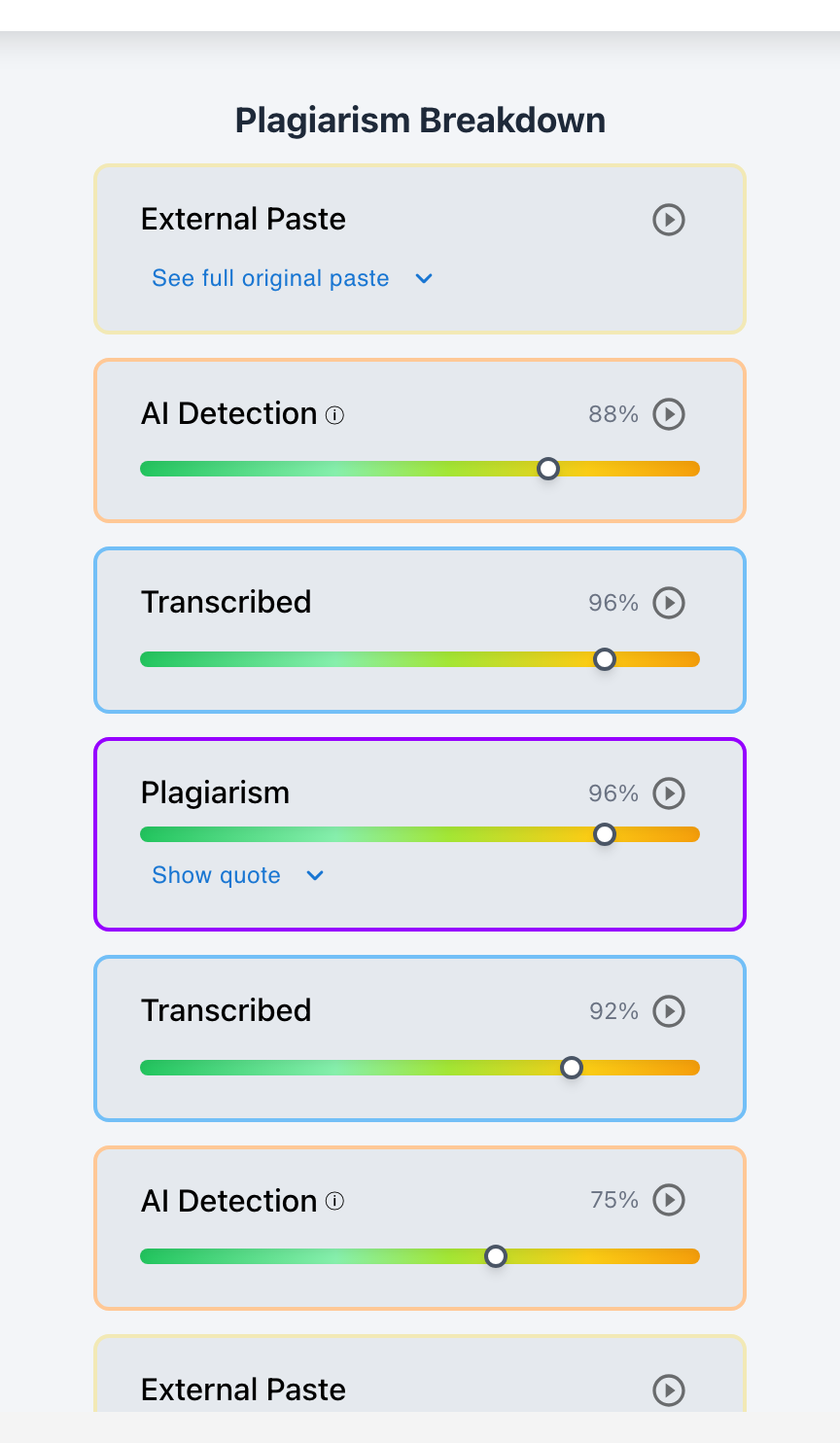
Checkmark Plagiarism preserves complete teacher editorial control by pairing autograding with essay writing playback, AI detection, plagiarism detection, and integrations with Canvas and Google Classroom.
The 4 Core Editorial Capabilities for Teachers
1. One-Click Rubric Cell Overrides
Click any alternative rating on the Canvas SpeedGrader rubric to immediately override the AI's suggestion; the total score recalculates in real time.
2. Full Rich-Text Feedback Editing
Every suggested feedback paragraph is an editable text box: teachers can delete sentences, add personalized praise, or insert classroom inside jokes.
3. IEP & 504 Accommodation Adjustments
Easily adjust mechanical or length criteria for students with documented learning accommodations while preserving high standards for analytical thought.
4. One-Click Manual Reset
If a teacher prefers to grade an unconventional or deeply personal essay from scratch, clicking "Clear Suggestions" resets the rubric to blank.
Why Teacher Override Authority Protects Educational Equity
Understanding the vital role of human discretion in automated grading:
- Accounting for Classroom Context: If a teacher told the class in person on Thursday to omit counter-arguments due to time constraints, the teacher can quickly override any deduction the rubric might have suggested.
- Recognizing Growth Trajectories: If a struggling writer made a monumental leap in thesis clarity, the teacher can award bonus effort points that an algorithm could never foresee.
- Preserving the Teacher-Student Relationship: Students know their work was read, reviewed, and finalized by their teacher, maintaining essential trust and mentorship.
Read more in how Checkmark writing process analysis works.
Comparison: Rigid Automated Systems vs. Checkmark Editable Autograding
Checkmark Editable Autograding (100% Teacher Authority)
- Every rubric cell and score is completely editable.
- Feedback text boxes allow custom teacher commentary.
- Grades only sync to gradebook upon explicit teacher click.
- Accommodates IEP/504 modifications seamlessly.
Rigid Automated Systems (Opaque & Inflexible)
- Locks in algorithmic scores without override options.
- Generic feedback cannot be modified or personalized.
- Direct-to-student publishing without teacher approval.
- Violates student accommodation compliance standards.
A 5-Step Educator Protocol for Editing AI Grades
Grade Editing and Override Checklist:
- 1. Open the student's essay in Canvas SpeedGrader with Checkmark Autograder.
- 2. Review the pre-populated rubric ratings and highlighted text evidence.
- 3. If a criterion rating requires adjustment, click the desired rubric cell to update the score.
- 4. Type personal encouragement or specific instructional notes into the feedback box.
- 5. Click "Submit" to push the finalized, human-approved grade directly into the LMS gradebook.
How Checkmark Plagiarism Powers Teacher Authority
Checkmark Plagiarism combines **AI detection, essay writing playback, static AI detection, plagiarism detection, autograding, and Canvas/Google Classroom integrations** to ensure that educators maintain total pedagogical control over every grade and feedback note.
Frequently Asked Questions
Can a student see if a teacher overrode the AI's suggested grade?
No. Students only see the final, finalized grade and approved feedback from their teacher in Canvas or Google Classroom.
What happens when a teacher changes a rubric score in SpeedGrader?
Canvas SpeedGrader immediately updates the total assignment score and recalculates the student's overall course average in real time.
Can teachers add voice or video comments alongside edited feedback?
Yes. Teachers can use native Canvas media recording tools to attach voice or video notes alongside Autograder's written feedback.
How does Checkmark support 504 and IEP accommodations?
Teachers can adjust grading strictness or override mechanical spelling/grammar criteria for students with documented IEP accommodations.
How does Checkmark Plagiarism integrate with Google Classroom?
Checkmark integrates directly into Google Classroom, allowing teachers to edit scores and private comments before clicking "Return."
Can a teacher edit feedback for the entire class simultaneously?
Yes. Teachers can add universal assignment-level announcements or common error notes to all student reports with a single broadcast.
What if the AI gave a lower score than the student deserved?
The teacher simply clicks the higher rubric descriptor cell, elevating the grade to reflect the true quality of the student's work.
Does Autograder learn from teacher edits?
Yes. When enabled by the institution, Checkmark calibrates to your grading patterns over time, aligning future suggestions closer to your standards.
Can department chairs review teacher grade overrides?
Yes. Department analytics display rubric consistency reports, showing grade distributions across sections for curriculum alignment.
Why is complete editorial control essential for educator adoption?
Because teachers are licensed educational professionals who understand their students' unique needs better than any algorithm ever could.
Sovereign Authority in the Modern Classroom
Artificial intelligence is a powerful assistant, but the human teacher is the heart of education. By providing total editorial freedom and one-click override control in Checkmark Autograder, educators leverage the speed of AI while ensuring every grade carries the wisdom, care, and authority of human teaching.
Checkmark Plagiarism supports this comprehensive approach with AI detection, essay writing playback, static AI detection, plagiarism detection, autograding, and integrations with Canvas and Google Classroom.
See how Checkmark gives teachers full editorial override control in Canvas SpeedGrader. View a sample report or request a demonstration.