
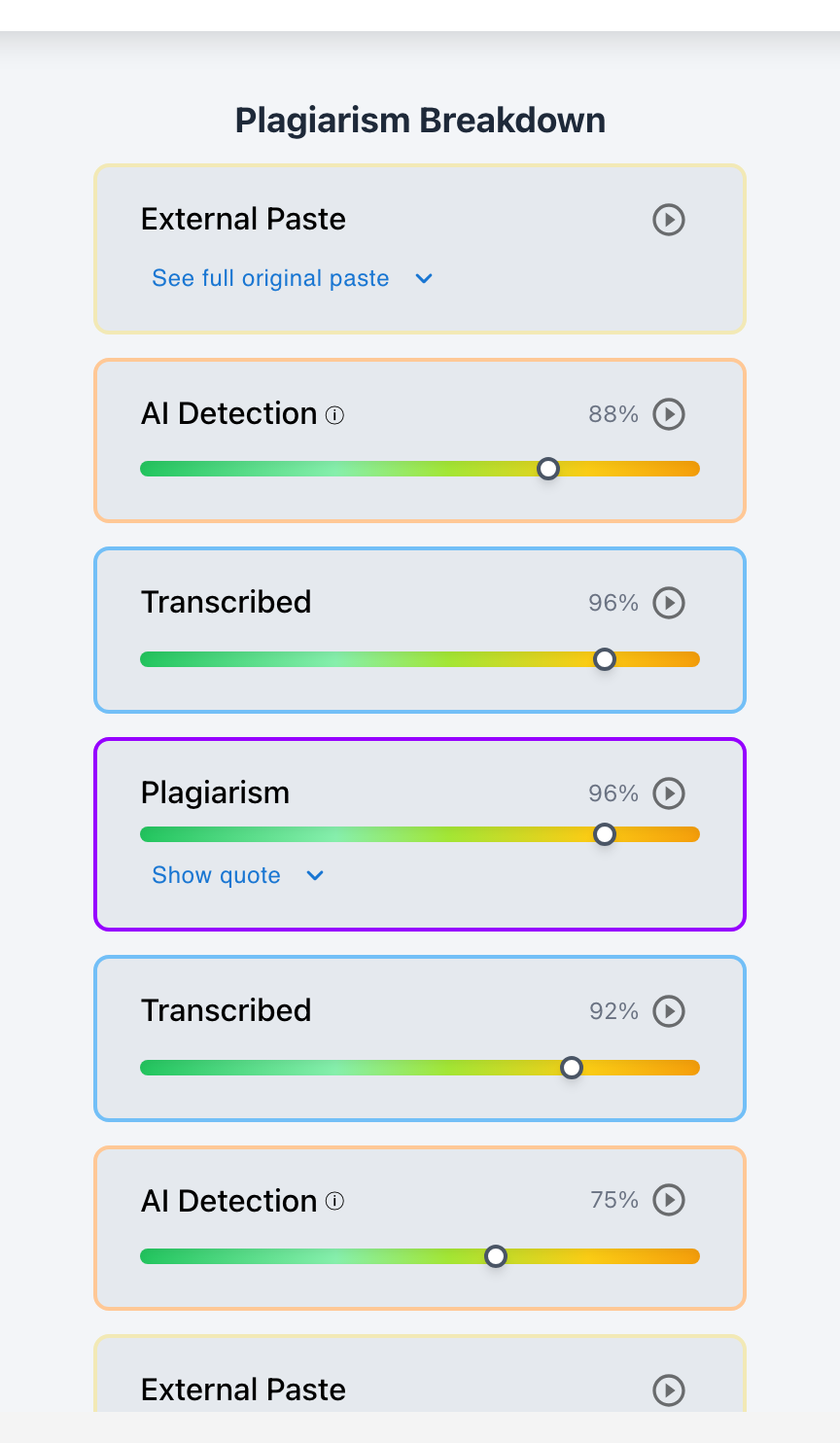
Yes. Retyping a source word-for-word does not bypass academic integrity systems: transcription leaves distinct, mathematically identifiable keystroke patterns that modern writing analytics and plagiarism engines detect with precision.
A common student belief is that if they manually type text from an external screen (such as a second monitor, phone, or printed article) rather than using Ctrl+C / Ctrl+V, no "paste event" will be recorded, making the copying invisible. However, the human act of transcription (reading and copying existing text) generates a completely different physical keystroke rhythm than composition (thinking, formulating, drafting, and revising original thoughts).
Through Checkmark Plagiarism's Transcription Detection, keystroke cadence analysis is paired with global text matching to uncover retyped sources effortlessly.
Checkmark Plagiarism powers transcription detection by pairing essay writing playback with AI detection, plagiarism detection, autograding, and integrations with Canvas and Google Classroom.
The 4 Keystroke Signatures of Manual Transcription
1. Robotic Linear Typing
Original writing involves stopping to think every few words. Transcription produces a steady, metronomic burst of 4–6 word chunks with no cognitive pauses.
2. Near-Zero Backspace / Revision Rate
Human writers backspace and restructure 15–25% of their keystrokes. Transcribing students almost never delete or reorganize paragraphs.
3. Direct Plagiarism String Matching
Even if typed by hand, the resulting text strings are identical to external web pages, academic journals, or peer essays in the database.
4. Unnatural Gaze-Shift Pauses
Keystroke logs record distinct 2-second rhythmic pauses as the student glances back and forth between their phone/second monitor and the keyboard.
How Checkmark Transcription Detection Works
Checkmark Plagiarism detects retyping through a multi-signal process:
- Keystroke Cadence Modeling: Compares the student's typing velocity, burst frequency, and backspace ratio against normal human composition baselines.
- Global Plagiarism Scan: Cross-references every typed sentence against billions of web pages and institutional papers regardless of how the text was entered.
- Visual Essay Playback Replay: Instructors can watch an accelerated video replay showing continuous linear typing without a single structural edit.
Read more in how Checkmark writing process analysis works.
Comparison: Authentic Human Composition vs. Manual Transcription
Authentic Composition (Thinking & Typing)
- Variable typing pauses (10–60 seconds to ideate).
- High backspace and deletion rate (15–30%).
- Frequent reorganization of clauses and paragraphs.
- 0% direct match in global plagiarism databases.
Manual Transcription (Copying a Screen)
- Uniform 2-second gaze-shift pause rhythm.
- Near-zero backspace or deletion rate (<2%).
- Linear typing from first word to last word.
- High direct match in plagiarism engines or AI detector.
A 5-Step Educator Protocol for Investigating Retyped Sources
Educator Transcription Investigation Checklist:
- 1. Check the Checkmark Plagiarism report for direct text matches in web/peer databases.
- 2. Review the writing playback replay to observe the student's keystroke cadence.
- 3. Look for transcription anomalies: low backspace rate, no revisions, and linear typing.
- 4. If the text matches AI style, check perplexity and burstiness scores.
- 5. Hold a student conference and ask the student to explain the origin of the matching text.
How Checkmark Plagiarism Powers Transcription Detection
Checkmark Plagiarism combines **AI detection, essay writing playback, static AI detection, plagiarism detection, autograding, and Canvas/Google Classroom integrations** to catch retyped text, proving that manual typing cannot disguise unauthorized copying.
Frequently Asked Questions
Does retyping an article prevent plagiarism detection?
No. Plagiarism checkers analyze the submitted text strings, not how the letters were entered. If the words match an existing source, it flags as plagiarism.
Can teachers tell if I typed an essay while looking at another screen?
Yes. Transcription produces a rhythmic "type-pause-type" cadence with near-zero backspacing and zero structural revisions that playback easily reveals.
What if I retype a ChatGPT response instead of pasting it?
The text will still exhibit signature AI language patterns (low burstiness, AI cliches) and the keystroke log will show unnatural linear transcription.
How does writing playback distinguish typing original thoughts from copying?
Original writing involves irregular thinking pauses, heavy backspacing, and rewriting sentences. Copying produces uniform chunked typing without structural edits.
What is a normal human backspace rate?
Authentic student writing typically exhibits a 15% to 30% backspace/deletion rate as thoughts are refined. Transcription rates are usually below 3%.
Can students fake natural typing patterns?
Simulating hours of natural hesitation, spontaneous typos, deletions, and paragraph restructuring is virtually impossible and takes longer than writing honestly.
What should a teacher do if a student retyped a source without quotes?
Present the direct source match link alongside the playback keystroke timeline during a supportive academic integrity conference.
How does Checkmark Plagiarism integrate with Canvas LMS?
Checkmark Plagiarism embeds keystroke analytics, visual playback replays, and direct source match links directly inside Canvas SpeedGrader.
Does transcription detection work for handwritten essays?
Plagiarism checking works on transcribed digital submissions; for handwritten work, OCR scanning and in-class baseline comparisons are used.
How does transcription detection protect honest students?
It ensures that students who expend genuine cognitive effort drafting original prose are evaluated fairly against those attempting deceptive shortcuts.
Authentic Thought Leaves a Natural Trace
Writing is an act of thinking, not transcription. By pairing keystroke dynamics with global source matching and essay writing playback, Checkmark Plagiarism ensures that retyping cannot hide unauthorized copying, protecting true intellectual effort.
Checkmark Plagiarism supports this comprehensive approach with AI detection, essay writing playback, static AI detection, plagiarism detection, autograding, and integrations with Canvas and Google Classroom.
See how Checkmark pairs essay writing playback with multi-signal detection to detect retyped sources and transcription patterns inside your LMS. View a sample report or request a demonstration.