
Yes. Teachers utilizing advanced semantic analysis can detect uncited sources even when a student paraphrases every word, alters sentence structures, or synthesizes ideas without direct quotations.
Plagiarism is not limited to verbatim copy-pasting. In academic scholarship, borrowing another author's unique arguments, data interpretations, historical chronologies, or conceptual frameworks without proper citation constitutes idea plagiarism (uncited source appropriation). While basic string-matching tools only flag exact word sequences, modern semantic engines analyze conceptual embeddings to identify when an uncredited source provided the foundational blueprint for a student's claims.
Through Checkmark Plagiarism's Uncited Reference Analysis, educators can uncover uncredited research roots and guide students toward ethical academic attribution.
Checkmark Plagiarism powers uncited reference analysis by pairing plagiarism detection with essay writing playback, AI detection, autograding, and integrations with Canvas and Google Classroom.
The 4 Mechanisms of Uncited Reference Analysis
1. Semantic Vector Similarity
Transforms sentences into mathematical meaning vectors, detecting identical logical propositions even when every single word has been replaced with a synonym.
2. Unique Data & Statistic Attribution
Identifies specific empirical figures, experimental percentages, or rare historical dates that could only originate from a specific published study.
3. Structural Argument Flow Mimicry
Flags when a student's 4-step argumentative progression follows the exact idiosyncratic rhetorical sequence of an uncited scholarly paper.
4. Specialized Jargon & Collocations
Detects clusters of technical terminology and conceptual phrases that are unique to a specific academic researcher or publication.
What Uncited Reference Cards Show the Teacher
When Checkmark detects uncredited conceptual borrowing, it generates an Uncited Reference Card:
- Conceptual Mapping: Explains why the passage was flagged (e.g., "Matches the theoretical framework and empirical data of Dr. Sarah Jenkins (2024), but no citation appears in the text or bibliography.").
- Side-by-Side Semantic Breakdown: Shows the student's paraphrased sentences alongside the original author's source text.
- Citation Recommendation: Generates a pre-formatted MLA/APA citation that the teacher can provide to the student as formative feedback.
Read more in how Checkmark writing process analysis works.
Comparison: Direct Copying vs. Uncited Paraphrasing vs. Ethical Synthesis
Direct Copying (Plagiarism)
- 100% exact word-for-word string match.
- No quotes or citations included.
- Caught by basic string matching.
Uncited Paraphrasing (Idea Plagiarism)
- Words changed via thesaurus/AI.
- No attribution to original author.
- Caught by semantic vector analysis.
Ethical Synthesis (Authentic)
- Student rephrases idea in own voice.
- Proper in-text citation included (Smith, 2024).
- 0% plagiarism flag in Checkmark.
A 5-Step Educator Protocol for Addressing Uncited Sources
Educator Uncited Reference Protocol:
- 1. Open the Checkmark Plagiarism report in Canvas SpeedGrader or Google Classroom.
- 2. Review the Uncited Reference Cards to inspect semantic overlap and matching data points.
- 3. Determine whether the missing citation reflects intentional deception or poor citation mechanics.
- 4. Provide formative citation feedback using Checkmark's pre-formatted citation cards.
- 5. Allow the student to revise the passage with proper in-text citations and bibliography entries.
How Checkmark Plagiarism Powers Uncited Reference Analysis
Checkmark Plagiarism combines **AI detection, essay writing playback, static AI detection, plagiarism detection, autograding, and Canvas/Google Classroom integrations** to detect uncited conceptual borrowing, ensuring that intellectual attribution is upheld across all disciplines.
Frequently Asked Questions
Is paraphrasing an article without citing it considered plagiarism?
Yes. Taking someone else's ideas, data, or arguments and putting them into your own words without giving credit is idea plagiarism.
How do plagiarism checkers find sources if I changed the words?
Modern semantic algorithms analyze sentence meaning vectors and conceptual structures, matching the underlying ideas to indexed publications.
What if I cite a specific statistic but didn't copy any full sentences?
Specific data points and empirical statistics require an in-text citation attributing the finding to the original researcher or study.
Can writing playback help identify uncited research?
Yes. Playback logs show long multi-minute research pauses right before complex data or arguments were typed, confirming external consultation.
What is the difference between common knowledge and uncited plagiarism?
Common knowledge consists of widely known facts (e.g., "George Washington was the first US President"). Specialized data and unique theories always require citation.
How does Checkmark Plagiarism integrate with Canvas LMS?
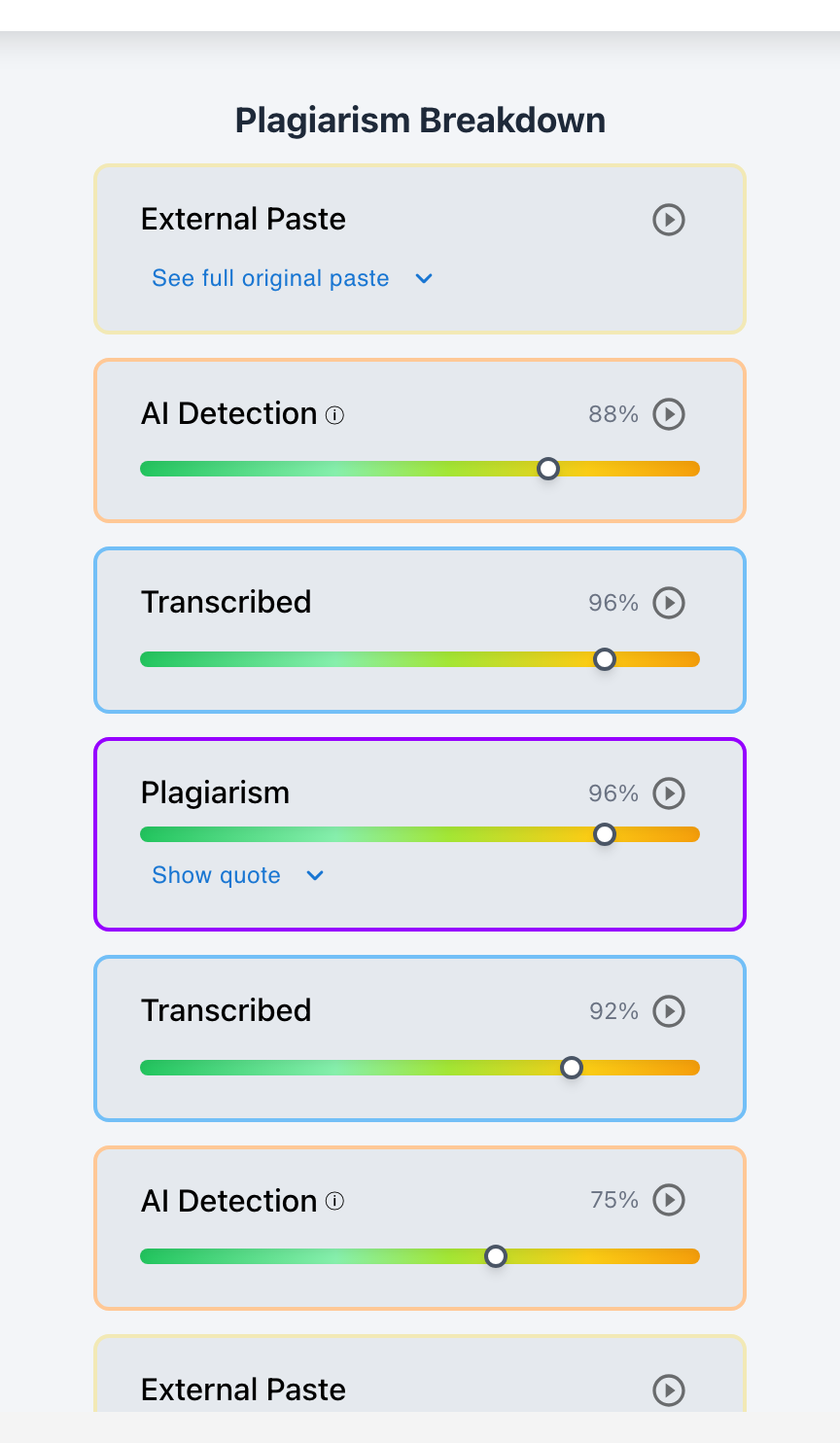
Checkmark Plagiarism displays visual writing playback timelines, uncited reference cards, and dual AI/plagiarism reports directly inside Canvas SpeedGrader.
How can teachers help students avoid uncited source plagiarism?
Teach the rule: "If you didn't know it before researching, cite where you found it—even if you put it into your own words."
Does uncited reference analysis protect honest students?
Yes. It automatically recognizes when an in-text citation (e.g., "According to Smith...") properly attributes the paraphrased idea, avoiding false flags.
What if a student used an AI tool to paraphrase an uncited article?
Checkmark flags both the semantic match to the original source and the synthetic AI language patterns used in the rewritten text.
Why is teaching ethical citation better than punitive grading?
Most uncited paraphrasing stems from confusion about citation mechanics. Formative feedback builds lifelong academic research skills.
Giving Credit Where Credit Is Due
Original scholarship builds on the work of others through transparent, ethical attribution. By identifying uncited sources through semantic analysis and guiding students with clear evidence cards, Checkmark Plagiarism ensures that intellectual integrity is taught and preserved.
Checkmark Plagiarism supports this comprehensive approach with AI detection, essay writing playback, static AI detection, plagiarism detection, autograding, and integrations with Canvas and Google Classroom.
See how Checkmark pairs essay writing playback with multi-signal detection to detect uncited sources and conceptual borrowing inside your LMS. View a sample report or request a demonstration.