
Yes. Teachers can readily detect ChatGPT-generated writing even after a student has modified the vocabulary, replaced synonyms, or rearranged sentences.
A widespread assumption among students is that changing every fourth word or replacing signature AI adjectives (such as "delve" or "tapestry") effectively "cleans" the text and eliminates detection. While light editing may alter surface-level statistical perplexity and lower raw scores on basic AI detectors, it fails to disguise the underlying generative architecture, timeline anomalies, and research hallucinations.
Educators detect edited ChatGPT writing not through word-matching alone, but through process playback transparency, structural symmetry analysis, citation database audits, and oral student conferences.
Checkmark Plagiarism exposes edited AI writing by combining AI detection with essay writing playback, static AI detection, plagiarism detection, autograding, and integrations with Canvas and Google Classroom.
The 4 Layers That Expose Edited ChatGPT Writing
1. Document Timeline Playback
Writing playback records the exact sequence: an instant wholesale paste of 1,200 words followed by 5 minutes of superficial word swapping.
2. Uncorrected Citation Hallucinations
Editing prose does not fix non-existent journal titles, fabricated author pairings, or phantom DOIs generated by AI.
3. Structural & Rhetorical Symmetry
The underlying 3-point thesis, rigid paragraph lengths, and generic commentary remain identical regardless of synonym changes.
4. Oral Comprehension Disconnect
The student cannot explain the synthesized arguments or define the modified vocabulary during a brief live conference.
1. What Edited AI Text Looks Like in Writing Playback
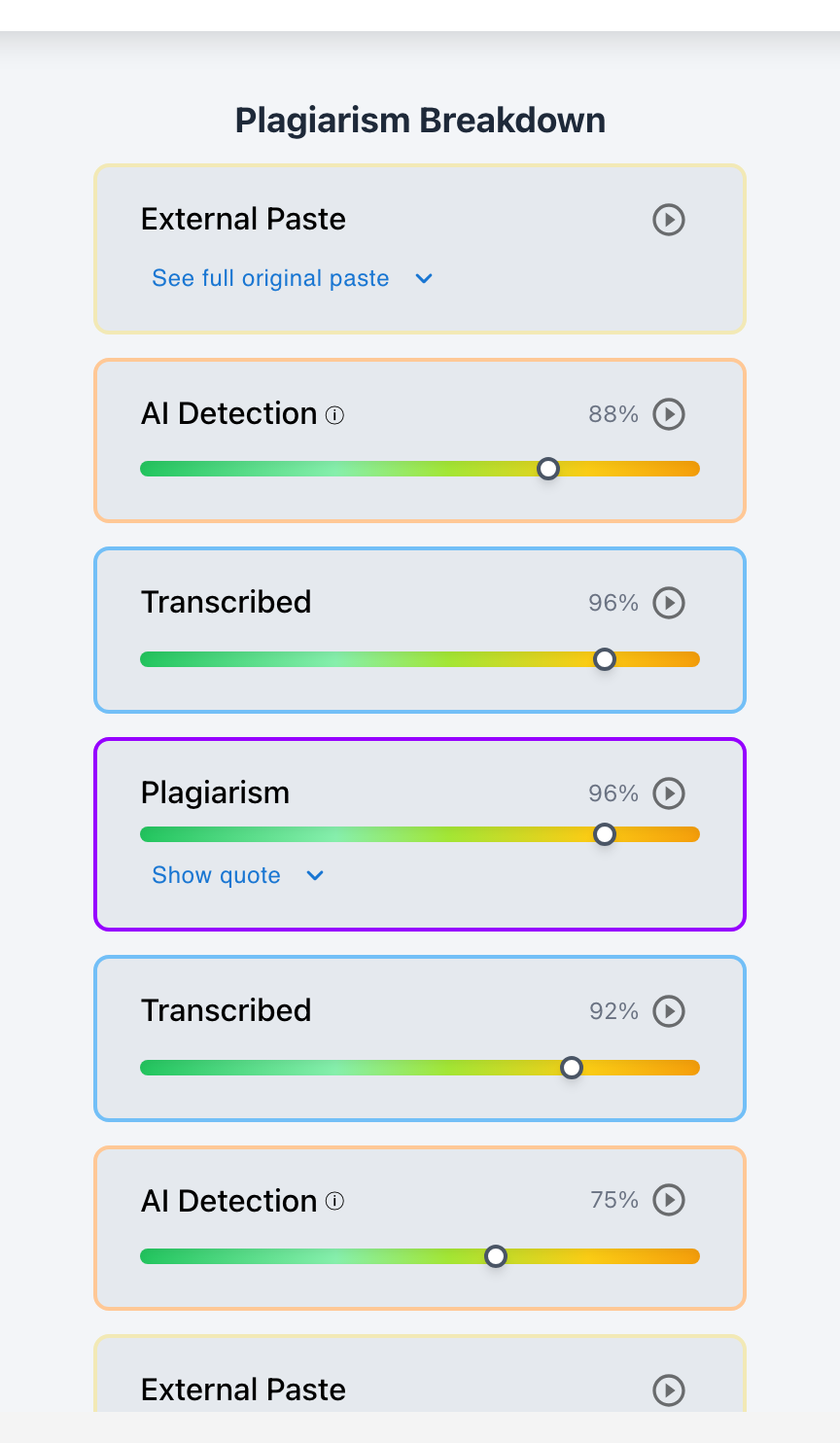
The single most definitive way teachers identify edited ChatGPT writing is through Checkmark Plagiarism's essay writing playback. While the student sees a polished final page, the creation playback tells an indisputable story:
- The Wholesale Paste: At 9:14 PM, a complete 1,400-word draft appears in the document in a single instant paste event.
- The Superficial Editing Session: Over the next 8 minutes, the student clicks through the document, swapping 15 individual words (e.g., changing "crucial" to "vital") without engaging in substantive restructuring.
- Zero Developmental Keystrokes: Playback proves that the thesis, evidence, and analytical structure were never typed or developed incrementally.
Read more in how Checkmark writing process analysis works.
2. The Persistence of Hallucinated Citations
Students who edit ChatGPT text almost always focus exclusively on body paragraphs while leaving the bibliography untouched. When instructors audit citations in academic databases (JSTOR, Google Scholar):
- Cited book titles and journal articles return zero search results.
- Provided DOIs lead to dead links or completely unrelated publications.
A non-existent citation provides objective physical evidence that no amount of synonym replacement can disguise. Read more in can ChatGPT cite sources that don't exist?
3. The "Patchwork" Stylistic Disconnect
When students edit AI text, they create a jarring stylistic clash between their authentic writing voice and the underlying AI phrasing:
- A casual, conversational sentence written by the student directly followed by an intricate, highly formal AI construction.
- Awkward synonym substitutions that do not make sense in academic context (e.g., substituting "monetary plunge" for "economic decline").
Comparison: Lightly Edited AI vs. Authentic Drafting
Lightly Edited ChatGPT Text
- Wholesale paste block followed by minor word tweaks.
- Generic analysis that avoids specific class lectures.
- Cites non-existent journal titles or fake DOIs.
- Rigid, symmetrical 3-point paragraph structure.
- Student struggles to explain ideas orally.
Authentic Student Drafting
- Multi-session keystroke history: typing, backspacing, revising.
- Deep engagement with classroom discussions and page numbers.
- All cited academic sources exist and are verified.
- Natural, varied sentence lengths and authentic voice.
- Student fluently explains arguments and research orally.
4. The Oral Conference: Testing Genuine Understanding
No matter how many words a student changed, live dialogue quickly reveals whether they authentically authored the ideas:
- "Can you explain why you chose this specific argument in paragraph 2?"
- "What was the main conclusion of the study you cited in your bibliography?"
- "Can you define this technical term in your own words?"
A student who spent hours researching and drafting understands their paper intimately. A student who lightly edited AI text will be unable to explain the underlying logic.
A 6-Step Protocol to Detect Edited AI Writing
Educator Protocol to Identify Edited AI Text:
- 1. Review essay writing playback to observe paste events and subsequent editing duration.
- 2. Search academic databases (JSTOR, Google Scholar) to audit all cited bibliography sources.
- 3. Inspect the document for rigid architectural symmetry and abstract, generic analysis.
- 4. Look for stylistic clashes between simple student phrasing and dense AI clauses.
- 5. Compare the submission against verified historical baseline writing samples.
- 6. Hold a supportive student conference to test oral conceptual understanding.
How Checkmark Plagiarism Exposes Edited AI Text
Checkmark Plagiarism combines **AI detection, essay writing playback, static AI detection, plagiarism detection, autograding, and Canvas/Google Classroom integrations** to give educators full visibility into document creation, paste events, and citation integrity.
Frequently Asked Questions
Can teachers tell if you edit ChatGPT text before turning it in?
Yes. Essay writing playback captures the paste of the AI draft and shows that only minor surface words were edited without substantive drafting.
Does changing words beat AI detectors?
It can lower basic probability scores, but writing playback logs, citation audits, and student interviews easily reveal the AI origins.
What does edited AI text look like in version history?
An empty document receives hundreds of polished words in an instant paste event, followed by a few minutes of minor punctuation or synonym adjustments.
Why do fake citations still appear in edited AI papers?
Students rarely verify or edit the bibliography, leaving hallucinated journal titles and dead DOIs that instantly confirm AI generation.
What is 'patchwriting' with AI?
When a student takes AI-generated text and manually changes every third or fourth word to disguise the source without altering the underlying ideas.
Can teachers tell if a student used QuillBot to edit ChatGPT?
Yes. QuillBot inserts awkward, thesaurus-heavy synonyms that create unnatural sentence phrasing, and writing playback records the external paste.
How does comparing previous writing help detect edited AI?
It reveals whether the analytical sophistication and vocabulary represent authentic student growth or an uncharacteristic leap in capability.
What if a student with an edited essay claims they wrote it in Microsoft Word?
Ask the student to provide the original Word file with version metadata, outlines, or research notes within 24–48 hours.
Can an authentic student be falsely accused of editing AI text?
Authentic students have multi-session keystroke playback logs, verified sources, and clear oral mastery, protecting them from false accusations.
How does Checkmark Plagiarism help teachers detect edited AI?
Checkmark Plagiarism records visual writing playback, audits citations, runs dual AI/plagiarism scans, and integrates directly with Canvas and Google Classroom.
Surface Edits Cannot Erase Creation Footprints
Changing words in an AI-generated essay does not create authentic student scholarship. By evaluating document creation timelines, citation validity, and oral conceptual mastery, educators see right through surface editing to protect genuine learning.
Checkmark Plagiarism supports this comprehensive approach with AI detection, essay writing playback, static AI detection, plagiarism detection, autograding, and integrations with Canvas and Google Classroom.
See how Checkmark pairs essay writing playback with multi-signal detection to expose edited AI writing with objective timeline proof. View a sample report or request a demonstration.