Yes. Teachers can check multiple assignments against each other automatically using Checkmark Plagiarism's Real-Time Cohort Indexing. When students submit work across different class periods, sections, or academic semesters, Checkmark automatically cross-references every paper against all active and historical submissions in your school's institutional repository—instantly alerting teachers to cross-period copying, paper trading, and recycled essays.
One of the most common plagiarism channels in secondary and higher education is cross-period sharing: a student in Period 1 completes an essay in the morning and shares their document with friends in Period 4 or Period 6 before the afternoon deadline. Traditional web search engines are completely blind to this peer sharing because the text has never been published online. Automated cross-assignment indexing ensures that all student papers within a department, grade level, or district are continuously compared against one another in real time. Checkmark Plagiarism automates this cross-matching directly inside Canvas and Google Classroom.
Below is a comprehensive guide on cross-checking assignments across classes and semesters automatically.
Checkmark Plagiarism enables cross-assignment indexing by pairing plagiarism detection with AI detection, essay writing playback, autograding, and integrations with Canvas and Google Classroom.
The 4 Mechanisms of Automated Cross-Assignment Indexing
1. Real-Time Intra-Class Indexing
Every submission is instantly added to an encrypted school repository, checking students in the same class against each other as they turn in work.
2. Cross-Period Section Matching
Papers submitted in Period 1 are automatically checked against submissions in Periods 2, 4, and 6, flagging cross-period collusion before grades are posted.
3. Multi-Year Institutional Archive
Checks current student submissions against essays turned in during previous semesters or previous academic years to catch recycled assignments.
4. FERPA-Compliant Peer Match Cards
Displays matched passages between students while redacting peer names and IDs to protect student privacy during initial review.
How Checkmark Solves the "Who Copied Whom?" Dilemma
Understanding how process telemetry determines original authorship during peer matches:
- The Timestamp Myth: A student who submits at 8:00 AM may have copied an essay from a friend who submitted at 11:50 PM. Submission time alone does not prove original authorship.
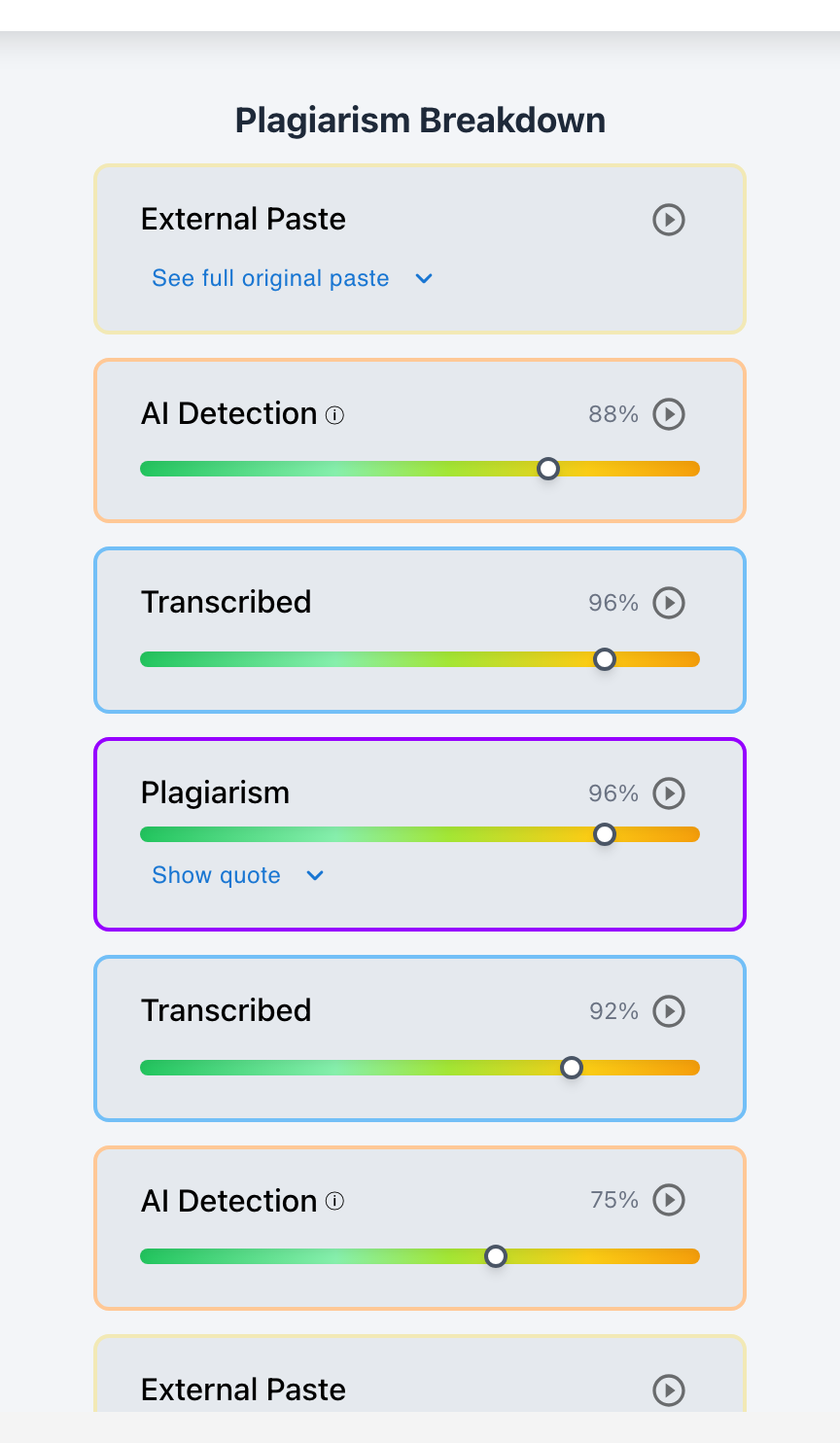
- Keystroke Telemetry Ground Truth: Checkmark Playback analyzes when the words were physically typed into the editor. The original author has 4 hours of typing and 20% backspaces; the copier has a 0.05-second paste payload.
- Instant Due Process Resolution: Educators can resolve peer plagiarism cases in minutes by presenting side-by-side keystroke timelines to both students.
Read more in how Checkmark writing process analysis works.
Comparison: Isolated Class Scanning vs. Checkmark Cross-Cohort Indexing
Checkmark Cross-Cohort Indexing (Total Coverage)
- Cross-checks all class periods and sections in real time.
- Indexes multi-year institutional archives automatically.
- Uses writing playback to prove original authorship.
- Maintains strict FERPA compliance and student privacy.
Isolated Class Scanning (Blind to Peer Sharing)
- Scans papers only against the public internet.
- Completely misses papers shared between class periods.
- Cannot detect essays recycled from previous years.
- Requires teachers to manually remember old student papers.
A 5-Step Educator Protocol for Cross-Assignment Audits
Cross-Assignment Audit Checklist:
- 1. Enable Institutional Repository Indexing on your assignment settings in Canvas.
- 2. Open the Assignment Integrity Dashboard after all sections have submitted.
- 3. Look for the "Peer Match Alert" badge: click on any submission showing an intra-school match.
- 4. Open the Side-by-Side Peer Match Card to inspect identical paragraphs and sentences.
- 5. Launch Checkmark Playback on both submissions to verify keystroke creation timestamps and determine original authorship.
How Checkmark Plagiarism Powers Cross-Assignment Protection
Checkmark Plagiarism combines **AI detection, essay writing playback, static AI detection, plagiarism detection, autograding, and Canvas/Google Classroom integrations** to automatically maintain an encrypted, private institutional repository that protects your school against assignment sharing.
Frequently Asked Questions
Do I have to manually upload previous years' essays to check against them?
No. Checkmark automatically indexes all past assignments submitted through your school's LMS, continuously building a permanent private repository.
Can students see who they matched with if peer plagiarism is flagged?
No. Checkmark adheres to strict FERPA privacy standards, showing matched text snippets to teachers while keeping student identities private on student-facing views.
What happens if a student legitimately resubmits their own work from a previous draft?
Checkmark matches the student's ID and tags the submission as a "Draft Revision" rather than peer plagiarism, preventing false self-plagiarism flags.
How does cross-period matching work across different teachers?
If Teacher A and Teacher B assign the same essay prompt, Checkmark cross-checks submissions across both teachers' courses within the school's account.
How does Checkmark Plagiarism integrate with Canvas LMS?
Checkmark integrates directly via LTI 1.3, enabling cross-section cohort scanning and embedding peer match alerts in SpeedGrader.
Can teachers check essays against other schools in the district?
Yes. District administrators can configure district-wide repository indexing to catch essays shared between different high schools or campuses.
What if two students worked together on a group project?
Teachers can enable "Collaborative Group Mode," which whitelists shared sections while evaluating each student's individual analysis.
How does Autograder evaluate peer-matched essays?
Checkmark Autograder automatically pauses automated grade passback on peer-matched submissions, routing them to the teacher for manual review.
Are student essays uploaded to public databases?
No. Submissions remain stored in a private, encrypted institutional vault and are never made public or used to train commercial AI models.
Why is cross-cohort indexing essential for academic fairness?
Because it closes the peer-sharing loophole, ensuring that grades reflect genuine, independent student achievement across every classroom.
Closing the Loop on Cross-Classroom Integrity
Academic honesty must be upheld across entire academic communities. By automatically checking assignments against classmates, other sections, and historical school archives with Checkmark Plagiarism, educators eliminate paper trading and ensure an equitable playing field for every student.
Checkmark Plagiarism supports this comprehensive approach with AI detection, essay writing playback, static AI detection, plagiarism detection, autograding, and integrations with Canvas and Google Classroom.
See how Checkmark cross-checks assignments across class periods and school archives in Canvas. View a sample report or request a demonstration.