
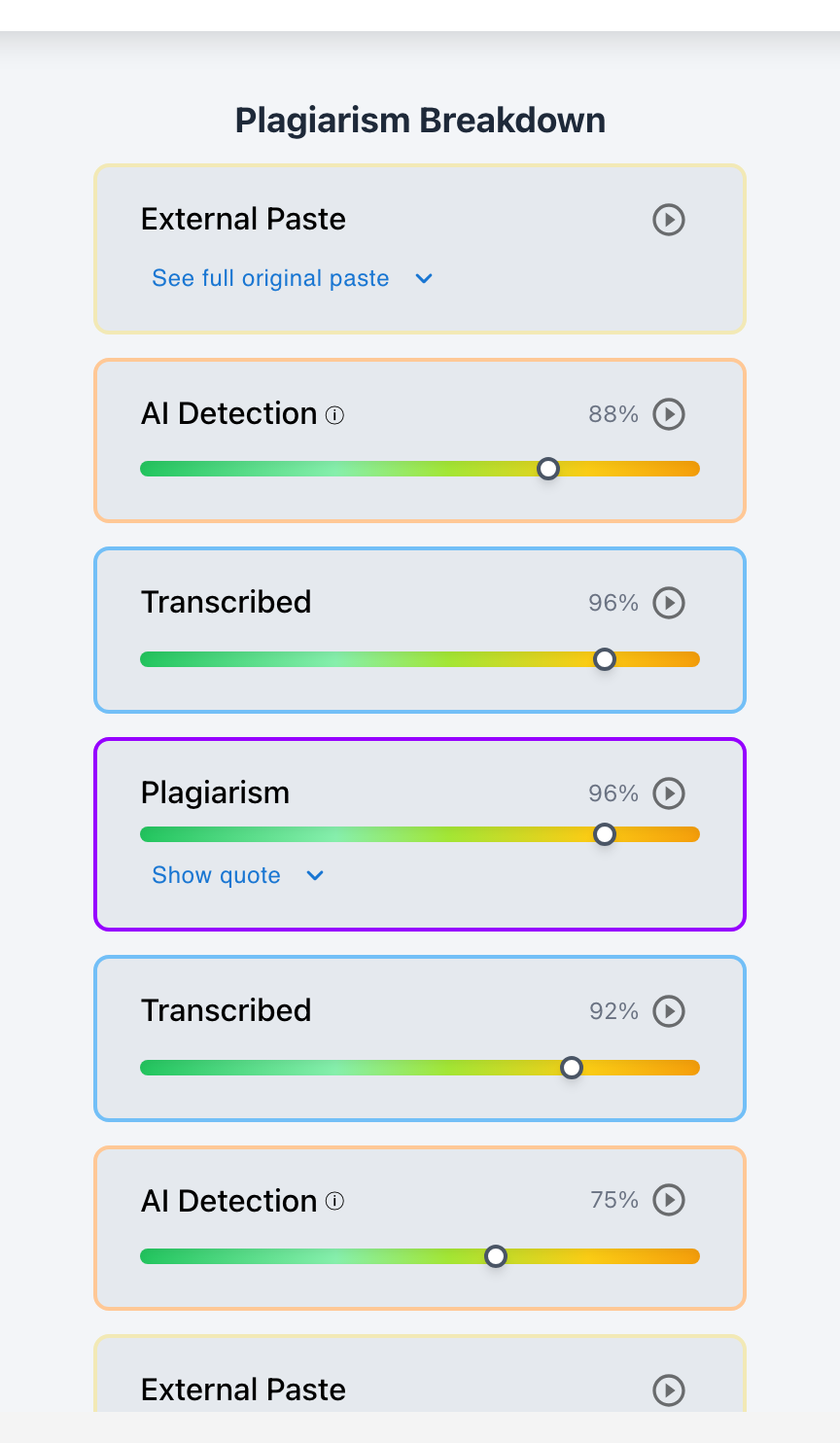
Students frequently attempt to use AI to hide plagiarism—and while it often deceives legacy text-matching scanners, it leaves clear forensic traces that modern multi-signal platforms easily expose.
A prevalent shortcut among students is taking copyrighted text from a website, academic paper, or peer essay, pasting it into ChatGPT or an automated paraphraser like QuillBot, and prompting the tool to "rewrite this so it passes plagiarism detection." By substituting synonyms and rearranging sentence clauses, the AI breaks up the consecutive matching word strings that traditional plagiarism scanners look for.
While this technique can lower similarity percentages to near 0%, it cannot fake the physical drafting timeline recorded by essay writing playback, nor can it eliminate strange synonym anomalies or prepare a student to explain the complex concepts during an oral conference.
Checkmark Plagiarism exposes AI-hidden plagiarism by combining plagiarism detection with AI detection, essay writing playback, static AI detection, autograding, and integrations with Canvas and Google Classroom.
How Students Use AI to Disguise Plagiarism
1. The AI Rewrite Prompt
Pasting an entire Wikipedia article or journal section into ChatGPT with the prompt: "Paraphrase this in academic language and don't match the original text."
2. Automated Synonym Spinning
Running stolen text through QuillBot or "AI humanizers" to swap vocabulary words while maintaining the stolen conceptual structure.
Why Basic Plagiarism Scanners Are Fooled
Traditional plagiarism detection software relies on exact n-gram matching: searching for 8–10 consecutive identical words across indexed web pages. When AI reorders clauses and inserts synonyms, it disrupts these exact sequences, causing legacy tools to report: "0% Similarity Found."
However, disrupting a text-matching algorithm does not make the work authentic. The underlying intellectual structure was still copied without attribution, and the writing was generated externally. Read more in AI detection vs. plagiarism detection.
How Multi-Signal Tools Expose Hidden Plagiarism
1. Essay Writing Playback Exposes Wholesale Pastes
Students who use AI to hide plagiarism do not compose sentences keystroke-by-keystroke. Checkmark Plagiarism's essay writing playback reveals:
- Wholesale Paste Events: The entire rewritten essay appears in the document in a single instant paste block.
- Minimal Active Drafting Time: Playback logs record only 5–10 minutes of active document time for a 1,500-word paper.
- Zero Revision History: No typing pauses, no backspacing, and no multi-session editing.
Read more in how Checkmark writing process analysis works.
2. The "Thesaurus Syndrome" (Incongruous Phrasing)
AI tools spinning plagiarized content often replace domain-specific terms with absurd synonyms (e.g., changing "balance of power" to "equilibrium of strength"). These bizarre phrasing choices immediately alert experienced educators.
3. Oral Comprehension Disconnect
During a brief student conference, a student who used AI to hide plagiarism cannot explain the underlying arguments, define unusual synonyms, or recall how sources were selected.
Comparison: Legacy Plagiarism Checkers vs. Multi-Signal Playback
Legacy Plagiarism Checker Alone
- Checks only for exact web matches.
- Bypassed easily by synonym swaps and AI rewrites.
- Blind to external paste timestamps.
Checkmark Multi-Signal System
- Detects AI language predictability and mosaic patterns.
- Captures visual essay writing playback of keystrokes & pastes.
- Audits citations for non-existent generative hallucinations.
A 5-Step Protocol to Detect AI-Disguised Plagiarism
Educator Protocol for AI-Disguised Submissions:
- 1. Inspect essay writing playback logs for wholesale paste events and active typing duration.
- 2. Look for unnatural, context-deaf synonym substitutions characteristic of AI spinning.
- 3. Audit cited sources in academic databases (JSTOR, Google Scholar) for hallucinations.
- 4. Compare the submission against historical in-class student writing baselines.
- 5. Hold a brief student conference asking the student to define unusual vocabulary orally.
How Checkmark Plagiarism Eliminates AI Cheating Loopholes
Checkmark Plagiarism combines **AI detection, essay writing playback, static AI detection, plagiarism detection, autograding, and Canvas/Google Classroom integrations** to give schools complete visibility into rewritten text, paste events, and citation authenticity.
Frequently Asked Questions
Can you use ChatGPT to hide plagiarism from teachers?
ChatGPT can rewrite text to bypass basic similarity checkers, but essay writing playback logs (capturing wholesale paste events), unnatural phrasing, and student interviews easily reveal the misconduct.
Is using AI to rewrite stolen text still plagiarism?
Yes. Taking someone else's ideas or writing and using AI to disguise the original source without attribution is patchwriting and plagiarism.
Why do legacy plagiarism checkers miss AI-rewritten text?
Because legacy checkers search for exact strings of 8–10 words. AI rephrasing breaks these exact matches while preserving the stolen conceptual argument.
How does writing playback catch AI-hidden plagiarism?
Writing playback proves that the rewritten text was pasted wholesale into the document in seconds rather than typed keystroke-by-keystroke over multiple drafting sessions.
What does AI-disguised plagiarism look like?
It often features awkward synonym choices, unnatural sentence structures, and an incongruous mix of simple and bizarre vocabulary layered over copied logic.
Can teachers find the original source that was rewritten?
Often yes. Searching for unique conceptual pairings or specific factual data sequences frequently leads teachers back to the original source article.
What if a student claims they used AI only for grammar?
Basic grammar editing preserves the student's authentic vocabulary and structure, while full AI rewriting introduces formulaic phrasing and wholesale paste blocks in playback.
How does comparing previous writing help detect hidden plagiarism?
It reveals whether the analytical sophistication and vocabulary represent authentic student growth or an uncharacteristic leap in capability.
What should a teacher do if they suspect an essay was rewritten with AI?
Review the writing playback timeline, audit citations, and invite the student to discuss their drafting choices in a supportive conference.
How does Checkmark Plagiarism protect schools from AI-disguised plagiarism?
Checkmark Plagiarism pairs database plagiarism matching with visual essay writing playback, static AI analysis, and LMS integrations to provide full integrity coverage.
Process Transparency Overcomes Automated Disguises
AI tools can disguise copied sentences, but they cannot manufacture authentic human ideation, genuine research, or multi-hour drafting timelines. By evaluating the complete document creation process, educators uncover hidden plagiarism with absolute clarity and fairness.
Checkmark Plagiarism supports this comprehensive approach with AI detection, essay writing playback, static AI detection, plagiarism detection, autograding, and integrations with Canvas and Google Classroom.
See how Checkmark pairs essay writing playback with multi-signal detection to expose AI-disguised plagiarism with objective timeline proof. View a sample report or request a demonstration.