
Yes. Students can unequivocally plagiarize ideas without copying exact words. Academic integrity protects original intellectual concepts, novel argumentative frameworks, and unique structural logic—meaning that taking an author's unique thesis or analytical sequence and rewording it without attribution is a direct violation of institutional honor codes.
A frequent misunderstanding among high school and university students is that plagiarism applies only to verbatim text copying: "I changed all the words into my own language, so it's not plagiarized." In academic scholarship, intellectual property resides in the ideas themselves, not merely the specific vocabulary used to express them. When a student adopts an author's unique 5-point argumentative progression, proprietary conceptual model, or original historical thesis without citing the source, they have committed idea plagiarism. Checkmark Plagiarism uses semantic concept mapping to identify structural borrowing even when zero verbatim matches exist.
Below is a comprehensive guide on identifying, defining, and evaluating idea plagiarism.
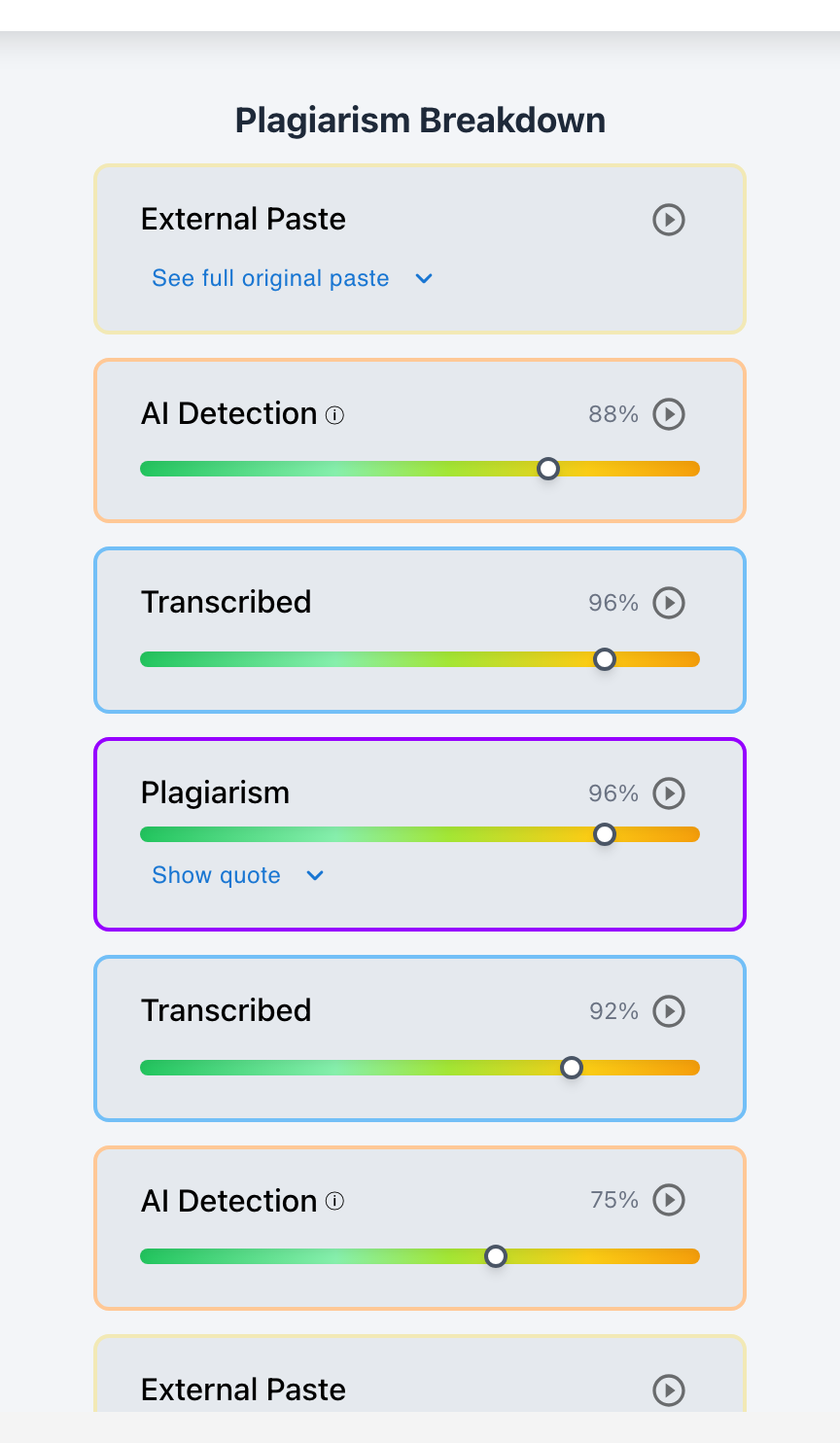
Checkmark Plagiarism identifies idea plagiarism by pairing plagiarism detection with AI detection, essay writing playback, autograding, and integrations with Canvas and Google Classroom.
The 4 Forms of Idea Plagiarism in Student Writing
1. Structural & Argumentative Mirroring
Adopting an existing scholar's exact step-by-step logical sequence, counterarguments, and evidence progression while rewording each sentence.
2. Uncredited Conceptual Frameworks
Presenting a unique analytical model, metaphor, or categorization system invented by another researcher as if it were the student's original insight.
3. Secondary Source Concealment
Reading a secondary synthesis book and citing all 10 primary sources listed in its bibliography—pretending the student located and analyzed those primary sources independently.
4. AI-Powered Paraphrasing of Paywalled Ideas
Using ChatGPT or QuillBot to ingest a published academic paper and output a completely rewritten summary without citing the original publication.
Why Rewording Does Not Erase Intellectual Debt
Understanding the distinction between common knowledge and proprietary ideas:
- Common Knowledge (No Citation Needed): Broad, undisputed factual statements (e.g., "The American Civil War ended in 1865") belong to the public domain.
- Proprietary Interpretation (Citation Mandatory): A scholar's specific thesis (e.g., "Lincoln's 1864 election strategy hinged on three specific railroad logistical decisions") requires explicit attribution, regardless of how it is phrased.
- Semantic Fingerprinting in Checkmark: Checkmark's Semantic Engine matches underlying conceptual structures across millions of scholarly papers, flagging argument mirroring even when words are synonym-swapped.
Read more in how Checkmark writing process analysis works.
Comparison: Legitimate Paraphrasing vs. Idea Plagiarism
Legitimate Paraphrasing (Honest Attribution)
- Ideas rephrased completely in student's own voice.
- Explicit in-text citation credits the original author.
- Student adds their own evaluation or application.
- Demonstrates true comprehension and academic honesty.
Idea Plagiarism (Uncredited Conceptual Theft)
- Ideas rephrased to evade verbatim text matching.
- Zero citation or author credit provided in the text.
- Presented as the student's original discovery.
- Direct violation of institutional honor codes.
A 5-Step Educator Protocol for Idea Plagiarism Audits
Idea Plagiarism Investigation Checklist:
- 1. Open the student's submission in Checkmark Plagiarism inside Canvas SpeedGrader.
- 2. Review the Semantic Source Match Card: check for matching argument progressions and source citations.
- 3. Compare the student's paragraph structure against the flagged source document.
- 4. Hold a brief 2-minute conference: "How did you develop this specific three-part analytical framework?"
- 5. If uncredited borrowing is confirmed, require revision with proper conceptual attribution.
How Checkmark Plagiarism Powers Semantic Idea Detection
Checkmark Plagiarism combines **AI detection, essay writing playback, static AI detection, plagiarism detection, autograding, and Canvas/Google Classroom integrations** to identify uncredited conceptual frameworks, structural mirroring, and synonym-swapped source text.
Frequently Asked Questions
Is it still plagiarism if you change every single word?
Yes. If you take an author's original idea, hypothesis, or analytical framework and reword it without citing the author, it is idea plagiarism.
What is common knowledge versus a proprietary idea?
Common knowledge consists of widely accepted facts found in standard reference texts. A proprietary idea is a specific interpretation, model, or conclusion developed by an individual author.
How does Checkmark detect plagiarism when words are changed?
Checkmark's Semantic Matching Engine evaluates conceptual relationships, argument structures, and source citation clusters rather than relying strictly on exact string matching.
What is 'secondary source concealment'?
It occurs when a student reads a review paper that compiled 10 primary sources, and copies those citations into their own bibliography pretending they read all 10 original papers.
Can a student plagiarize an essay outline?
Yes. Copying the unique, detailed outline structure of a published paper or classmate's work without permission constitutes structural plagiarism.
How does Checkmark Plagiarism integrate with Canvas LMS?
Checkmark provides certified LTI 1.3 integration, SpeedGrader sidebar embeds, two-way grade passback, and single sign-on (SSO).
What should a teacher do when a student commits idea plagiarism?
Explain that academic integrity requires citing the origin of concepts, not just direct quotes, and guide the student through proper paraphrase attribution.
Can writing playback show if an idea was borrowed?
Yes. Playback logs whether the argument was drafted from scratch or transcribed rapidly while referencing an uncredited secondary source.
How can teachers design assignments to prevent idea plagiarism?
Require students to apply concepts to localized, personal, or novel case studies that have not been analyzed in published literature.
Why is idea attribution essential for developing scholars?
Because ethical scholarship is built on honoring intellectual lineage and joining an ongoing scholarly conversation with honesty and humility.
Honoring Intellectual Lineage in Student Scholarship
True education is about learning to think critically while respecting the thinkers who came before us. By detecting semantic idea borrowing and guiding students on conceptual attribution with Checkmark Plagiarism, educators ensure that academic integrity is upheld in both word and thought.
Checkmark Plagiarism supports this comprehensive approach with AI detection, essay writing playback, static AI detection, plagiarism detection, autograding, and integrations with Canvas and Google Classroom.
See how Checkmark pairs semantic concept matching with multi-signal detection to identify idea plagiarism. View a sample report or request a demonstration.