
No. Students cannot delete, edit, or purge the revision history of an existing Google Doc—Google's cloud architecture permanently preserves all version snapshots. However, students frequently attempt to bypass this by creating a brand-new document or clicking "Make a copy," which copies only the final text and resets the revision history to zero. Checkmark Plagiarism and Google Classroom prevent and detect these history-reset workarounds automatically.
When students realize that Google Docs records their every paste event, deletion, and midnight drafting session, some attempt to "clean up" their document before turning it in. They search online for "how to delete Google Docs version history" and find tutorials instructing them to copy the finished text into a fresh, blank document. To an unsuspecting teacher, the new document shows only one clean version created 10 minutes before the deadline. Recognizing the digital signature of a history reset is a crucial forensic skill for modern educators.
Below is a comprehensive guide on the immutability of Google Docs history and how to detect reset workarounds.
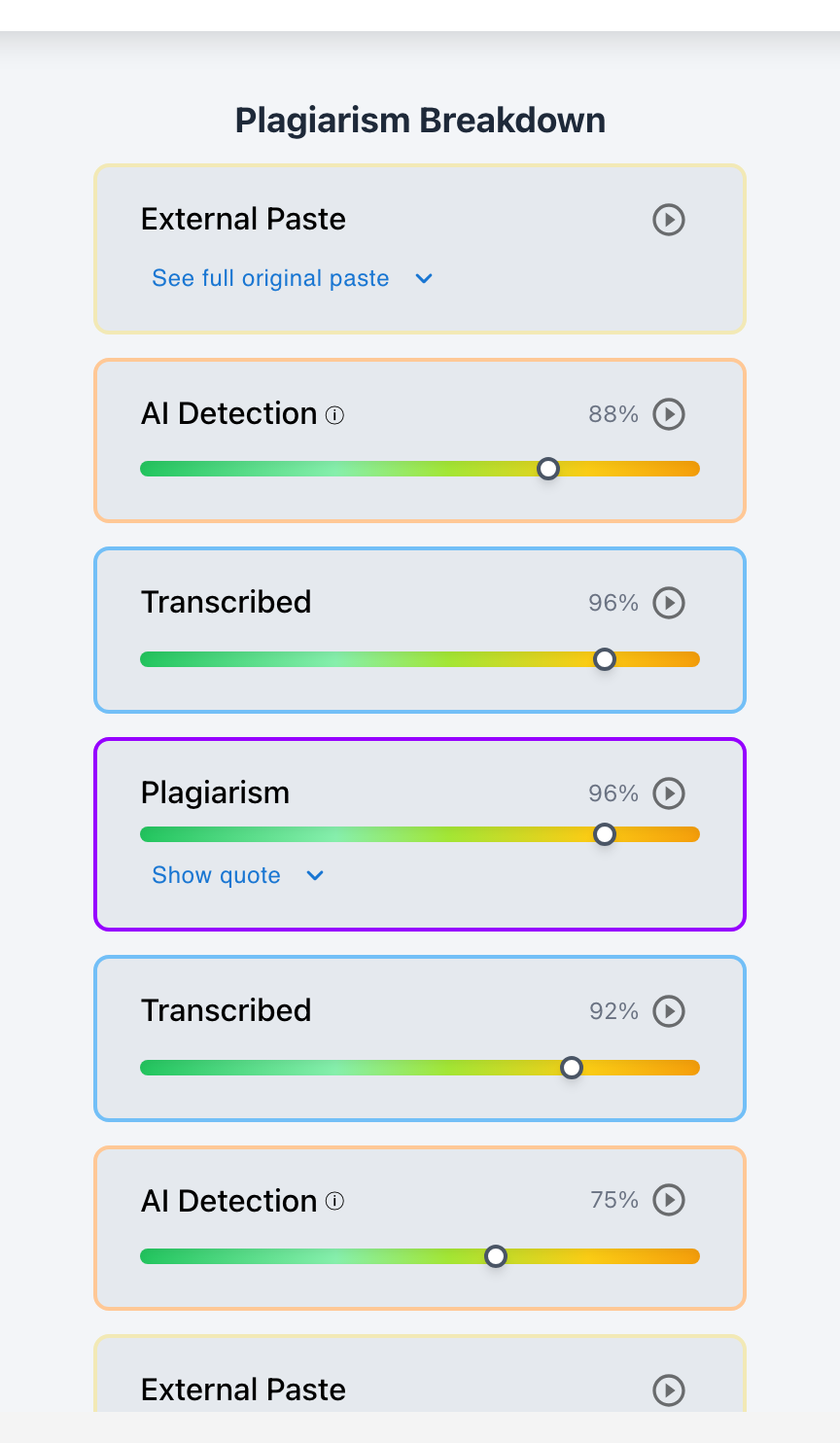
Checkmark Plagiarism detects history resets by pairing essay writing playback with AI detection, plagiarism detection, autograding, and integrations with Google Classroom and Canvas.
The 3 Workarounds Students Use to Reset History (and How They Fail)
1. "Make a Copy" Reset
The Trick: Clicking File > Make a copy copies current text into a new doc without carrying over version history.
The Detection: The new doc has a creation date 5 minutes before submission with zero typing hours.
2. Fresh Doc Copy-Paste
The Trick: Opening a blank doc and pressing Ctrl+V to paste the entire finished essay.
The Detection: Checkmark Playback logs a 0.05-second clipboard paste payload containing 100% of the paper's text.
3. Word Download / Re-Upload
The Trick: Downloading as .docx and re-uploading to Google Drive to break cloud version logs.
The Detection: Google Classroom records the file upload event and flags the absence of assigned template telemetry.
How Google Classroom Prevents Document History Resets
Understanding the security safeguards built into modern LMS workflows:
- Assigned Template Enforcement: When a teacher creates an assignment with "Make a copy for each student," Google Classroom generates a unique file ID. If a student submits a different file, Classroom flags an attachment mismatch.
- Freezing History Upon Submission: The moment a student clicks "Turn In," edit permissions transfer to the teacher, permanently locking the revision history against retroactive modifications.
- Checkmark Instant Paste Flag: Even if a student creates a new document, Checkmark Playback flags the single-snapshot paste event and calculates 0 hours of active drafting.
Read more in how Checkmark writing process analysis works.
Comparison: Legitimate Drafting History vs. Reset Document Signature
Legitimate Drafting History (Authentic Work)
- Document age spans days or weeks.
- 15+ recorded version history snapshots.
- Active typing duration: 3.5 hours recorded in Playback.
- Organic backspaces, restructuring, and self-editing.
Reset Document Signature (Wiped History)
- Document created <30 minutes before due date.
- Only 1 or 2 version history snapshots total.
- Active typing duration: <5 minutes recorded in Playback.
- Entire essay appears in a single clipboard paste payload.
A 5-Step Educator Protocol for Investigating History Resets
History Reset Audit Checklist:
- 1. Open the student's submission in Google Classroom or Canvas SpeedGrader.
- 2. Check the Document Creation Date: verify whether the file was created weeks ago or 10 minutes before submission.
- 3. Launch Checkmark Writing Playback: check if the entire essay entered in a single 0.05-second paste.
- 4. If the doc is a reset copy, ask the student: "Can you share the original Google Doc where you drafted this text?"
- 5. If the student cannot produce an original draft with typing telemetry, conduct an oral defense check-in.
How Checkmark Plagiarism Powers History Integrity
Checkmark Plagiarism combines **AI detection, essay writing playback, static AI detection, plagiarism detection, autograding, and Canvas/Google Classroom integrations** to automatically alert teachers when a submitted document exhibits the classic "Zero-Draft Reset" fingerprint.
Frequently Asked Questions
Is there any button to delete version history in Google Docs?
No. Google Docs has no native setting or button that allows users to clear or delete revision history.
What does it mean if a student's document has only one version?
It means the student either pasted the entire essay into a brand new document or created a copy right before turning it in, resetting the drafting record to zero.
What should a teacher do if a student submits a copied doc with no history?
Request access to the original draft file in their Google Drive or hold a brief 2-minute oral check-in to assess their comprehension of the arguments.
Can students hide specific snapshots while keeping others?
No. Version history is an all-or-nothing system; individual snapshots cannot be cherry-picked, edited, or hidden.
How does Checkmark Plagiarism integrate with Google Classroom?
Checkmark connects directly with Google Classroom to verify file IDs, track keystrokes, and embed writing playback in the grading sidebar.
What if a student legitimately wanted a clean document for final formatting?
An honest student who made a copy for formatting can easily share the original draft doc containing their hours of typing history.
Can a student wipe history by renaming the file?
No. Renaming a Google Doc preserves 100% of its revision history and logs the name change as an event in version history.
How does Checkmark Playback handle newly pasted docs?
Playback visually records the blank canvas being filled in a 0.05-second flash, tagging the exact paste payload and character count.
What if a student drafted offline in Microsoft Word?
Ask the student to submit the original .docx file, which contains internal metadata timestamps and incremental save logs.
Why is history reset awareness vital for academic integrity?
Because knowing how to spot and request original draft files ensures that students cannot hide AI generation or ghostwriting behind fresh documents.
Closing the Loop on Document Integrity
Academic authenticity leaves an indelible digital footprint. By understanding that Google Docs revision history cannot be deleted—and utilizing Checkmark Plagiarism to catch history-reset workarounds—educators ensure that student evaluation is always grounded in genuine, verifiable effort.
Checkmark Plagiarism supports this comprehensive approach with AI detection, essay writing playback, static AI detection, plagiarism detection, autograding, and integrations with Google Classroom and Canvas.
See how Checkmark detects history resets and paste events in Google Docs assignments. View a sample report or request a demonstration.