
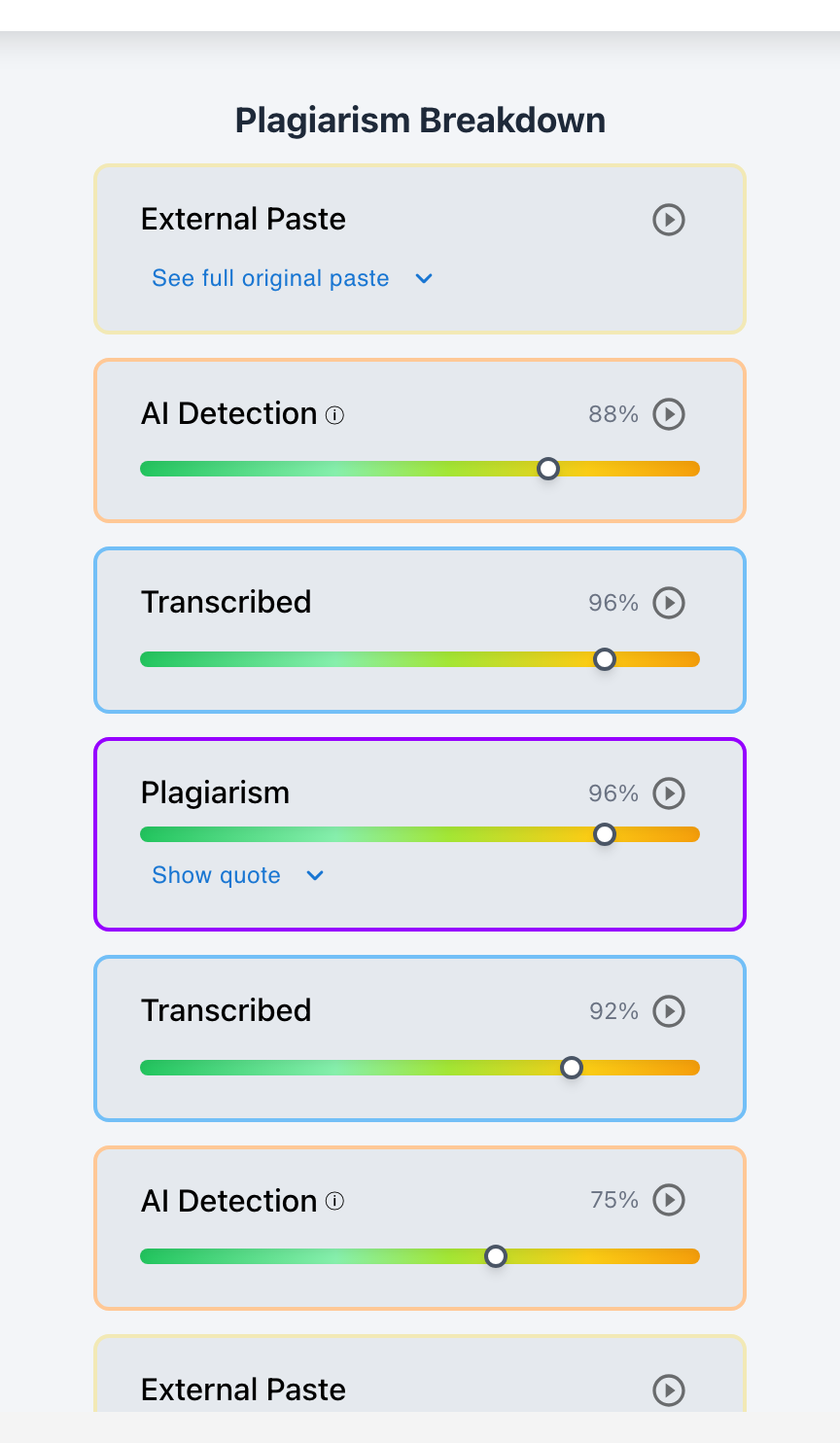
No. Students cannot bypass AI detection by reading ChatGPT on their phone while typing on their computer. While this cross-device technique prevents clipboard paste tracking on the laptop, it leaves a glaring transcription keystroke footprint (robotic typing cadence, sub-2% backspaces, missing cognitive pauses) while the submitted text still triggers high AI probability scores.
The "Phone-to-Laptop" technique is one of the most common AI evasion tactics in middle and high schools: a student opens the ChatGPT mobile app on their phone, props it up against their Chromebook screen, and types the essay out word-for-word. Students believe that because the AI prompt occurred on a personal mobile device outside the school's network, the submission is completely untraceable. In reality, the physical act of transcribing text from a secondary screen creates an unmistakable forensic profile that Checkmark Plagiarism exposes instantly.
Below is a comprehensive guide on how teachers detect cross-device AI transcription.
Checkmark Plagiarism exposes cross-device transcription by pairing essay writing playback with AI detection, plagiarism detection, autograding, and integrations with Canvas and Google Classroom.
The 4 Forensic Red Flags of Phone-to-Laptop Transcription
1. The "Read-Type-Read" Keystroke Cadence
Keystroke telemetry captures short, steady 4- to 8-word typing bursts separated by 1.5-second pauses as the student glances back down at their phone screen.
2. Near-Zero Backspace Rate (<2%)
Because the student is transcribing pre-composed sentences, there are zero deleted phrases, rewritten transitions, or restructured thesis arguments.
3. Persistent AI Linguistic Flags
The words submitted on Canvas still carry ChatGPT's synthetic perplexity, uniform burstiness, and formulaic rhetorical markers, scoring 85%+ AI probability.
4. Collapse in Oral Verification
In a 2-minute teacher check-in, the student cannot define collegiate vocabulary words they typed just hours earlier from their phone.
Why Reading from a Phone Cannot Fool Modern Integrity Tools
Cross-device evasion fails against multi-signal integrity architectures:
- Linguistic Detection Evaluates the Text: Static AI detectors do not know or care which device ran the prompt. They evaluate the mathematical predictability of the submitted words.
- Keystroke Telemetry Evaluates the Behavior: Authentic composition involves deep cognitive pauses (45–120 seconds) while thinking. Phone transcription exhibits mechanical, continuous entry.
- Drafting Speed Impossibility: Retyping a 1,200-word phone output takes 18 minutes; composing 1,200 words honestly takes 3+ hours.
Read more in how Checkmark writing process analysis works.
Comparison: Authentic Human Drafting vs. Phone-to-Laptop Transcription
Authentic Student Drafting (Cognitive Process)
- Speed: variable 35–50 WPM with deep thinking pauses.
- 18% to 28% backspaces and active sentence rewrites.
- Vocabulary matches student's in-class diagnostic baseline.
- Active drafting duration: 3.5+ hours for 1,500 words.
Phone-to-Laptop AI Transcription (Copying)
- Speed: steady 70+ WPM with 1.5s glance pauses.
- <2% backspaces; zero restructured sentences.
- Collegiate AI vocabulary far above historical baseline.
- Active drafting duration: 20 minutes for 1,500 words.
A 5-Step Educator Protocol for Phone-to-Laptop Inquiries
Phone-to-Laptop Audit Checklist:
- 1. Open the student's submission in Checkmark Playback inside Canvas SpeedGrader.
- 2. Review the AI Probability Score: check if neural classifiers flag synthetic vocabulary.
- 3. Inspect the Deletion Rate and Active Typing Time metrics.
- 4. Watch the 15-second video replay: look for the rhythmic "read-type-read" cadence without thinking pauses.
- 5. Hold a 2-minute oral check-in: ask the student to define 3 complex terms and explain their thesis.
How Checkmark Plagiarism Powers Cross-Device Forensics
Checkmark Plagiarism combines **AI detection, essay writing playback, static AI detection, plagiarism detection, autograding, and Canvas/Google Classroom integrations** to make cross-device copying completely transparent.
Frequently Asked Questions
Can teachers tell if a student is copying from their phone?
Yes. The rhythmic cadence of glancing at a phone and typing short word bursts with near-zero backspaces creates an unmistakable transcription signature in Essay Playback.
Does using ChatGPT on a personal phone hide the AI prompt?
While the prompt is hidden on the phone, the resulting text still triggers high AI detection scores on Canvas, and the keystroke history proves transcription.
What does phone transcription look like in Essay Playback?
It shows steady, continuous typing at 70+ WPM with uniform 1.5-second pauses between short clauses and a sub-2% backspace rate.
How long does it take to type an essay from a phone?
A student can retype a 1,200-word ChatGPT essay in approximately 18 to 22 minutes, compared to 3+ hours for authentic composition.
What if a student copied handwritten notes from their notebook?
Ask the student to present their handwritten notes during a brief check-in to confirm authentic offline drafting.
How does Checkmark Plagiarism integrate with Canvas LMS?
Checkmark provides certified LTI 1.3 integration, SpeedGrader sidebar embeds, two-way grade passback, and single sign-on (SSO).
Why do students have low backspaces when copying from a phone?
Because they are transcribing pre-composed sentences, eliminating the need to rethink, rephrase, or restructure ideas.
Can students fake realistic human pauses while transcribing?
Simulating hours of realistic keystroke speed fluctuations, pauses, and backspaces takes more time than simply writing the essay honestly.
What questions should a teacher ask to confirm phone transcription?
Ask: "What does this word mean?", "How did you choose this example?", and "Can you explain your conclusion in your own words?"
Why is multi-signal evidence essential for cross-device cases?
Because combining linguistic AI scores with keystroke cadence telemetry provides objective, defensible proof of misconduct.
Exposing Cross-Device Shortcuts with Scientific Telemetry
Switching screens cannot disguise the absence of genuine student learning. By analyzing keystroke cadence, revision depth, and linguistic AI patterns with Checkmark Plagiarism, educators ensure that cross-device evasion tactics are accurately identified and addressed.
Checkmark Plagiarism supports this comprehensive approach with AI detection, essay writing playback, static AI detection, plagiarism detection, autograding, and integrations with Canvas and Google Classroom.
See how Checkmark pairs cross-device transcription forensics with multi-signal detection to catch phone-to-laptop AI copying. View a sample report or request a demonstration.