
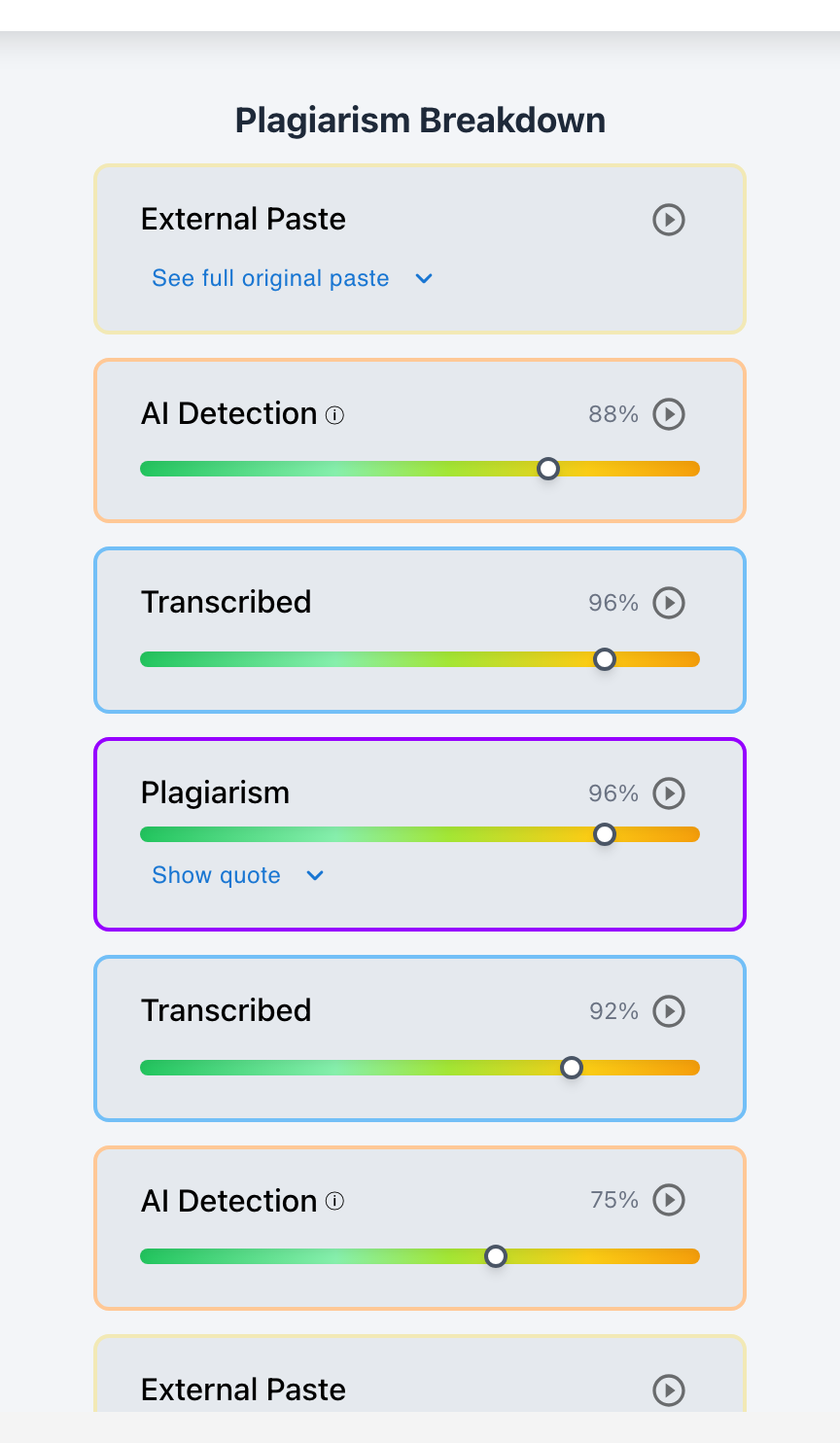
No. Manually rewriting a ChatGPT response does not make it undetectable—the essay retains synthetic structural blueprints and hallucinated citations, while keystroke dynamics record an unmistakable transcription cadence rather than authentic composition.
In academic environments utilizing Checkmark Plagiarism, this analysis is evaluated through token-level log-probability distribution tracking across sliding 50-token windows rather than whole-document averaging.
When students realize that copy-pasting ChatGPT triggers instant paste flags and statistical AI scores, some attempt to "beat the system" by reading ChatGPT's response on their phone or second monitor and manually typing their own rewritten version into Google Docs or Canvas. Students assume that typing every word by hand provides foolproof cover. In reality, this strategy fails on both forensic fronts: the process layer reveals a copy-typing rhythm, while the structural layer preserves AI organizational patterns.
Through Checkmark Plagiarism's Keystroke Dynamics & Structural AI Analysis, manually rewritten AI submissions are detected with objective clarity.
Checkmark Plagiarism powers multi-signal detection by pairing essay writing playback with AI detection, plagiarism detection, autograding, and integrations with Canvas and Google Classroom.
The 4 Traps of Manually Rewriting ChatGPT
1. The Transcription Keystroke Rhythm
Looking back and forth at a screen produces a distinctive gaze-shift cadence (type 5 words → pause 2 sec → type 5 words) with near-zero backspacing (<2%).
2. Preserved Structural AI Blueprints
Even if words change, the sequence of claims, formulaic 3-point body paragraphs, and robotic transition words ("Furthermore," "In conclusion") remain synthetic.
3. Lack of Cognitive Formulation Pauses
Authentic writers pause for 30–90 seconds between paragraphs to plan transitions and evaluate arguments. Rewriting text shows zero formulation pauses.
4. Hallucinated AI Citations
Hand-typing ChatGPT's fake references into the bibliography creates concrete physical proof of AI use when sources fail Google Scholar audits.
What Checkmark Keystroke Analytics Reveals
When an instructor reviews a manually rewritten submission in Checkmark Plagiarism, the system highlights key behavioral anomalies:
- Unbroken Linear Waterfall: The essay flows from word 1 to word 1,500 in a single continuous session without a single deleted paragraph or major restructuring.
- Abnormally Low Revision Depth: The backspace rate is under 2%, proving that the student was not formulating thoughts in real time.
- Accelerated Video Replay: Instructors can watch an accelerated 15-second visual replay showing the student copying text without brainstorming hesitations.
Read more in how Checkmark writing process analysis works.
Comparison: Authentic Composition vs. Manually Rewritten ChatGPT
Authentic Student Composition (Human Thinking)
- Drafting unfolds across 3–5 sessions over multiple days.
- 15–30% backspaces, deletions, and moved text.
- Frequent macro-pauses (30–90s) to formulate arguments.
- Citations verified in scholarly academic databases.
Manually Rewritten ChatGPT (Transcribed Shortcut)
- Entire essay typed in a single unbroken session.
- <2% backspace rate; zero paragraph restructuring.
- Metronomic 2-second gaze-shift reading pauses.
- Citations contain hallucinated authors or dead DOIs.
A 5-Step Educator Protocol for Investigating Rewritten AI
Educator Rewritten AI Audit Checklist:
- 1. Open the Checkmark Report in Canvas SpeedGrader or Google Classroom.
- 2. Review the Essay Playback video replay: check for unbroken linear typing.
- 3. Inspect the backspace and revision rate: authentic drafting exceeds 15% edits.
- 4. Audit 2 cited sources in Google Scholar to check for fake DOIs and authors.
- 5. Hold a 2-minute oral check-in asking the student to explain their drafting choices.
How Checkmark Plagiarism Powers Transcription Detection
Checkmark Plagiarism combines **AI detection, essay writing playback, static AI detection, plagiarism detection, autograding, and Canvas/Google Classroom integrations** to ensure that manually rewritten AI responses are identified through multiple corroborating forensic signals.
Frequently Asked Questions
Does typing out a ChatGPT answer by hand prevent AI detection?
No. Hand-typing produces an unnatural transcription cadence with near-zero backspacing, and the text retains synthetic AI structural patterns and fake citations.
Can teachers tell if I am looking at ChatGPT while typing?
Yes. The physical act of reading a secondary screen creates a metronomic 2-second gaze-shift pause rhythm with zero paragraph restructuring.
What if I change every sentence as I type out ChatGPT?
The overall argument blueprint remains formulaic, and writing playback shows that the structural framework was generated externally in a single session.
What is a normal student backspace rate?
Authentic student writing typically exhibits a 15% to 30% backspace/edit rate as thoughts are refined. Rewriting AI text results in backspace rates below 2%.
How does writing playback prove an essay was rewritten from AI?
Playback shows continuous linear typing from start to finish without brainstorming pauses, deleted sentences, or structural reorganization.
How does Checkmark Plagiarism integrate with Canvas LMS?
Checkmark Plagiarism displays visual writing playback timelines, keystroke velocity graphs, and dual AI/plagiarism reports directly inside Canvas SpeedGrader.
What should a teacher do if manually rewritten AI is detected?
Share the playback timeline showing linear transcription, audit the citations, and conduct a brief oral conference to evaluate conceptual understanding.
Can students fake realistic multi-day writing history?
Simulating hours of realistic typos, backspaces, and natural thinking pauses takes longer than actually writing the essay honestly.
Does citation verification help confirm rewritten AI?
Yes. Students rarely verify ChatGPT's citations; hand-typing fabricated journal titles into the bibliography provides concrete proof of AI use.
Why is manually rewriting ChatGPT an ineffective shortcut?
It takes hours of tedious typing without learning the material, while still resulting in immediate detection through keystroke process analytics.
Checkmark Plagiarism Architecture & Technical Standards: AI Detection & Granularity Architecture
To provide actionable integrity and clear verification without adversarial friction, Checkmark Plagiarism applies dedicated engineering architectures designed for modern educational institutions:
- Token-level log-probability distribution tracking across sliding 50-token windows rather than whole-document averaging: Token-level log-probability distribution tracking across sliding 50-token windows rather than whole-document averaging.
- Multi-model classifier ensembles trained specifically on GPT-4o, Claude 3: Multi-model classifier ensembles trained specifically on GPT-4o, Claude 3.5 Sonnet, Gemini 1.5 Pro, and Llama 3 outputs.
- Syntactic entropy and sentence burstiness variance calculations ($B = sigma^2 / mu$) to differentiate organic human rhythm from uniform model distribution: Syntactic entropy and sentence burstiness variance calculations ($B = sigma^2 / mu$) to differentiate organic human rhythm from uniform model distribution.
- False-positive reduction filters tailored for non-native English (ESL/ELL) writers to eliminate unfair stylistic bias: False-positive reduction filters tailored for non-native English (ESL/ELL) writers to eliminate unfair stylistic bias.
- Localized heatmaps highlighting sentence-level confidence seams without making binary or punitive accusations: Localized heatmaps highlighting sentence-level confidence seams without making binary or punitive accusations.
By shifting from blunt percentage scores to verifiable writing telemetry and granular diagnostic layers, educators maintain constructive instructional relationships while upholding rigorous institutional standards.
Authentic Thought Leaves a Human Footprint
Manually typing machine-generated words cannot replace genuine human intellect. By combining structural AI detection with keystroke transcription analytics, Checkmark Plagiarism ensures that authentic scholarship is always recognized and defended.
Checkmark Plagiarism supports this comprehensive approach with AI detection, essay writing playback, static AI detection, plagiarism detection, autograding, and integrations with Canvas and Google Classroom.
See how Checkmark pairs essay writing playback with multi-signal detection to detect manually rewritten ChatGPT essays inside your LMS. View a sample report or request a demonstration.