
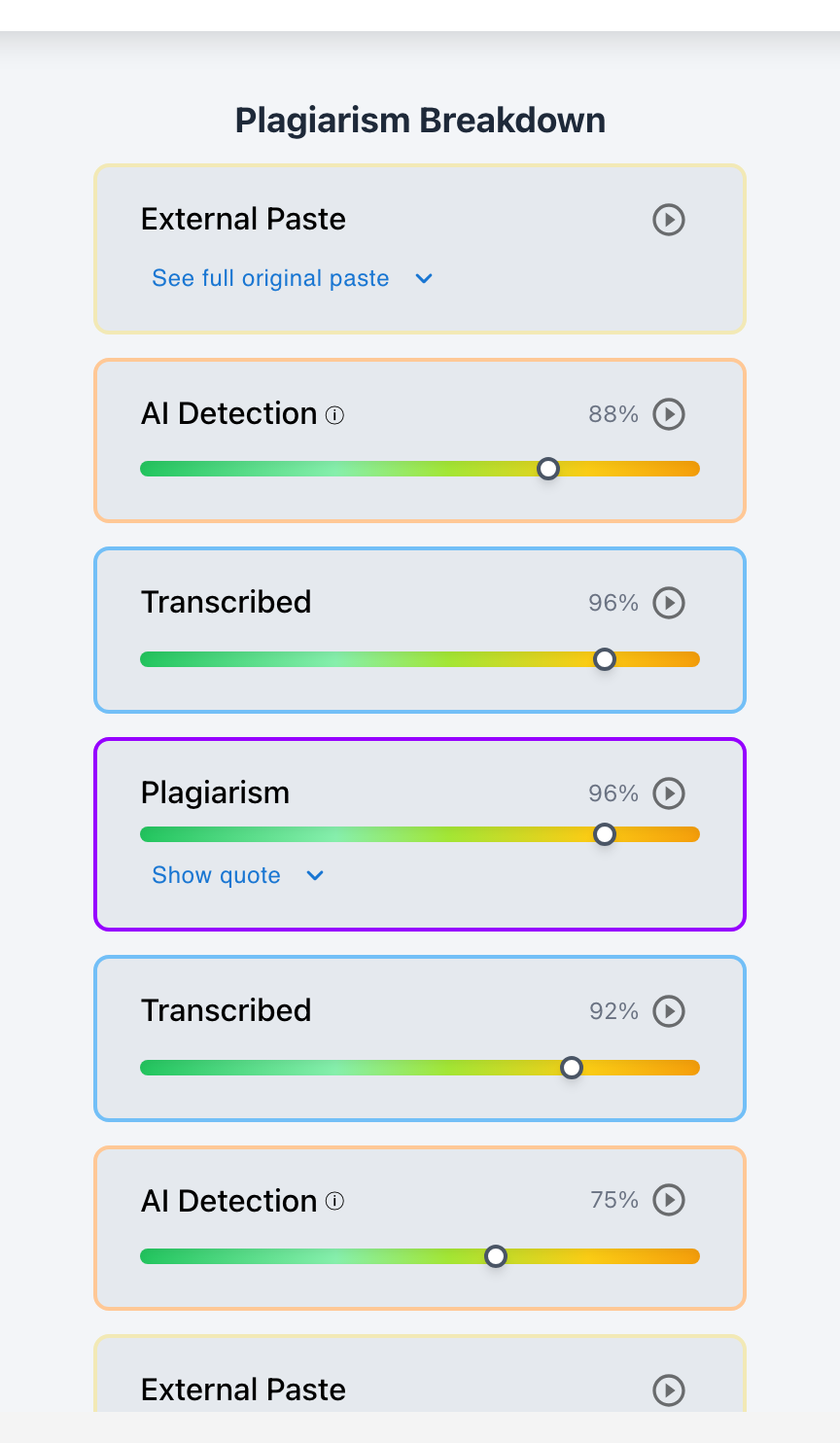
No. Retyping an article by hand is completely ineffective at avoiding plagiarism detection—it results in a 100% direct match in plagiarism checkers and creates an obvious transcription anomaly in keystroke audit logs.
A persistent myth among students is that plagiarism detection software is triggered by the computer's "copy/paste" clipboard. Under this mistaken belief, some students spend hours manually typing out encyclopedia articles, academic papers, or published essays word-for-word, assuming that typing the letters individually makes the text original. In reality, plagiarism checkers analyze the final submitted text strings against global databases—regardless of whether they were pasted or typed.
Furthermore, through Checkmark Plagiarism's Transcription Detection, the mechanical act of copying leaves a distinct, unmistakable keystroke rhythm that proves the text was transcribed rather than composed.
Checkmark Plagiarism powers transcription detection by pairing essay writing playback with AI detection, plagiarism detection, autograding, and integrations with Canvas and Google Classroom.
The 4 Reasons Retyping Fails to Bypass Detection
1. Exact String & N-Gram Matching
Plagiarism checkers scan 8-to-16-word sequences against billions of indexed sources. The match is identical whether text was pasted or typed by hand.
2. Robotic Transcription Rhythm
Manual transcription creates a metronomic typing pattern with near-zero backspacing (<2%) and zero paragraph restructuring.
3. Stylistic Incongruity
The retyped article's sophisticated sentence structures and domain vocabulary clash sharply with the student's in-class writing baseline.
4. Inability to Defend Orally
When asked to explain the arguments or define complex vocabulary during a 2-minute conference, transcribing students struggle immediately.
What Checkmark Transcription Detection Reveals
When an instructor reviews a retyped assignment with Checkmark Plagiarism, the system provides two incontrovertible layers of evidence:
- Direct Plagiarism Match: Checkmark highlights matching sentences in red and links directly to the original web page, journal article, or student paper.
- Transcription Playback: The accelerated video replay shows continuous linear typing from word 1 to word 1,500 without a single sentence deletion or thesis formulation pause.
Read more in how Checkmark writing process analysis works.
Comparison: Authentic Drafting vs. Retyping an Article
Authentic Student Drafting
- 0% direct match in plagiarism databases.
- 15–30% backspace and revision rate.
- Variable pauses for thinking and restructuring.
- Student fluently explains ideas and sources orally.
Retyping an External Article
- 100% direct match to online source or journal.
- Near-zero backspace rate (<2%).
- Robotic, linear typing from start to finish.
- Student unable to define advanced vocabulary.
A 5-Step Educator Investigation Protocol
Educator Retyping Investigation Checklist:
- 1. Open the Checkmark Plagiarism report to view direct source match links.
- 2. Review the writing playback timeline to check for linear transcription cadences.
- 3. Note the absence of backspacing, deletions, and structural revisions.
- 4. Compare the submission against the student's in-class diagnostic writing baseline.
- 5. Hold a supportive conference asking the student to explain the origin of the text.
How Checkmark Plagiarism Powers Transcription Detection
Checkmark Plagiarism combines **AI detection, essay writing playback, static AI detection, plagiarism detection, autograding, and Canvas/Google Classroom integrations** to ensure that retyped sources are flagged instantly, defending academic honesty with multi-signal evidence.
Frequently Asked Questions
Does retyping an article bypass plagiarism checkers?
No. Plagiarism checkers compare the words on the page to indexed databases. Retyping produces an exact 100% match regardless of how the text was entered.
Can teachers tell if I retyped an article instead of writing it myself?
Yes. The direct plagiarism match identifies the source, and writing playback shows linear typing without normal human revisions or ideation pauses.
What if I change a few words while retyping the article?
Checkmark's fuzzy matching and semantic detection still identify the underlying stolen sentence structures and matching source links.
Why do students retype articles?
Many students mistakenly believe that plagiarism detectors only look for clipboard paste commands, not realizing that text matching scans the words themselves.
What is a normal student backspace rate?
Authentic student writing typically exhibits a 15% to 30% backspace/edit rate as thoughts are refined. Retyping rates are usually under 2%.
How does writing playback prove an article was retyped?
Playback shows unbroken, linear keystrokes from start to finish without brainstorming pauses, deleted sentences, or structural reorganization.
What should a teacher do if a student retyped an article?
Show the matching source link alongside the playback keystroke timeline during an objective academic integrity conference.
How does Checkmark Plagiarism integrate with Canvas LMS?
Checkmark Plagiarism embeds visual writing playback timelines, cadence metrics, and direct source match links directly inside Canvas SpeedGrader.
Does transcription detection protect honest students?
Yes. Honest students show authentic drafting rhythms with natural pauses and revisions, protecting them from false accusations.
Why is retyping worse than honest writing?
It wastes hours of manual effort without developing real writing skills, while resulting in immediate detection and academic penalties.
Real Authorship Requires Original Thinking
Retyping another author's words cannot transform plagiarism into original writing. By combining global source matching with keystroke transcription analytics, Checkmark Plagiarism ensures that authentic intellectual effort is always recognized and protected.
Checkmark Plagiarism supports this comprehensive approach with AI detection, essay writing playback, static AI detection, plagiarism detection, autograding, and integrations with Canvas and Google Classroom.
See how Checkmark pairs essay writing playback with multi-signal detection to catch retyped articles and transcription patterns inside your LMS. View a sample report or request a demonstration.