
Yes. Plagiarism checkers and writing analytics tools detect text copied from another screen just as effectively as text copied and pasted directly via the clipboard.
A widespread misconception among students is that plagiarism detectors monitor the computer's "copy/paste clipboard." Consequently, some students place a phone, tablet, or secondary monitor next to their laptop and manually type out an online article, Wikipedia page, or ChatGPT response word-for-word, believing that physical retyping breaks the digital connection.
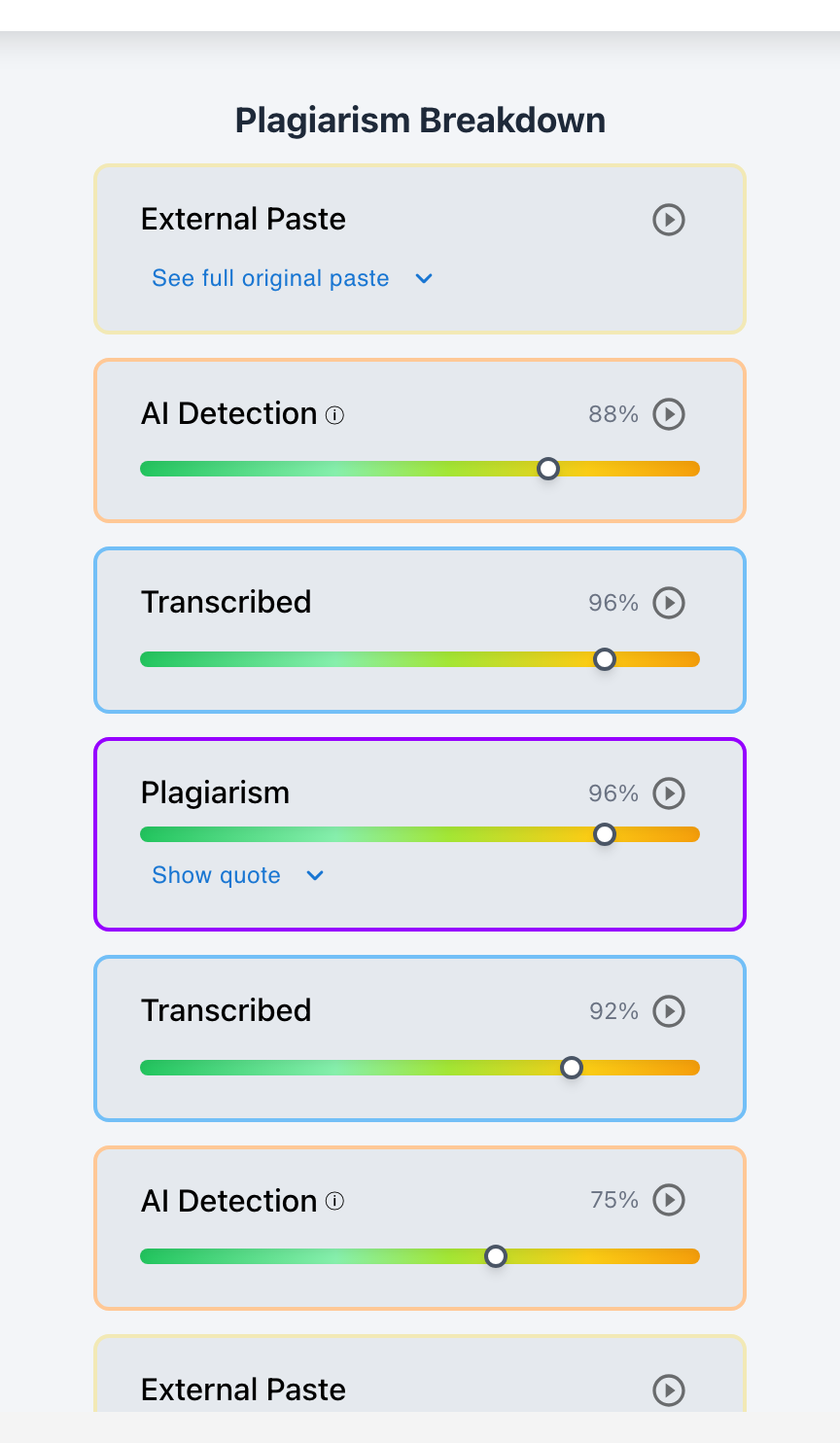
In reality, plagiarism algorithms evaluate the final submitted text strings against global databases—regardless of how the letters were entered. Furthermore, through Checkmark Plagiarism's Transcription + Source Matching, the physical keystroke rhythm of reading from a second screen is recorded and exposed.
Checkmark Plagiarism powers source matching by pairing essay writing playback with AI detection, plagiarism detection, autograding, and integrations with Canvas and Google Classroom.
Why Retyping from Another Screen Fails to Beat Plagiarism Checkers
1. String & N-Gram Matching
Plagiarism engines compare 8-word to 16-word sequences (n-grams) against billions of web pages. The resulting text match is 100% identical regardless of typing method.
2. Transcription Keystroke Rhythm
Looking back and forth at a phone creates a distinctive gaze-shift pause pattern (type 5 words → pause 2 sec → type 5 words) with near-zero backspacing.
3. Cross-Institutional Peer Indexing
If the text is copied from a classmate's phone, institutional repository matching identifies the exact sentence structures across both submissions.
4. AI Detection Remains Active
If the secondary screen displays ChatGPT, retyping the response by hand does not change its statistical perplexity, burstiness, or hallucinated citations.
The Dual Trap: What Checkmark Analysis Reveals
When a student types text from a secondary screen, they trigger two simultaneous detection layers in Checkmark Plagiarism:
- The Linguistic Layer: If the text came from a website, Checkmark highlights the exact matching URL. If it came from AI, the AI detector flags low burstiness and signature cliches.
- The Behavioral Layer: Essay Writing Playback reveals that the entire paper was typed linearly from start to finish without a single sentence deletion or major revision.
Read more in how Checkmark writing process analysis works.
Comparison: Direct Copy-Paste vs. Cross-Screen Retyping vs. Authentic Writing
Direct Copy-Paste
- 100% Plagiarism / AI match.
- 1-second instant paste flag.
- 0 minutes active typing.
Cross-Screen Retyping
- 100% Plagiarism / AI match.
- Gaze-shift pause rhythm.
- 0% structural revisions.
Authentic Writing
- 0% Plagiarism / AI match.
- Natural ideation pauses.
- 20%+ backspace/revision rate.
A 5-Step Educator Investigation Protocol
Educator Cross-Screen Audit Checklist:
- 1. Open the Checkmark Plagiarism report to review overall direct match percentages.
- 2. Click highlighted source links to view matching web pages side-by-side.
- 3. Open Essay Playback to check the student's typing cadence and backspace rate.
- 4. If typing is completely linear with 0% edits, transcription from a second screen is confirmed.
- 5. Hold a supportive conference asking the student to explain how the text was composed.
How Checkmark Plagiarism Simplifies Cross-Screen Detection
Checkmark Plagiarism combines **AI detection, essay writing playback, static AI detection, plagiarism detection, autograding, and Canvas/Google Classroom integrations** to catch copied text regardless of whether it was pasted or manually typed from another device.
Frequently Asked Questions
Can plagiarism checkers tell if I typed from my phone?
Yes. The text itself is matched against global databases, and the typing rhythm reveals a distinctive gaze-shift transcription pattern.
Does retyping text bypass Turnitin or Checkmark?
No. Plagiarism engines check the words on the page. If the words match an existing website or paper, the system flags it with 100% certainty.
What if I retype a ChatGPT response from my tablet?
The text will still trigger AI detection due to low burstiness, and the keystroke log will show linear typing without normal human thinking pauses.
Can teachers see what is on my second monitor?
No. Software does not monitor external screens or devices; it evaluates the submitted text and the keystroke cadence within the document.
What is a gaze-shift typing pattern?
A pattern where a student types 4–6 words, pauses 2 seconds to read their phone, types another 5 words, and repeats with zero backspaces.
How does writing playback prove an essay was copied from a screen?
Playback shows continuous linear typing from start to finish without brainstorming pauses, deleted sentences, or structural revisions.
What should a teacher do when cross-screen copying is detected?
Share the direct source match link and the playback keystroke timeline during an objective, supportive academic integrity meeting.
How does Checkmark Plagiarism integrate with Canvas LMS?
Checkmark Plagiarism displays visual writing playback replays, keystroke metrics, and direct source match links directly inside Canvas SpeedGrader.
Does transcription detection protect honest students?
Yes. Honest students have natural typing cadences with high backspace rates and ideation pauses, proving genuine cognitive creation.
Why is retyping from a screen worse than honest writing?
It wastes hours of manual effort without producing any learning, while still resulting in immediate detection and academic integrity consequences.
The Words on the Page Tell the Whole Story
Retyping text from a secondary screen is an ineffective shortcut that leaves both textual and behavioral footprints. By combining global source matching with keystroke transcription analytics, Checkmark Plagiarism ensures that authentic scholarship is always recognized and defended.
Checkmark Plagiarism supports this comprehensive approach with AI detection, essay writing playback, static AI detection, plagiarism detection, autograding, and integrations with Canvas and Google Classroom.
See how Checkmark pairs essay writing playback with multi-signal detection to catch cross-screen transcription and source matching inside your LMS. View a sample report or request a demonstration.