
Yes. Paraphrased sources still count as plagiarism in two common scenarios: when a student paraphrases an author's ideas without including an in-text citation crediting the source, or when the paraphrasing is incomplete (known as patchwriting), where the student swaps a few synonyms but preserves the original author's sentence structure without quotation marks.
A widespread misconception among secondary and undergraduate students is that changing the words of a source grants total immunity from plagiarism rules: "I put it in my own words, so I don't need a citation." In academic scholarship, citations acknowledge the origin of intellectual ideas, not just verbatim strings of text. If the idea, statistic, or argument was discovered or conceptualized by someone else, an in-text citation is mandatory regardless of how thoroughly the text was rephrased. Checkmark Plagiarism's Semantic Analysis Engine detects uncredited paraphrased sources to ensure complete attribution accuracy.
Below is a comprehensive guide on when paraphrasing crosses the line into plagiarism and how educators can teach proper attribution.
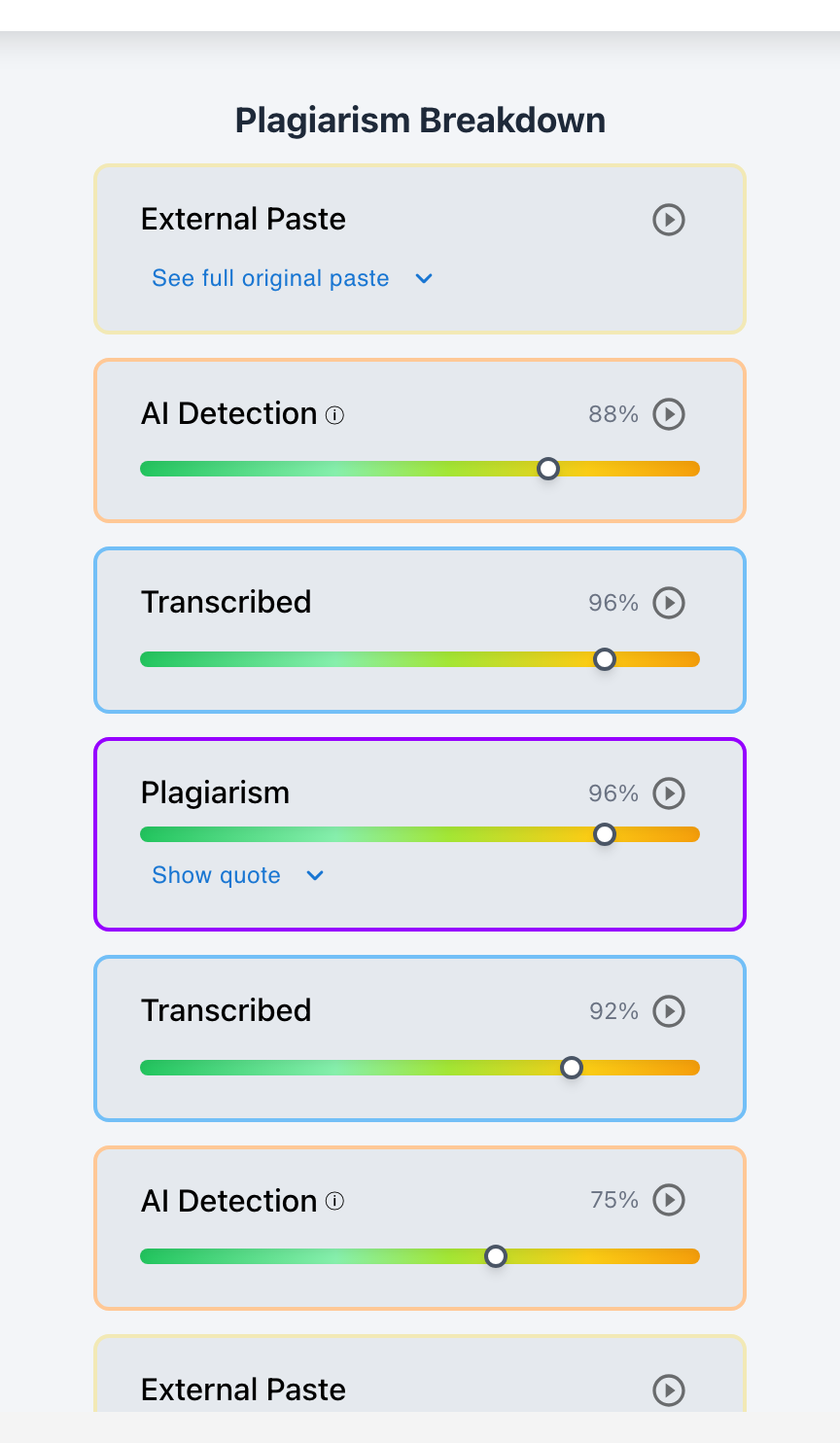
Checkmark Plagiarism analyzes paraphrased content by pairing plagiarism detection with AI detection, essay writing playback, autograding, and integrations with Canvas and Google Classroom.
The 3 Ways Paraphrasing Becomes Plagiarism
1. Uncited Paraphrasing
The student rewrites an author's unique finding in entirely new words and syntax, but provides zero citation or author credit—claiming the idea as original insight.
2. Incomplete Paraphrasing (Patchwriting)
The student includes a citation at the end, but copied the source's exact clause structure and simply swapped 3 or 4 synonyms without quotation marks.
3. Misleading / Buried Citation
The student paraphrases 3 full paragraphs from a single source, but places only one citation at the very end of the third paragraph, obscuring the true extent of borrowing.
The Legal & Ethical Rules of Academic Paraphrasing
Understanding the standard expectations across APA, MLA, and Chicago style guides:
- Rule 1: Idea Attribution Is Mandatory: Any time you borrow a concept, historical theory, medical finding, or analytical argument from a source, you must cite the author in-text.
- Rule 2: Complete Structural Transformation: A legitimate paraphrase must completely dismantle the original sentence structure, expressing the core meaning in the student's unique authentic voice.
- Rule 3: Exact Phrasing Requires Quotation Marks: If any distinctive 3- to 5-word phrases from the original text are retained, they must be placed inside quotation marks within the paraphrase.
Read more in how Checkmark writing process analysis works.
Comparison: Legitimate Paraphrase vs. Paraphrase Plagiarism vs. Patchwriting
Legitimate Paraphrase (Honest)
"Research indicates that sleep deprivation directly impairs academic retention among teenagers (Miller, 2024)."
✓ New syntax + in-text citation
Uncited Paraphrase (Plagiarism)
"Research indicates that sleep deprivation directly impairs academic retention among teenagers."
✗ New syntax, but ZERO citation
Patchwriting (Plagiarism)
"Studies show that lack of rest severely harms school memory in adolescents (Miller, 2024)."
✗ Has citation, but copied structure
A 5-Step Educator Protocol for Paraphrase Audits
Paraphrase Plagiarism Audit Checklist:
- 1. Open the student's submission in Checkmark Plagiarism inside Canvas SpeedGrader.
- 2. Review the Semantic Source Match report: check for highlighted uncredited paraphrase blocks.
- 3. Inspect the In-Text Citation tags to ensure every paraphrased claim has a matching reference.
- 4. Check the side-by-side comparison card: evaluate whether the sentence structure was authentically rewritten.
- 5. Hold a 2-minute conference: guide the student through adding proper in-text attribution.
How Checkmark Plagiarism Powers Paraphrase Verification
Checkmark Plagiarism combines **AI detection, essay writing playback, static AI detection, plagiarism detection, autograding, and Canvas/Google Classroom integrations** to evaluate semantic idea similarity and ensure that every paraphrased source is properly attributed.
Frequently Asked Questions
Do you have to cite a source if you don't use direct quotes?
Yes. If you borrow an idea, statistic, or argument from an external source, an in-text citation is mandatory regardless of whether you quote or paraphrase.
What is the difference between quoting and paraphrasing?
Quoting uses the exact words of an author enclosed in quotation marks. Paraphrasing explains the author's idea in completely new words and syntax with an in-text citation.
How does Checkmark detect paraphrased plagiarism?
Checkmark's Semantic Matching Engine evaluates conceptual relationships, argument structures, and factual claim clusters rather than relying strictly on exact string matching.
What is patchwriting?
Patchwriting is an incomplete paraphrase where a student swaps a few synonyms but keeps the original sentence structure without quotation marks.
Can you plagiarize a source by summarizing it?
Yes. If you summarize an author's book chapter or research study without providing an in-text citation, you are claiming their intellectual work as your own.
How does Checkmark Plagiarism integrate with Canvas LMS?
Checkmark provides certified LTI 1.3 integration, SpeedGrader sidebar embeds, two-way grade passback, and single sign-on (SSO).
What is 'common knowledge' in paraphrasing?
Common knowledge refers to widely known, undisputed facts (e.g., "Water freezes at 0 degrees Celsius") that do not require citation.
How can teachers teach students to paraphrase properly?
Teach the "Read, Close, Write" method: read the passage, close the source, write the idea from memory, and immediately insert the author citation.
What should a teacher do when uncited paraphrasing is discovered?
Hold a conference to explain that ideas require citation just like quotes, and require the student to revise the essay with proper in-text attribution.
Why is understanding paraphrase plagiarism essential for academic integrity?
Because ethical scholarship is built on honoring the origin of ideas, ensuring that students develop true critical thinking and honest research habits.
Cultivating Ethical Research and Intellectual Honesty
Paraphrasing is an essential scholarly tool for synthesizing complex information. By teaching students the rules of idea attribution and using Checkmark Plagiarism to identify uncredited paraphrasing, educators ensure that student writing reflects genuine comprehension and rigorous academic ethics.
Checkmark Plagiarism supports this comprehensive approach with AI detection, essay writing playback, static AI detection, plagiarism detection, autograding, and integrations with Canvas and Google Classroom.
See how Checkmark pairs semantic paraphrase detection with multi-signal forensics to evaluate student research. View a sample report or request a demonstration.