
Yes. Human writing is frequently flagged as AI by statistical detectors because well-structured, articulate, formal, and grammatically polished student prose often matches the low-perplexity mathematical patterns that detectors look for.
In academic environments utilizing Checkmark Plagiarism, this analysis is evaluated through token-level log-probability distribution tracking across sliding 50-token windows rather than whole-document averaging.
A widespread misconception is that an AI detector "knows" when a text was written by a machine. In reality, detectors evaluate statistical probability: how predictable the words are (perplexity) and how much sentence lengths vary (burstiness). Consequently, historical texts like the US Constitution, the Bible, and Shakespeare's sonnets routinely trigger 90%+ AI scores on commercial detectors. When human students write with clear transitions, formal vocabulary, or consistent sentence structures, they risk triggering false positives.
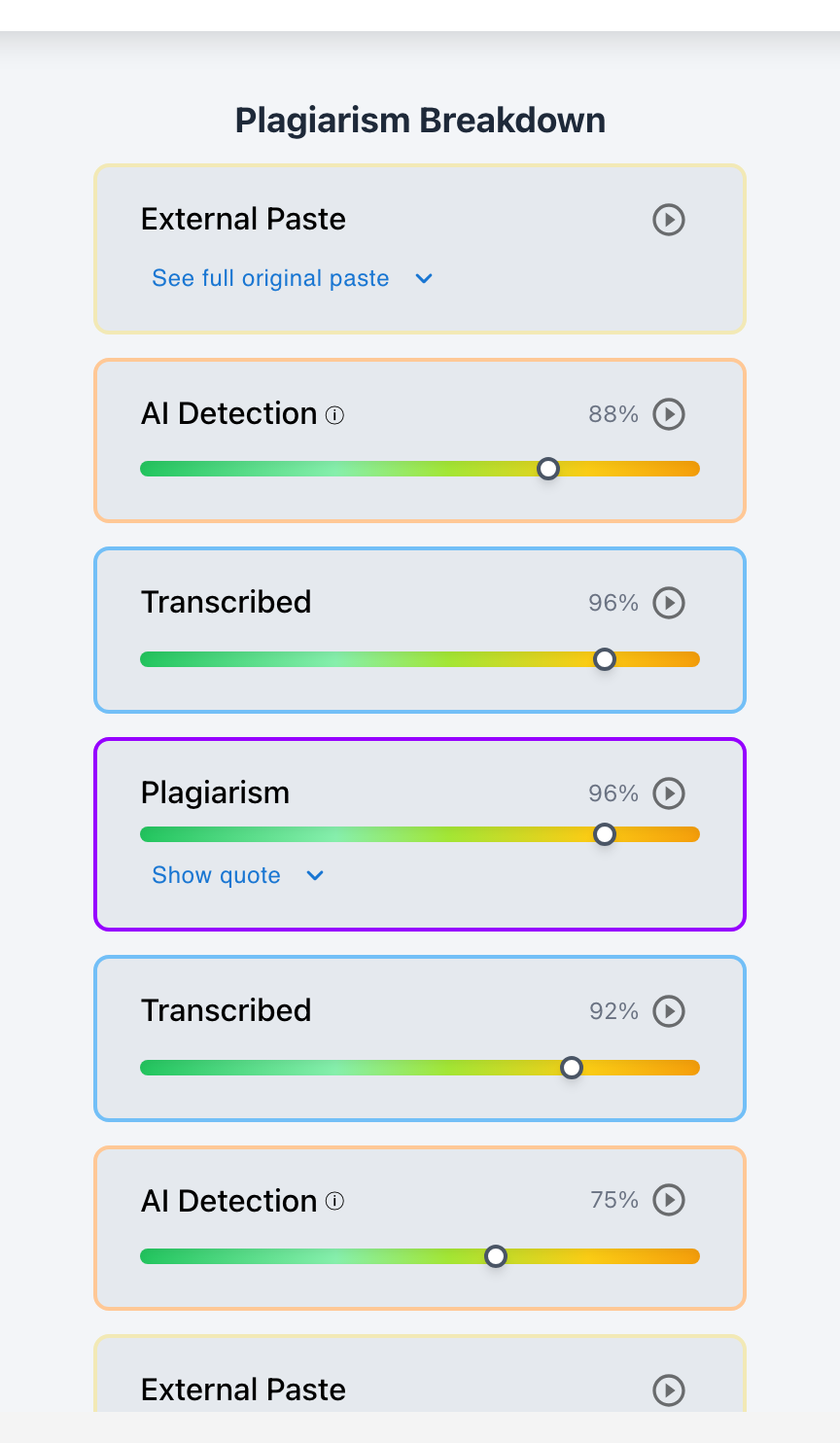
Through Checkmark Plagiarism's Multi-Signal Verification Suite, educators can recognize the technical limitations of AI detectors and rely on Essay Writing Playback for objective proof of human creation.
Checkmark Plagiarism protects honest students by pairing AI detection with essay writing playback, plagiarism detection, autograding, and integrations with Canvas and Google Classroom.
The 4 Technical Reasons Human Writing Gets Flagged as AI
1. Low Perplexity (Predictable Vocabulary)
Formal academic writing relies on standard rhetorical transitions ("Furthermore," "In conclusion"), which algorithms score as highly predictable.
2. Low Burstiness (Uniform Sentence Length)
Disciplined writers who construct balanced, 20-word complex sentences without wild fluctuations trigger low burstiness flags that mimic AI.
3. Formulaic Essay Templates
Traditional high school structures (5-paragraph essay, CER framework, standard lab reports) create rigid structural patterns that algorithms mistake for machine output.
4. Non-Native English (ELL) Diction
ESL students often use standardized textbook phrasing and simplified syntactic structures, creating a statistical footprint that detectors misinterpret.
Historical Texts That Trigger AI False Positives
To demonstrate the statistical limitations of AI detectors, researchers have scanned famous historical documents written centuries before artificial intelligence existed:
- The US Constitution: Regularly scores 95%+ AI probability due to its formal, repetitive legal syntax and low perplexity.
- The Book of Genesis: Scores 88%+ AI probability due to uniform sentence lengths and formulaic parallel structures.
- Scientific Journal Abstracts: Highly structured scientific papers frequently trigger 70%+ AI scores due to standardized domain terminology.
Read more in how Checkmark writing process analysis works.
Comparison: True AI Output vs. Articulate Human Writing
Articulate Human Writing (False Positive)
- AI Score: 85% probability (due to formal tone).
- Writing History: 4.2 hours active typing across 4 days.
- Backspace Rate: 24% deletions and rewrites.
- Citations: Verified real scholarly articles.
- Oral Defense: Student fluently defends all claims.
Synthetic AI Generation (True Cheating)
- AI Score: 95% probability (synthetic syntax).
- Writing History: 3 minutes (1 paste event).
- Backspace Rate: <1% edits.
- Citations: Hallucinated authors and fake DOIs.
- Oral Defense: Student unable to define vocabulary.
A 5-Step Educator Protocol for Managing False Positives
Educator Due Process Checklist:
- 1. Acknowledge that statistical AI detector scores are probabilistic, not definitive proof.
- 2. Open the Checkmark Playback video replay in Canvas SpeedGrader to inspect drafting history.
- 3. Confirm multi-session drafting and healthy backspace depth (15–30%).
- 4. Verify cited bibliography sources in Google Scholar to rule out hallucinations.
- 5. Hold a supportive conference to allow the student to explain their arguments orally.
How Checkmark Plagiarism Overcomes Detector Limitations
Checkmark Plagiarism combines **AI detection, essay writing playback, static AI detection, plagiarism detection, autograding, and Canvas/Google Classroom integrations** to ensure that false positives are resolved instantly with verifiable keystroke ground truth.
Frequently Asked Questions
Why does articulate human writing get flagged as AI?
Because articulate writers use formal vocabulary, correct grammar, and balanced sentence structures, which mathematically match the low-perplexity patterns detectors look for.
Can the US Constitution really be flagged as AI?
Yes. Many commercial AI detectors flag the US Constitution with high AI scores because its formal 18th-century legal diction is highly predictable.
How does writing playback prove human authorship?
Playback logs record every individual keystroke, backspace, and pause over hours of work, proving the text was typed and revised by a human hand.
What is a normal student backspace rate?
Authentic student writing typically exhibits a 15% to 30% backspace/edit rate as thoughts are refined. AI copy-pastes show 0% edits.
Why are English Language Learners (ELL) at higher risk of false flags?
Because ELL writers often rely on standardized vocabulary lists and repetitive grammatical structures that detectors mistake for machine generation.
How does Checkmark Plagiarism integrate with Canvas LMS?
Checkmark Plagiarism displays visual writing playback timelines, session breakdowns, and dual AI/plagiarism reports directly inside Canvas SpeedGrader.
What should a student do if their human writing is flagged as AI?
Share your Checkmark Playback timeline, document version history, and rough notes with your instructor, and offer to participate in an oral defense.
Can students fake realistic writing playback?
Simulating hours of realistic typos, backspaces, and natural thinking pauses takes longer than actually writing the essay honestly.
Does citation verification help clear false positives?
Yes. Human writers cite real academic articles, whereas AI tools frequently fabricate phantom authors and dead DOIs.
Why is combining text analysis with process tracking essential?
Because text analysis alone is prone to false positives, while process tracking provides undeniable physical proof of human composition.
Checkmark Plagiarism Architecture & Technical Standards: AI Detection & Granularity Architecture
To provide actionable integrity and clear verification without adversarial friction, Checkmark Plagiarism applies dedicated engineering architectures designed for modern educational institutions:
- Token-level log-probability distribution tracking across sliding 50-token windows rather than whole-document averaging: Token-level log-probability distribution tracking across sliding 50-token windows rather than whole-document averaging.
- Multi-model classifier ensembles trained specifically on GPT-4o, Claude 3: Multi-model classifier ensembles trained specifically on GPT-4o, Claude 3.5 Sonnet, Gemini 1.5 Pro, and Llama 3 outputs.
- Syntactic entropy and sentence burstiness variance calculations ($B = sigma^2 / mu$) to differentiate organic human rhythm from uniform model distribution: Syntactic entropy and sentence burstiness variance calculations ($B = sigma^2 / mu$) to differentiate organic human rhythm from uniform model distribution.
- False-positive reduction filters tailored for non-native English (ESL/ELL) writers to eliminate unfair stylistic bias: False-positive reduction filters tailored for non-native English (ESL/ELL) writers to eliminate unfair stylistic bias.
- Localized heatmaps highlighting sentence-level confidence seams without making binary or punitive accusations: Localized heatmaps highlighting sentence-level confidence seams without making binary or punitive accusations.
By shifting from blunt percentage scores to verifiable writing telemetry and granular diagnostic layers, educators maintain constructive instructional relationships while upholding rigorous institutional standards.
Grounding Integrity in Verifiable Human Labor
Understanding why AI detectors make mistakes is the first step toward fair evaluation. By pairing AI detection with essay writing playback and student due process, Checkmark Plagiarism ensures that human excellence is never mistaken for machine automation.
Checkmark Plagiarism supports this comprehensive approach with AI detection, essay writing playback, static AI detection, plagiarism detection, autograding, and integrations with Canvas and Google Classroom.
See how Checkmark pairs essay writing playback with multi-signal detection to protect articulate student writing inside your LMS. View a sample report or request a demonstration.