
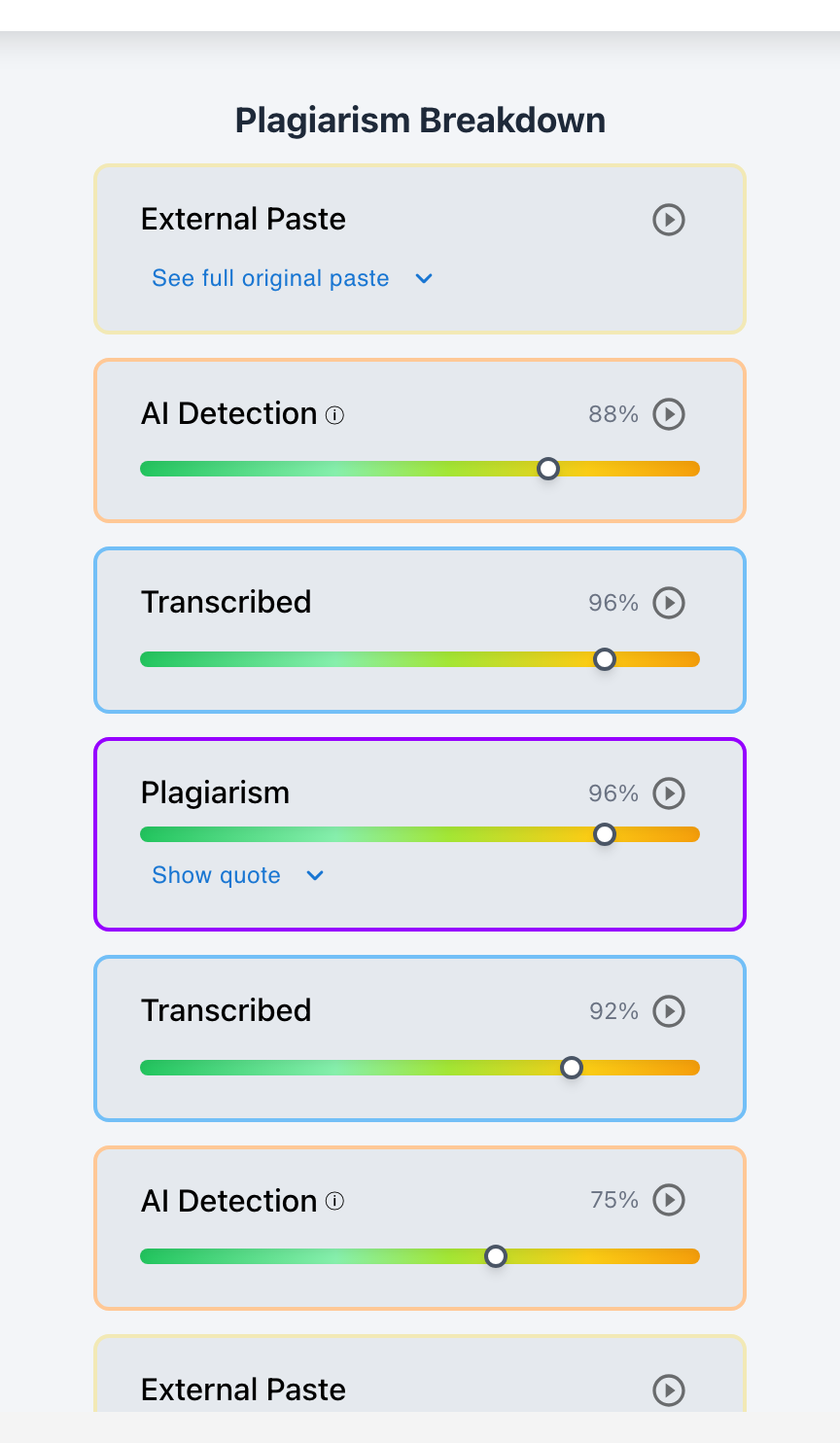
Native Google Docs does not explicitly label text as "pasted" versus "typed"—it simply records character additions within periodic autosave snapshots. However, teachers can infer paste events when a massive block of text (e.g., 800+ words) appears inside a single 2-minute snapshot. To obtain definitive, millisecond-level proof of clipboard paste events, schools use Checkmark Plagiarism, which captures browser clipboard payloads and logs exact paste timestamps and character counts.
A common student belief is that pasting text into Google Docs is completely invisible if done during a writing session: "If I open a Google Doc, type one sentence, paste my ChatGPT essay, and fix a few commas, Google Docs will just show that I was working on the document." While native Google Docs bundles character insertions into single green highlights, the physical velocity of a paste event is unmistakable. Checkmark Plagiarism's Keystroke Engine measures the exact inter-arrival time of characters, exposing 0.05-second clipboard paste payloads with incontrovertible clarity.
Below is a comprehensive guide on how paste events appear in Google Docs and how educators can verify them.
Checkmark Plagiarism detects paste events by pairing essay writing playback with AI detection, plagiarism detection, autograding, and integrations with Google Classroom and Canvas.
The 4 Forensic Signals of a Paste Event in Document History
1. Impossible Insertion Velocity
In native history, 1,200 words appear within a single 2-minute window. In Checkmark Playback, this is recorded as a 0.05-second character payload insertion.
2. Zero Pre-Writing Foundation
The pasted text appears in finished, fully formatted paragraphs without preceding rough bullet points, outline notes, or structural false starts.
3. Formatting & HTML Artifacts
Pasting from AI or web pages often carries hidden styling artifacts: non-breaking spaces, unusual font span tags, or curled quotation marks.
4. Explicit Telemetry Paste Flags
Checkmark Playback tags the exact moment of the paste with a red marker, displaying: "Paste Event Detected: 1,412 characters inserted at 10:42 PM."
Why Native Google Docs Snapshots Mask Keystroke Timing
Understanding the difference between snapshot history and telemetry logs:
- The Snapshot Bundling Problem: Because Google Docs saves bandwidth by syncing every 5–15 minutes, a student typing 300 words and a student pasting 1,500 words both show up as a single green text addition in native history.
- The Telemetry Difference: Checkmark records at the DOM and keystroke layer, tracking the millisecond gap between characters. Typing produces 100–300ms intervals; pasting produces a 0ms single payload.
- Visual Time-Lapse: In Checkmark Playback, educators watch the 15-second video replay: human typing flows across the screen organically, whereas a paste event flashes onto the canvas instantly.
Read more in how Checkmark writing process analysis works.
Comparison: Native Google Docs Snapshot vs. Checkmark Paste Telemetry
Checkmark Paste Telemetry (Millisecond Proof)
- Explicitly labels paste events with exact timestamps.
- Logs character count and payload duration (e.g., 0.05s).
- Displays visual red flag on the video playback bar.
- Distinguishes pasting research quotes from whole essays.
Native Google Docs History (Inference Only)
- Shows character addition in green highlight.
- Does not state whether text was typed or pasted.
- Requires teacher to manually calculate words per minute.
- Easily contested by students during grade appeals.
A 5-Step Educator Protocol for Investigating Paste Events
Paste Event Investigation Checklist:
- 1. Open the student's submission in Google Classroom or Canvas SpeedGrader.
- 2. Launch Checkmark Writing Playback: check the timeline for bright red Paste Event markers.
- 3. Inspect the paste size: small pastes (50–100 words) often represent legitimate citations; large pastes (>500 words) flag external generation.
- 4. Check if the pasted text was preceded by hours of genuine typing or appeared out of nowhere.
- 5. Hold a 2-minute check-in: "I noticed this 1,000-word section was pasted at 11:14 PM. Where did you draft this text?"
How Checkmark Plagiarism Powers Paste Detection
Checkmark Plagiarism combines **AI detection, essay writing playback, static AI detection, plagiarism detection, autograding, and Canvas/Google Classroom integrations** to automatically flag and log paste payloads, removing all guesswork from document analysis.
Frequently Asked Questions
Does Google Docs tell you where pasted text came from?
No. Google Docs cannot access external clipboard origins; however, Checkmark cross-checks pasted text against web databases and AI classifiers to identify its source.
Can a student hide a paste by making minor edits afterwards?
No. In Checkmark Playback, the initial large paste event remains permanently recorded with its exact timestamp, regardless of later minor edits.
What if a student legitimately wrote the essay in another software and pasted it in?
The student can verify their process by submitting the original .docx file or cloud version history from the other application to prove genuine drafting.
What is a normal typing speed vs. a paste speed?
A fast student types 60–80 words per minute (about 1–2 words per second). A paste event inserts 1,000+ words in 0.05 seconds—a mathematical impossibility for human fingers.
How does Checkmark Plagiarism integrate with Google Classroom?
Checkmark integrates seamlessly with Google Classroom, displaying paste logs and writing playback directly inside the assignment grading view.
Are small paste events always suspicious?
No. Students frequently paste research quotes, bibliographic references, or assignment prompts; Checkmark distinguishes between citation pasting and full-essay pasting.
What if a student copied text from their phone?
If a student manually retyped text from a phone, Playback shows flat, mechanical typing without backspaces, which Checkmark's Velocity Classifier detects.
How does paste detection protect student due process?
By providing exact character counts and timestamps, educators present objective physical facts rather than subjective accusations.
Can teachers see paste logs on exported reports?
Yes. Checkmark exports standardized PDF audit dossiers containing complete paste logs, character counts, and timestamps for administrative review.
Why is paste event telemetry essential for academic integrity?
Because it provides undeniable proof of how text entered the file, protecting authentic student writers while holding external shortcuts accountable.
Transforming Inferences into Objective Proof
Academic honesty relies on verifiable truth. By utilizing Checkmark Plagiarism to capture precise clipboard paste telemetry within Google Docs, educators eliminate ambiguity, celebrate genuine human composition, and uphold rigorous academic standards.
Checkmark Plagiarism supports this comprehensive approach with AI detection, essay writing playback, static AI detection, plagiarism detection, autograding, and integrations with Google Classroom and Canvas.
See how Checkmark captures paste events and writing playback in Google Docs assignments. View a sample report or request a demonstration.