
Yes. ChatGPT frequently invents completely fabricated academic sources—generating non-existent journal articles, phantom book titles, fake digital object identifiers (DOIs), and "Frankenstein" author pairings that look impeccably formatted according to APA, MLA, or Chicago standards but do not exist in reality.
A widespread assumption among students is that because ChatGPT can generate detailed, sophisticated prose on historical or scientific topics, its citations must be drawn from real academic libraries. In reality, Large Language Models (LLMs) do not search indexed research databases unless connected to live retrieval tools; instead, they generate citations through autoregressive token prediction. The model predicts which words, author names, and journal titles statistically sound like a legitimate academic paper. Checkmark Plagiarism automates source validation to expose hallucinated citations in seconds.
Below is a comprehensive technical and pedagogical guide on why ChatGPT invents sources and how teachers can easily identify them.
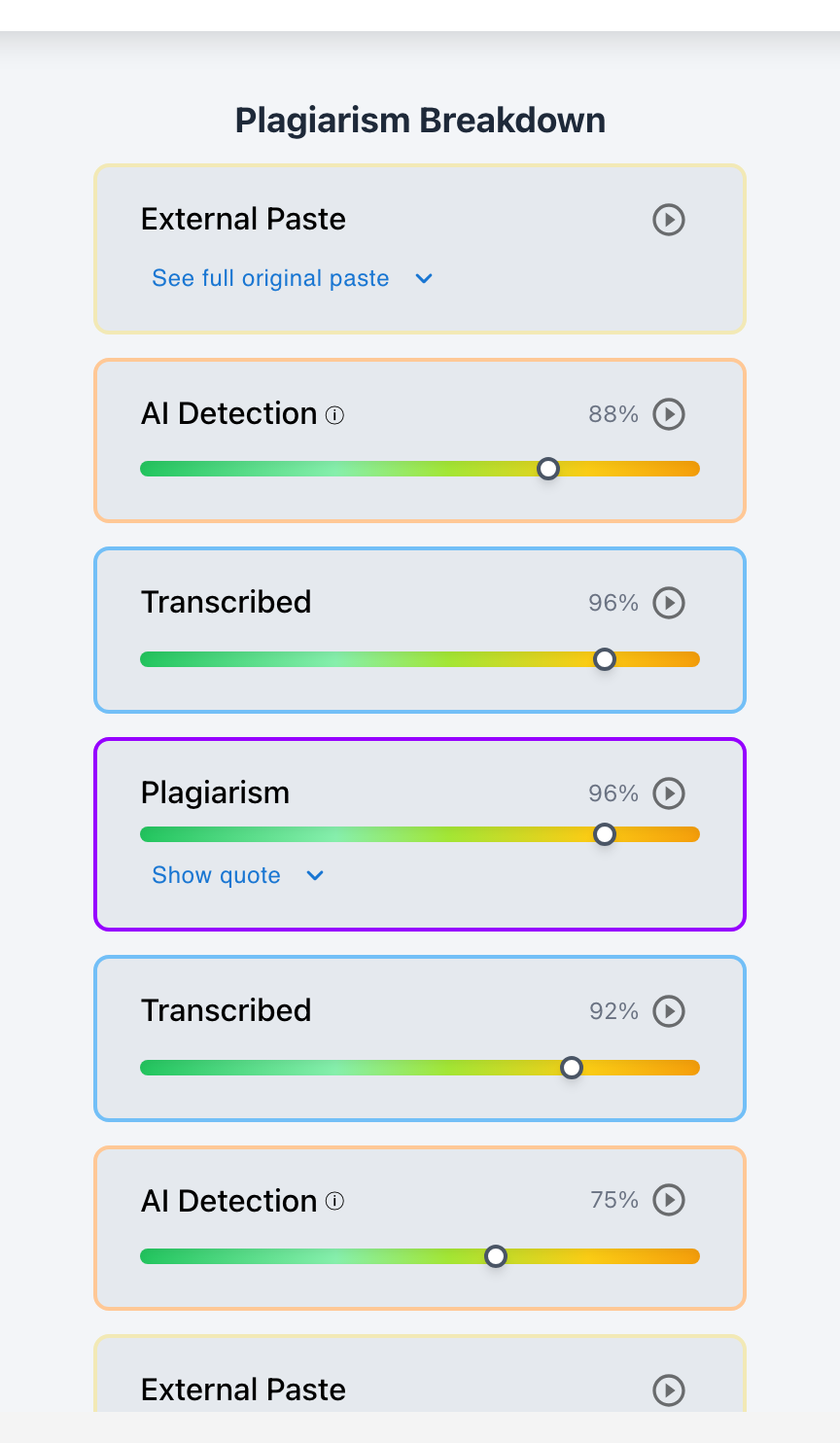
Checkmark Plagiarism identifies hallucinated sources by pairing plagiarism detection with AI detection, essay writing playback, autograding, and integrations with Canvas and Google Classroom.
The Technical Mechanics: Why AI Hallucinates Citations
1. Autoregressive Token Prediction
LLMs predict text one word at a time based on mathematical probability. When prompted for citations, the AI generates characters that resemble bibliography syntax without verifying facts.
2. Associative Memory Blending
The model recognizes that scholar Dr. Smith often writes about cognitive psychology in the Journal of Memory, and blends these concepts into a fabricated article title.
3. Synthetic DOI String Generation
The AI generates the prefix 10.1016/ (a common Elsevier identifier) followed by random numbers that match standard DOI formatting but have never been registered.
4. Failure of Negative Constraints
Even when students prompt "only use real, verifiable sources," the model's core architecture still generates plausible probabilistic hallucinations rather than searching real databases.
The 4 Telltale Signs of ChatGPT-Invented Sources
Teachers can quickly identify hallucinated citations by looking for four structural anomalies:
- Unresolvable DOIs: Clicking the cited DOI on doi.org returns an immediate "DOI Not Found" 404 error.
- Zero Google Scholar Matches: Searching the exact article title in quotation marks on Google Scholar yields 0 search results.
- Phantom Volume/Page Numbers: The citation references a journal volume from 2021 that was never published, or lists page numbers far beyond the issue's actual length.
- Mismatched Scholarly Topics: A real, famous economist is cited as the author of an article on cellular biology or marine conservation.
Read more in how Checkmark writing process analysis works.
Comparison: Real Academic Research vs. ChatGPT Source Fabrication
Real Academic Research (Human Scholarship)
- Citations resolve to peer-reviewed publisher pages.
- Student can produce full-text PDFs upon request.
- Quotes exist on the exact page numbers cited.
- Playback shows research reading pauses and active drafting.
ChatGPT Source Fabrication (Synthetic Hallucination)
- DOIs return 404 errors; titles return 0 Scholar hits.
- Student cannot produce the source or explain it.
- Quotes are synthetic fabrications that never existed.
- Playback shows instant wholesale text insertion.
A 5-Step Educator Protocol for Investigating Invented Sources
Invented Source Investigation Checklist:
- 1. Open the student's submission in Checkmark Plagiarism inside Canvas SpeedGrader.
- 2. Review the automated Citation Verification tab: check for unresolvable DOIs and flagged titles.
- 3. Search the suspicious article title in quotation marks on Google Scholar and Crossref.
- 4. Cross-reference with the Writing Playback timeline to verify drafting duration and paste logs.
- 5. Hold a 2-minute oral check-in: ask the student to provide the PDF of the flagged article.
How Checkmark Plagiarism Powers Automated Source Validation
Checkmark Plagiarism combines **AI detection, essay writing playback, static AI detection, plagiarism detection, autograding, and Canvas/Google Classroom integrations** to automatically query academic databases and flag fabricated citations in seconds.
Frequently Asked Questions
Why does ChatGPT make up fake sources instead of using real ones?
Because ChatGPT generates text by predicting likely word sequences rather than retrieving documents from an active database, resulting in plausible-looking fabrications.
Can ChatGPT cite real sources accurately?
While newer versions connected to web search can sometimes find real articles, standard models frequently hallucinate authors, volume numbers, and page references.
What is a 'Frankenstein citation'?
It is an AI hallucination that combines a real author's name with a fabricated article title and a real journal name, creating a convincing illusion of scholarship.
How does Checkmark detect invented sources?
Checkmark automatically verifies DOIs, ISBNs, and titles against Crossref, Google Scholar, PubMed, and OpenAlex upon assignment submission.
What if a student made an honest formatting typo in a citation?
An honest typo (like a misspelled journal name) will still return real search results for the title and author, whereas an AI hallucination returns zero results everywhere.
How does Checkmark Plagiarism integrate with Canvas LMS?
Checkmark provides certified LTI 1.3 integration, SpeedGrader sidebar embeds, two-way grade passback, and single sign-on (SSO).
What should a teacher do when fake sources are proven?
Present the failed database search to the student during a conference as objective proof of AI generation, applying institutional integrity policies.
Can students fake academic database verification?
No. Academic registries like Crossref and PubMed are centralized, immutable databases that cannot be faked.
Does writing playback show citation assembly?
Yes. Playback reveals whether citations were researched and formatted over time or appeared instantaneously in a single paste event.
Why are fake citations definitive evidence of AI use?
Because humans cannot accidentally invent a non-existent academic study with a fabricated DOI—it is a unique technological artifact of generative AI.
Empirical Certainty in Academic Research
Scholarly research requires engaging with real human knowledge. By automating citation validation and keystroke playback with Checkmark Plagiarism, educators ensure that student research papers are held to the highest standards of truth, accuracy, and academic integrity.
Checkmark Plagiarism supports this comprehensive approach with AI detection, essay writing playback, static AI detection, plagiarism detection, autograding, and integrations with Canvas and Google Classroom.
See how Checkmark pairs automated citation validation with multi-signal detection to catch invented AI sources. View a sample report or request a demonstration.