
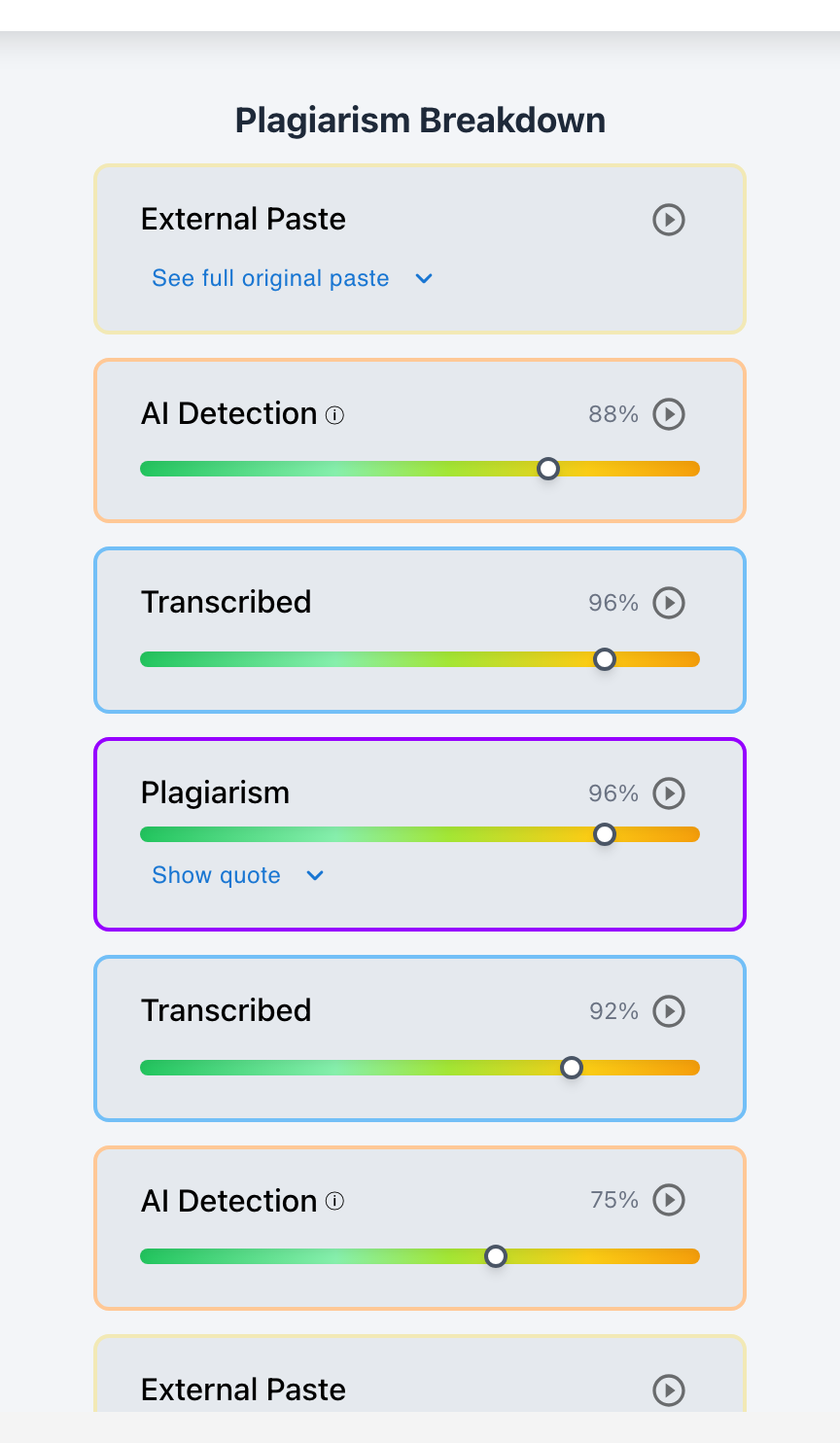
Yes. An essay can easily be partially AI-generated—and in fact, hybrid writing (where 20% to 60% of an essay is written by AI while the rest is human) is the most common pattern in modern classrooms. Students frequently combine human research notes with AI-generated body paragraphs, use ChatGPT for introductions and conclusions, or prompt AI to expand rough outlines into full prose.
The misconception that an essay must be either "100% human" or "100% AI" creates massive confusion for teachers using older, single-percentage detectors. In reality, modern students treat generative AI like a collaborative partner: writing the parts they enjoy or find easy, and outsourcing the difficult transitions, counterarguments, or synthesis to machine models. Checkmark Plagiarism is purpose-built for hybrid authorship forensics, using sentence-level neural classification and keystroke writing playback to calculate exact human-versus-AI percentage breakdowns.
Below is a comprehensive guide on the mechanics, detection, and evaluation of partially AI-generated essays.
Checkmark Plagiarism evaluates hybrid writing by pairing AI detection with essay writing playback, plagiarism detection, autograding, and integrations with Canvas and Google Classroom.
The 4 Common Patterns of Partially AI-Generated Essays
1. The "Bookend" AI Pattern
The student writes all the body paragraphs with original research, but prompts ChatGPT to generate the introduction hook and the concluding summary.
2. The Outline Expansion Pattern
The student drafts a 150-word bullet-point outline, and asks AI to "expand these notes into a 1,000-word formal essay with academic vocabulary."
3. The Difficult Section Shortcut
The student writes paragraphs 1, 2, and 4, but prompts AI to write paragraph 3 (the complex historical counterargument or statistical analysis).
4. The AI Polish & Restructure Pattern
The student types a rough draft and asks ChatGPT to rewrite every sentence for clarity, resulting in a hybrid document with human ideas but synthetic syntax.
How Multi-Signal Classifiers Measure Partial AI Content
Understanding how Checkmark calculates exact hybrid percentages:
- Sentence-by-Sentence Perplexity: Checkmark evaluates each individual sentence's statistical probability, tagging it as "Human," "AI-Generated," or "AI-Edited."
- Keystroke Telemetry Segmentation: Playback records active typing sessions, distinguishing between the multi-hour typing of human sections and the instant paste of AI sections.
- Proportional Percentage Score: SpeedGrader displays a clear breakdown (e.g., "68% Human / 32% AI Content Detected") rather than a confusing binary label.
Read more in how Checkmark writing process analysis works.
Comparison: 100% AI vs. Hybrid AI vs. 100% Human Essay
100% Human Writing
Drafted across 3+ hours; high sentence length variance; 20%+ backspaces; student explains all claims fluently.
Hybrid / Partial AI (30–60%)
Human core with isolated AI paste blocks; sentence heatmap lights up specific paragraphs; mixed drafting telemetry.
100% AI Generated
<10 mins drafting time; zero backspaces; uniform 22-word syntax throughout; hallucinated citations.
A 5-Step Educator Protocol for Evaluating Hybrid Essays
Hybrid Essay Evaluation Checklist:
- 1. Open the student's submission in Checkmark Plagiarism inside Canvas SpeedGrader.
- 2. Review the Authorship Breakdown Meter: note the exact percentage of human vs. AI content.
- 3. Inspect the Sentence Heatmap: identify which specific paragraphs were machine-generated.
- 4. Cross-examine with Writing Playback to verify when the AI blocks were pasted into the document.
- 5. Apply course policy: score human sections on merit while requiring a rewrite of AI sections.
How Checkmark Plagiarism Powers Hybrid Authorship Forensics
Checkmark Plagiarism combines **AI detection, essay writing playback, static AI detection, plagiarism detection, autograding, and Canvas/Google Classroom integrations** to give educators complete visibility into hybrid human-AI compositions.
Frequently Asked Questions
Can an essay have a 30% AI score?
Yes. A 30% AI score typically indicates that approximately one-third of the sentences or paragraphs were generated or rewritten by an AI model.
How does Checkmark calculate partial AI percentages?
Checkmark calculates the exact word count of sentences flagged as AI-generated divided by the total word count of the submission.
What is the most common form of partial AI use?
The "Bookend Pattern" (using AI for introductions and conclusions) and using AI to rewrite difficult counterargument paragraphs are the most common.
How does writing playback support partial AI detection?
Playback visually demonstrates the contrast between the hours spent typing human paragraphs and the 0.05-second paste of AI paragraphs.
How does Checkmark Plagiarism integrate with Canvas LMS?
Checkmark provides certified LTI 1.3 integration, SpeedGrader sidebar embeds, two-way grade passback, and single sign-on (SSO).
Can students fool detectors by editing AI sentences slightly?
No. Sentence-level neural classifiers analyze underlying token distributions, catching AI text even when students change isolated words.
What should a teacher do if a student submits a hybrid paper?
Hold a conference to discuss the human vs. AI breakdown, grade the authentic work, and require an independent revision of the AI sections.
How can teachers design rubrics for hybrid writing?
Clearly state the allowable percentage of AI assistance (e.g., "AI allowed for brainstorming only; 0% AI text in final submission").
Does Autograder provide feedback on both human and AI sections?
Yes. Checkmark Autograder evaluates human arguments on merit while generating specific feedback flags on machine-generated paragraphs.
Why is partial AI detection superior to binary pass/fail labels?
Because real classroom writing is nuanced, and granular data ensures that students receive fair, proportional assessment rather than arbitrary penalties.
Clarity and Nuance in the Age of Hybrid Writing
The modern writing process is evolving rapidly. By providing sentence-level heatmaps and keystroke playback telemetry, Checkmark Plagiarism equips educators with the nuanced tools needed to evaluate hybrid writing with absolute fairness, accuracy, and pedagogical integrity.
Checkmark Plagiarism supports this comprehensive approach with AI detection, essay writing playback, static AI detection, plagiarism detection, autograding, and integrations with Canvas and Google Classroom.
See how Checkmark pairs sentence-level heatmaps with writing playback to evaluate hybrid human-AI essays. View a sample report or request a demonstration.