
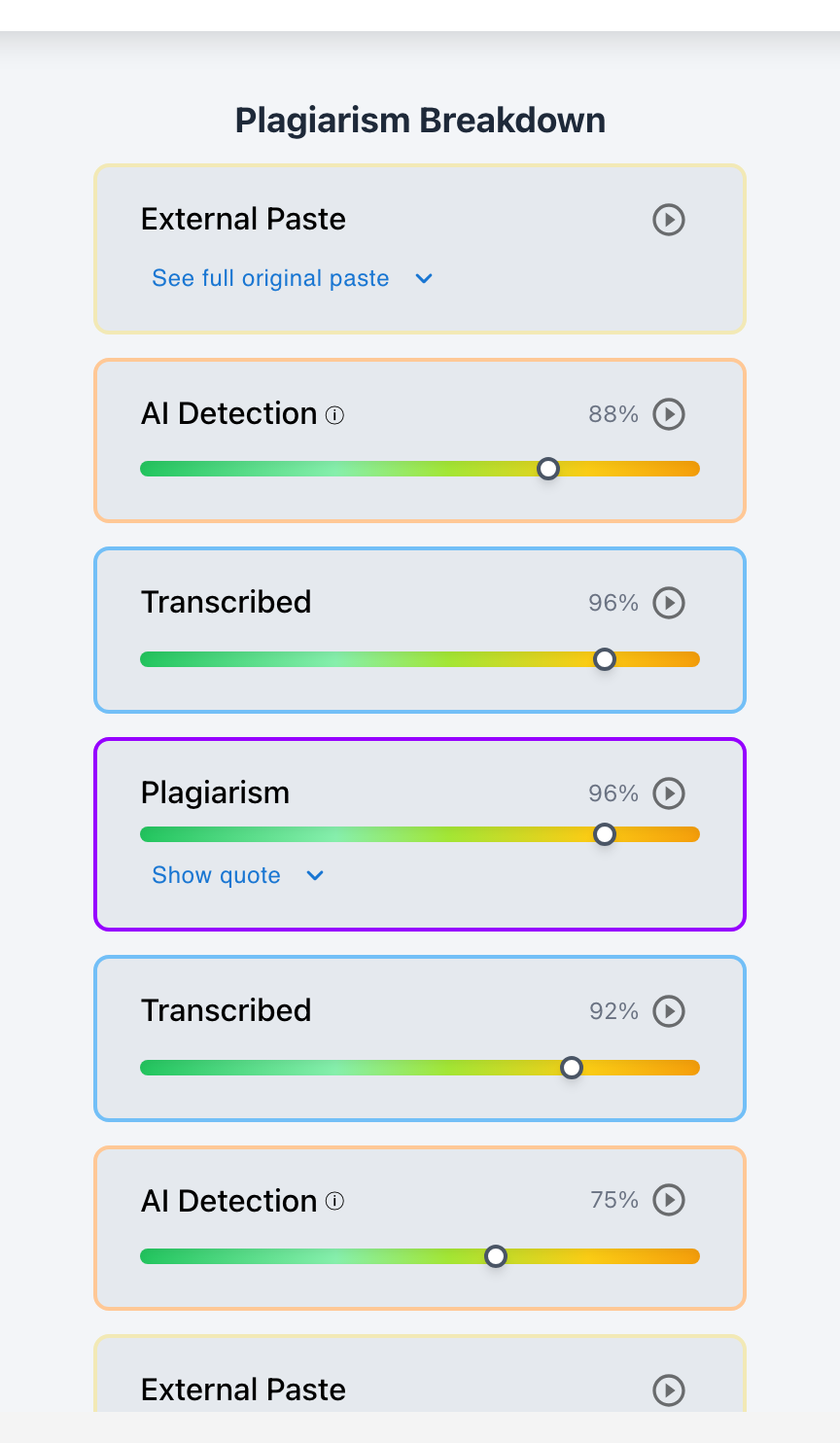
Yes, AI paraphrasing tools can reduce similarity scores on basic exact-match plagiarism checkers—but they fail completely against modern multi-signal detection systems.
Many students turn to automated paraphrasing tools like QuillBot, SpinBot, or so-called "AI humanizers" to rewrite copied web content or ChatGPT outputs. These tools swap out words for synonyms, flip active voice to passive, and rearrange clauses specifically designed to break up the 8–10 word matching sequences that legacy plagiarism checkers look for.
While this technique can fool simple string-matching algorithms, it introduces severe linguistic anomalies, preserves underlying hallucinated citations, and leaves unmistakable wholesale paste footprints in essay writing playback.
Checkmark Plagiarism exposes AI paraphrasing tricks by pairing plagiarism detection with AI detection, essay writing playback, static AI detection, autograding, and integrations with Canvas and Google Classroom.
How AI Paraphrasers Attempt to Beat Plagiarism Checkers
1. Synonym Substitution (Spinning)
Replacing key nouns and verbs with thesaurus alternatives to disrupt continuous string matches across databases.
2. Clause Reordering
Inverting introductory clauses and rearranging sentence order while keeping the underlying conceptual argument identical.
On legacy checkers that only search for verbatim text strings, this word manipulation lowers the calculated similarity percentage. However, the resulting text is frequently awkward, unnatural, and completely transparent upon closer inspection.
Why AI Paraphrasing Fails Against Multi-Signal Verification
1. Essay Writing Playback Exposes External Pastes
No matter how thoroughly an AI paraphraser spins text, it cannot manufacture the keystroke timeline of authentic drafting. When educators review Checkmark Plagiarism's essay writing playback:
- Wholesale Paste Events: The entire spun text appears in the document in one instant paste block at 11:15 PM.
- Zero Drafting Duration: Playback records only 6 minutes of total active document time for a 1,500-word essay.
- Absence of Genuine Revisions: No natural typing cadences, backspacing, or sentence restructuring.
Read more in how Checkmark writing process analysis works.
2. The "Thesaurus Syndrome" (Incongruous Phrasing)
Automated paraphrasers frequently swap terms with bizarre, context-deaf synonyms (e.g., converting "greenhouse effect" to "glasshouse outcome" or "Cold War" to "Chilly Conflict"). These absurd phrasings instantly alert instructors to automated spinning.
3. Preserving Hallucinated Citations
Spinning the prose of an essay does not fix non-existent journal titles, fake author names, or broken DOIs generated by AI. Auditing the bibliography in academic databases (JSTOR, Google Scholar) provides undeniable physical proof of generative AI involvement. Read more in can ChatGPT cite sources that don't exist?
Comparison: Legacy Plagiarism Checker vs. Multi-Signal Playback
Legacy Plagiarism Checker Alone
- Fooled by synonym swaps and clause inversions.
- Reports a misleadingly low similarity score.
- Blind to external copy-paste timestamps.
Checkmark Multi-Signal System
- Detects mosaic and patchwriting patterns.
- Records visual essay writing playback of paste events.
- Audits citations for non-existent sources.
A 5-Step Protocol to Detect AI Paraphrased Text
Educator Protocol to Identify AI-Spun Submissions:
- 1. Inspect essay writing playback logs for wholesale paste events and active typing duration.
- 2. Look for unnatural, context-deaf synonym substitutions characteristic of spinning tools.
- 3. Audit cited sources in academic databases (JSTOR, Google Scholar) to detect hallucinations.
- 4. Compare the submission against historical in-class student writing baselines.
- 5. Hold a brief student conference asking the student to define unusual vocabulary orally.
How Checkmark Plagiarism Eliminates Paraphraser Loopholes
Checkmark Plagiarism combines **AI detection, essay writing playback, static AI detection, plagiarism detection, autograding, and Canvas/Google Classroom integrations** to give educators full visibility into spun text, paste events, and citation authenticity.
Frequently Asked Questions
Can QuillBot bypass plagiarism checkers like Turnitin?
QuillBot can lower similarity scores on legacy text-matching tools by swapping words, but modern AI detection modules and writing playback logs easily uncover the spun content.
Is using QuillBot considered plagiarism?
Yes. Taking text from an external source and running it through an automated spinner to submit without proper attribution is patchwriting and plagiarism.
What does AI-paraphrased writing look like?
It often features awkward synonym choices, unnatural sentence structures, and an incongruous mix of simple and bizarre vocabulary layered over formulaic logic.
How does writing playback catch AI paraphrasing tools?
Students typically paraphrase text externally in a browser tab and paste the finished draft into the document in one instant event, which playback records with exact timestamps.
Can teachers tell if a student used an 'AI humanizer'?
Yes. "Humanizers" create strange grammatical inversions that stand out to educators, and writing playback confirms the lack of keystroke drafting.
What is 'patchwriting' in academic integrity?
Patchwriting occurs when a writer copies text from a source, replaces some words with synonyms, and presents it as their own writing without quotation or synthesis.
Can citation audits catch paraphrased AI papers?
Yes. Paraphrasing tools rewrite sentences but cannot fix non-existent journal titles, fake authors, or dead DOIs invented by generative AI.
How does an oral conference expose AI paraphrasing?
Students who used spinning tools cannot explain the bizarre vocabulary or summarize the underlying logic during a brief conversation.
What should a teacher do if they suspect an essay was spun by AI?
Check writing playback logs, audit bibliography citations, and invite the student to discuss their drafting choices in a supportive conference.
How does Checkmark Plagiarism handle AI paraphrased submissions?
Checkmark Plagiarism captures visual drafting playback, highlights paste events, validates citations, and integrates seamlessly with Canvas and Google Classroom.
Process Visibility Exposes Automated Rewriting
AI paraphrasing tools can swap individual words, but they cannot fake authentic human drafting, genuine research, or multi-hour writing timelines. By inspecting document creation playback and citation validity, educators see right through automated spinning tricks.
Checkmark Plagiarism supports this comprehensive approach with AI detection, essay writing playback, static AI detection, plagiarism detection, autograding, and integrations with Canvas and Google Classroom.
See how Checkmark pairs essay writing playback with multi-signal detection to expose AI-spun text and verify authentic drafting. View a sample report or request a demonstration.