
Yes. AI can grade essays without replacing the teacher by operating under a strict "Teacher-in-the-Loop" (TITL) architecture. In this paradigm, platforms like Checkmark Autograder act as an expert teaching assistant: pre-evaluating student drafts against the teacher's exact rubric, highlighting quoted textual evidence for each score, and drafting personalized feedback comments. The teacher retains 100% decision-making authority—reviewing, editing, and approving all scores before students ever see them.
The prospect of AI grading often provokes justifiable anxiety among educators: "Will automated algorithms replace the nuanced human understanding of student growth? Will grading become an impersonal, robotic black box?" In reality, automated grading is not about replacing educators—it is about liberating them from the exhausting, repetitive mechanical labor of preliminary rubric scoring. By handling first-pass evaluations and line-by-line evidence mapping, AI grading co-pilots empower teachers to spend their energy on genuine mentorship, creative instruction, and high-impact student relationships.
Below is a comprehensive guide on how the Teacher-in-the-Loop grading model preserves educator authority while transforming productivity.
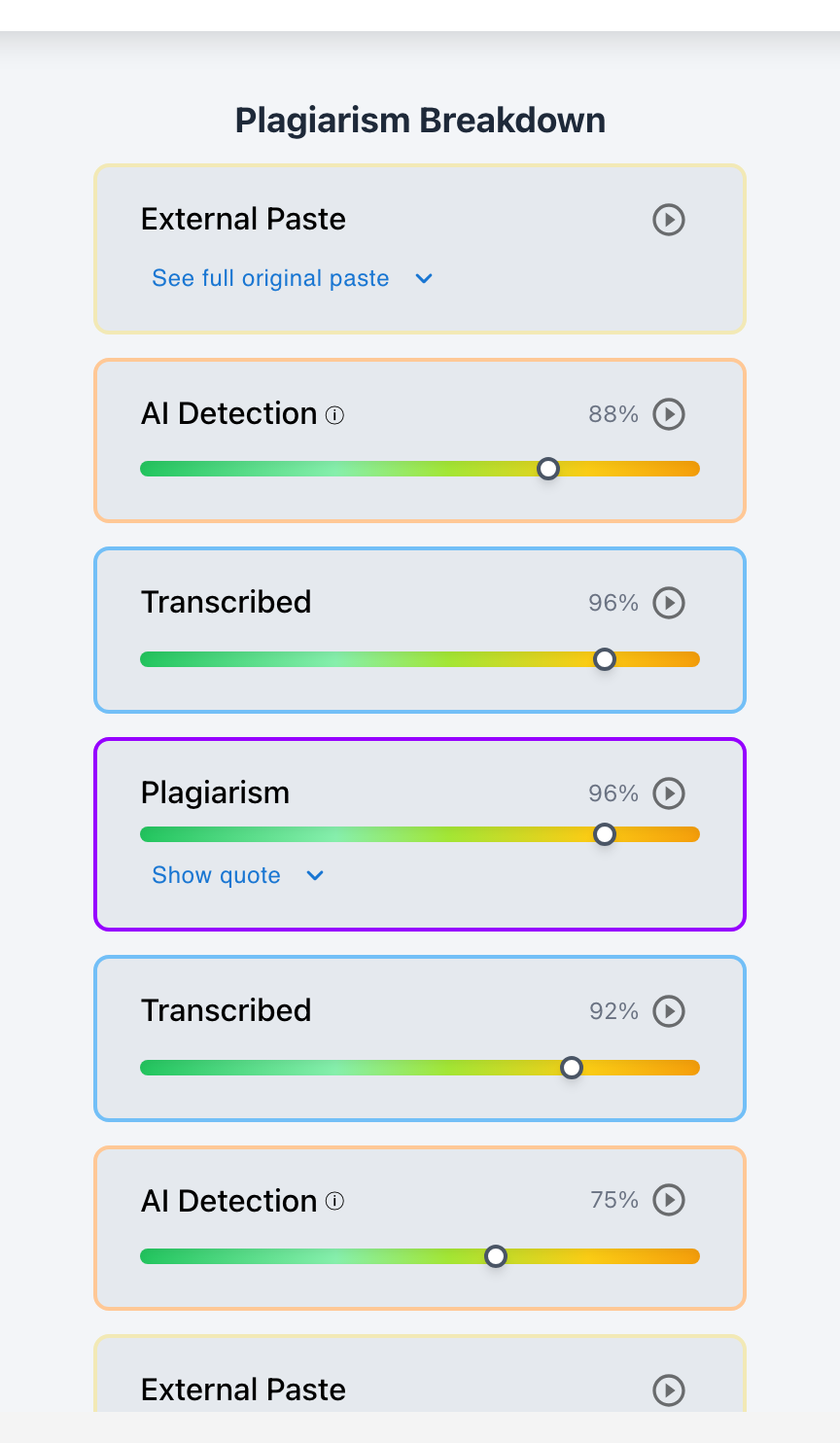
Checkmark Plagiarism powers Teacher-in-the-Loop grading by pairing autograding with essay writing playback, AI detection, plagiarism detection, and integrations with Canvas and Google Classroom.
The 4 Principles of Teacher-in-the-Loop AI Grading
1. Absolute Human Approval Authority
No automated score, rubric rating, or feedback comment is ever finalized or released to a student without explicit teacher review and approval.
2. Evidence-Anchored Rubric Alignment
Autograder never outputs arbitrary scores; every rating is justified by quoting specific student sentences and mapping them directly to rubric criteria.
3. Instant One-Click Educator Overrides
Teachers can adjust any criterion score, tweak drafted comments, or add personal notes in Canvas SpeedGrader with a single click.
4. Elevating Teacher Mentorship
Freeing teachers from 30+ hours of repetitive mechanical grading allows them to focus on 1-on-1 coaching, conferences, and student connection.
How the AI Grading Co-Pilot Workflow Operates
Understanding the collaborative relationship between educator and AI:
- Phase 1: Automated Ingestion & Analysis: As essays are turned in, Checkmark Autograder analyzes thesis strength, evidence integration, organization, and voice against your custom rubric.
- Phase 2: Pre-Drafted SpeedGrader Sidebar: When you open Canvas SpeedGrader, each rubric criterion has a recommended score, accompanied by highlighted student quotes and drafted feedback.
- Phase 3: Rapid Human Review: You review the highlighted evidence, adjust any nuanced points, add a personal encouraging message, and click "Submit Grade."
Read more in how Checkmark writing process analysis works.
Comparison: Autonomous AI Grading vs. Checkmark Teacher-in-the-Loop Co-Pilot
Checkmark Teacher-in-the-Loop Co-Pilot (Empowering & Ethical)
- Teacher reviews and approves every grade before release.
- Feedback quotes exact student sentences as evidence.
- One-click score overrides in Canvas SpeedGrader.
- Maintains the teacher-student relationship and trust.
Autonomous AI Grading (Black-Box & Impersonal)
- Releases grades directly to students without review.
- Generic feedback without quoted textual justification.
- Removes teacher oversight and pedagogical discretion.
- Creates student alienation and trust erosion.
A 5-Step Educator Protocol for Co-Pilot Grading
Teacher-in-the-Loop Grading Checklist:
- 1. Open the student's submission in Canvas SpeedGrader with Checkmark Autograder enabled.
- 2. Review the pre-populated rubric scores in the sidebar.
- 3. Click each criterion to inspect the highlighted student sentences that justify the suggested rating.
- 4. Adjust scores or edit drafted feedback comments to reflect the student's unique growth arc.
- 5. Approve and submit the finalized grade to Canvas gradebook.
How Checkmark Plagiarism Powers Co-Pilot Grading
Checkmark Plagiarism combines **AI detection, essay writing playback, static AI detection, plagiarism detection, autograding, and Canvas/Google Classroom integrations** to serve as the ultimate educator co-pilot, enhancing grading quality while preserving human oversight.
Frequently Asked Questions
Does Checkmark ever post grades without teacher permission?
No. Checkmark Autograder strictly requires teacher review and manual confirmation before any scores or feedback sync to the student LMS portal.
Can teachers customize the feedback tone?
Yes. Educators can configure feedback settings for encouraging, rigorous, Socratic, or technical tones tailored to their classroom culture.
How does AI grading handle creative or unconventional writing?
Autograder evaluates analytical structure against rubric parameters, while the teacher reviews creative flair and unique voice during human inspection.
Can teachers edit the suggested feedback comments?
Yes. All feedback comments are fully editable text fields in SpeedGrader; teachers can add, delete, or rewrite comments in seconds.
How does Checkmark Plagiarism integrate with Canvas LMS?
Checkmark integrates seamlessly via LTI 1.3, embedding pre-scored rubrics, writing playback, and integrity checks directly into Canvas SpeedGrader.
How much time does Teacher-in-the-Loop grading save?
Educators report saving 70% to 80% of total grading time, reducing a 30-hour essay grading stack to under 6 hours of high-impact review.
Can students tell that an AI co-pilot assisted the teacher?
Students receive personalized, rubric-aligned feedback quoting their exact words, signed off and refined by their teacher.
What happens if the AI misinterprets a complex argument?
The teacher simply clicks to adjust the score and refine the comment, ensuring that nuanced human reasoning always governs grading.
Does Autograder support custom state and AP rubrics?
Yes. Checkmark imports custom rubrics, AP Literature/Language 6-point analytical scales, and standard district rubrics flawlessly.
Why is Teacher-in-the-Loop the only ethical model for AI grading?
Because education is fundamentally relational: AI provides computational speed, but human teachers provide wisdom, empathy, and pedagogical mentorship.
Amplifying the Power of the Human Teacher
Technology should never diminish the essential role of the educator. By embracing Teacher-in-the-Loop AI grading with Checkmark Plagiarism, educators eliminate grading exhaustion, deliver richer feedback faster, and amplify their vital impact as mentors and guides.
Checkmark Plagiarism supports this comprehensive approach with AI detection, essay writing playback, static AI detection, plagiarism detection, autograding, and integrations with Canvas and Google Classroom.
See how Checkmark Autograder serves as a Teacher-in-the-Loop grading co-pilot in Canvas SpeedGrader. View a sample report or request a demonstration.