
Yes. Advanced autograding platforms like Checkmark Autograder are specifically engineered to follow custom, teacher-created rubrics with exact fidelity. Rather than applying generic scoring formulas, Checkmark ingests your specific rubric criteria, point distributions, performance level descriptors (e.g., Exemplary, Proficient, Developing), and assignment prompts directly from Canvas or Google Classroom, evaluating every student essay strictly against your bespoke pedagogical standards.
Every classroom is unique: an 8th-grade English teacher grading a persuasive speech outline has completely different expectations than an AP Literature teacher scoring a Prose Fiction Analysis essay or a college professor evaluating a sociology literature review. Generic AI tools that assign an arbitrary "B+" or "85/100" without understanding the assignment's explicit rubric are useless in real educational settings. Rubric-anchored AI autograding guarantees that automated evaluations mirror your exact instructional goals, point weightings, and curricular standards.
Below is a comprehensive guide on how AI interprets, parses, and adheres to custom teacher-created rubrics.
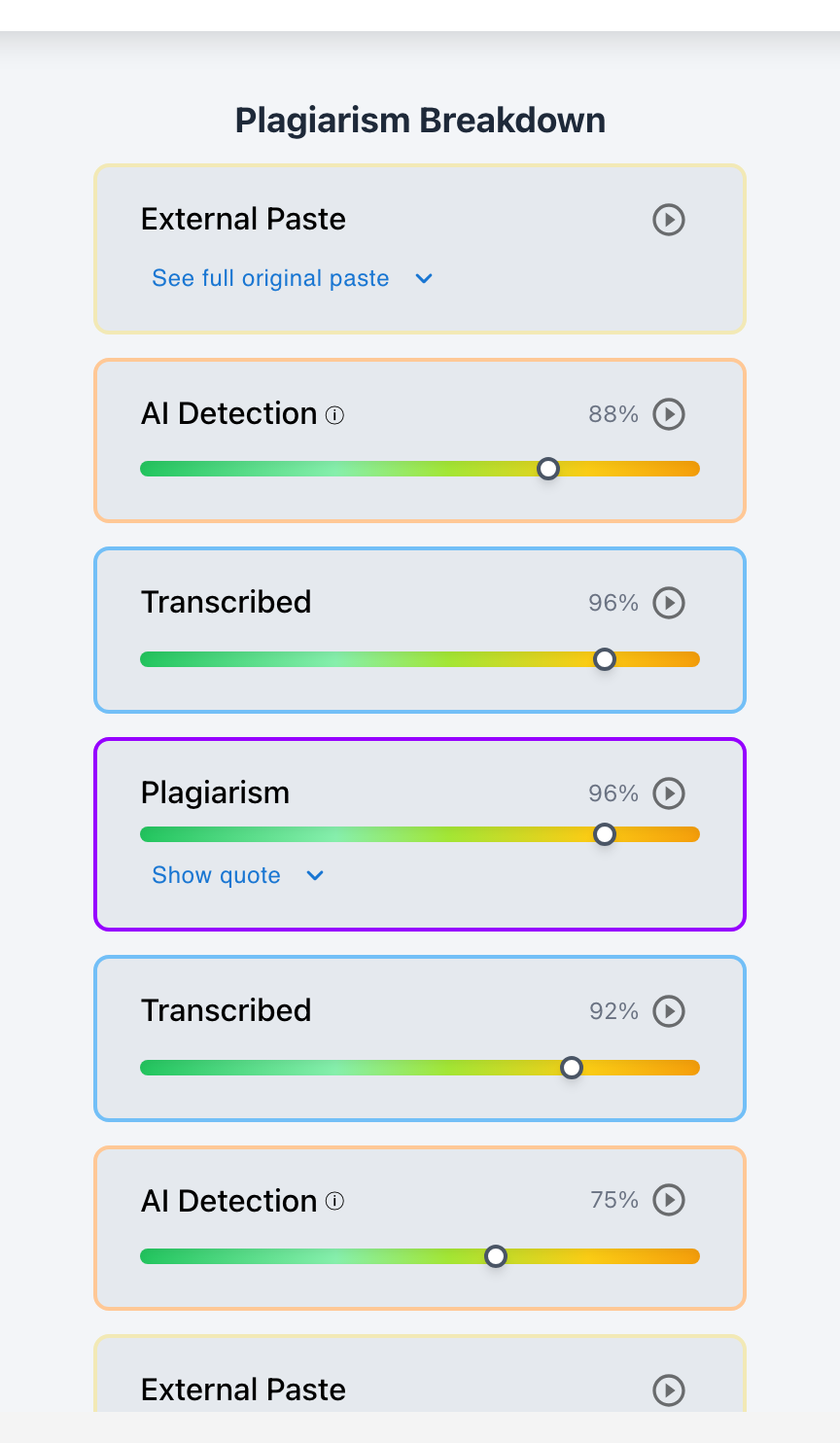
Checkmark Plagiarism follows custom teacher rubrics by pairing autograding with essay writing playback, AI detection, plagiarism detection, and integrations with Canvas and Google Classroom.
The 4 Steps of Custom Rubric Ingestion and Execution
1. Direct LMS Rubric Import
Checkmark automatically imports your existing Canvas or Google Classroom rubrics with one click—preserving all criteria names, descriptions, and point scales.
2. Multi-Criteria Decomposition
Autograder evaluates each criterion independently (e.g., Thesis: 10 pts, Evidence: 15 pts, Organization: 10 pts, Mechanics: 5 pts) without bleeding scores across categories.
3. Performance Descriptor Matching
The AI reads your exact text descriptors (e.g., "Demonstrates sophisticated synthesis of 3+ sources") and maps student evidence directly to that descriptor level.
4. Assignment Constraint Integration
Autograder factors in specific assignment rules: required text excerpts, counter-argument mandates, or minimum primary source citation counts.
How Autograder Adheres to Non-Traditional Rubrics
Understanding how AI adapts to diverse pedagogical frameworks:
- AP 6-Point Analytical Scales: Autograder natively supports the College Board AP English Literature and Language 6-point rubrics (Row A: Thesis 0–1 pt, Row B: Evidence & Commentary 0–4 pts, Row C: Sophistication 0–1 pt).
- Standards-Based Grading: For standards-based mastery models (e.g., 4-3-2-1 scales with no letter grades), Autograder provides mastery level recommendations tied to state ELA standards.
- Holistic vs. Analytic Rubrics: Whether you use a single comprehensive holistic scale or a detailed 8-criterion analytical grid, Checkmark adapts seamlessly.
Read more in how Checkmark writing process analysis works.
Comparison: Generic AI Chatbot Grading vs. Checkmark Rubric Autograding
Checkmark Rubric Autograding (Pedagogically Aligned)
- Follows your exact Canvas rubric criteria and point weights.
- Feedback quotes student sentences matching rubric descriptors.
- Evaluates specific assignment constraints and prompt requirements.
- Pre-populates the official Canvas SpeedGrader rubric cells.
Generic AI Chatbot Grading (Arbitrary & Unaligned)
- Outputs generic letter grades based on unknown internal standards.
- Vague feedback that does not match assignment expectations.
- Ignores teacher point allocations and specific criteria.
- Requires tedious manual copy-pasting into chat prompts.
A 5-Step Educator Protocol for Rubric-Aligned AI Grading
Custom Rubric AI Grading Checklist:
- 1. Attach your custom rubric to the assignment in Canvas or Google Classroom.
- 2. Enable Checkmark Autograder: confirm that all criteria and point values imported correctly.
- 3. Add any specific assignment instructions or required source titles in the prompt box.
- 4. Open Canvas SpeedGrader: observe pre-scored rubric criteria and evidence quotes.
- 5. Adjust any scores as needed and click "Submit" to finalize the grade in the LMS gradebook.
How Checkmark Plagiarism Powers Rubric Fidelity
Checkmark Plagiarism combines **AI detection, essay writing playback, static AI detection, plagiarism detection, autograding, and Canvas/Google Classroom integrations** to guarantee that every essay is evaluated strictly through the lens of your curriculum and rubric standards.
Frequently Asked Questions
Can I import rubrics directly from Canvas into Checkmark?
Yes. Checkmark syncs directly with Canvas LMS via LTI 1.3, importing existing Canvas rubrics with zero manual re-entry.
What if my rubric has 8 different criteria with uneven point values?
Checkmark handles complex rubrics with any number of criteria, custom weightings, and fractional point values effortlessly.
Can AI grade writing based on specific historical documents (DBQs)?
Yes. Autograder evaluates whether students correctly cited and analyzed the specific primary source documents required by the DBQ prompt.
How does Autograder explain its criterion scores to students?
Autograder connects the student's text to the specific descriptor on the rubric, quoting their sentences to explain why they earned that score.
How does Checkmark Plagiarism integrate with Google Classroom?
Checkmark imports Google Classroom rubric attachments, populating criterion scores and comments directly in the grading interface.
Can teachers save and reuse rubrics across multiple courses?
Yes. Checkmark maintains a private Rubric Library where teachers can save, share, and reuse vetted rubrics across academic terms.
What happens if a student writes an essay that doesn't answer the prompt?
Autograder flags prompt misalignment on the Task Response criterion, warning the teacher that the essay drifted from the core question.
Does Autograder support state standardized test rubrics (e.g., STAAR, Regents)?
Yes. Checkmark comes pre-loaded with official state testing rubrics and AP scoring guidelines.
Can teachers override individual criterion scores?
Yes. Teachers can override any individual rubric cell in SpeedGrader with a single click, instantly updating the total grade.
Why is strict rubric alignment essential for student growth?
Because clear alignment between instruction, rubrics, and feedback provides students with transparent pathways for mastering writing skills.
Bespoke Pedagogy Powered by Intelligent Technology
Automated evaluation should reflect your pedagogical voice, not replace it. By empowering Checkmark Autograder to follow your custom teacher-created rubrics with exact fidelity, educators deliver consistent, transparent, and transformative feedback across every assignment.
Checkmark Plagiarism supports this comprehensive approach with AI detection, essay writing playback, static AI detection, plagiarism detection, autograding, and integrations with Canvas and Google Classroom.
See how Checkmark Autograder follows custom teacher rubrics in Canvas SpeedGrader. View a sample report or request a demonstration.