
Yes. A student can commit severe academic plagiarism even when their overall similarity score is extremely low (under 5%)—because overall percentage scores dilute concentrated passage-level copying across long documents, while automated paraphrasers, idea theft, and cross-lingual translation easily evade basic string-matching algorithms.
One of the most dangerous myths in modern grading is the assumption that a low similarity percentage (such as 2% or 4%) automatically guarantees authentic student scholarship. In a 3,000-word term paper, a single 150-word paragraph copied verbatim from an uncredited medical journal accounts for only 5% of the total document word count. Yet that single paragraph may contain the entire thesis, empirical finding, or conclusion of the paper. Checkmark Plagiarism prioritizes passage-level clustering and semantic evidence over misleading global percentages.
Below is a comprehensive guide on why low similarity scores can hide severe plagiarism and how educators can detect it.
Checkmark Plagiarism exposes disguised plagiarism by pairing plagiarism detection with AI detection, essay writing playback, autograding, and integrations with Canvas and Google Classroom.
The 4 Ways Plagiarism Hides in Low-Percentage Scores
1. Lethal Passage Clustering
A 4% overall score sounds safe, but that 4% is concentrated in one single 120-word block where the student copied an author's unique thesis verbatim without quotation marks.
2. AI-Powered Synonym Paraphrasing
The student copied an article and ran it through QuillBot or an AI humanizer, swapping enough words to lower the string-match score while stealing the ideas.
3. Cross-Lingual & Translation Theft
The student found a scholarly article in Spanish, German, or Mandarin, translated it via Google Translate, and submitted it in English with a 0% English similarity score.
4. Uncredited Idea & Structural Borrowing
The student copied an author's unique 5-step analytical model and evidence sequence while rewording each individual sentence, evading exact string matches.
Why Global Percentages Are Pedagogically Flawed
Understanding why looking at total similarity percentage leads to grading errors:
- The "Dilution Effect": In long 10-page essays, large sections of copied text represent tiny numerical percentages (e.g., 200 copied words in a 4,000-word paper = 5%).
- The False Sense of Security: Students deliberately aim for "under 10%" by mixing copied text with original filler paragraphs to pass automated threshold filters.
- Passage-Level Forensics: Checkmark flags continuous matching clusters regardless of the global document percentage, alerting teachers to isolated blocks of copied text.
Read more in how Checkmark writing process analysis works.
Comparison: Misleading 4% Score vs. Passage-Level Integrity Analysis
Misleading Global Score (Single Number View)
- "Document similarity is 4% (Green / Passed)."
- Teacher glances at number and skips detailed review.
- Conceals a 150-word uncredited thesis copy.
- Rewards students who game automated filters.
Checkmark Passage-Level Forensics (Evidence View)
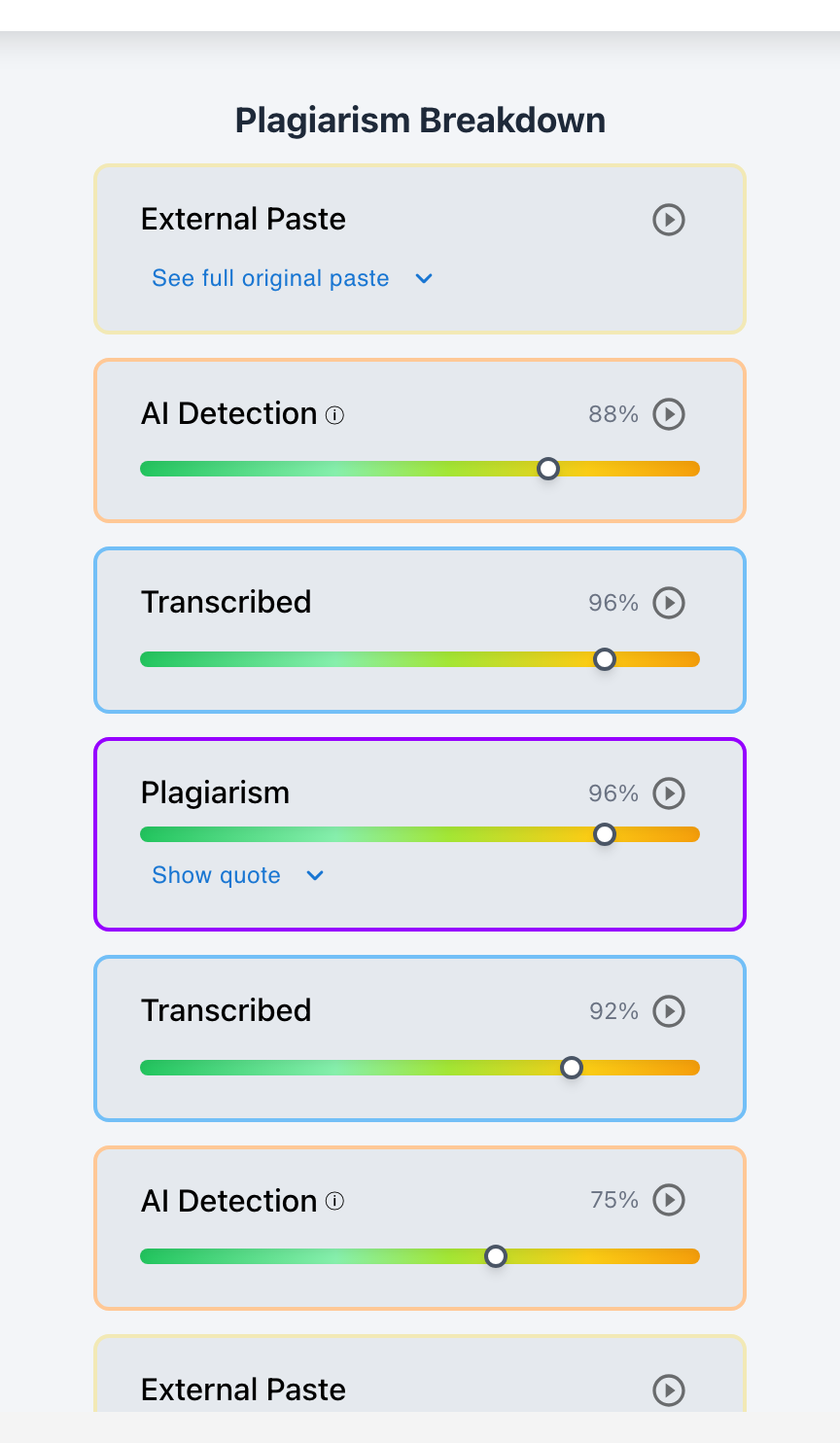
- Flags 1 concentrated cluster of 120 matching words.
- Displays side-by-side evidence card with original URL.
- Writing Playback reveals the 120 words entered via paste.
- Ensures uncompromising academic integrity standards.
A 5-Step Educator Protocol for Low-Score Audits
Low-Score Plagiarism Audit Checklist:
- 1. Open the student's submission in Checkmark Plagiarism inside Canvas SpeedGrader.
- 2. Ignore the global percentage number; look directly at the Passage Match Cluster list.
- 3. If any single cluster contains >40 continuous words from one source without quotation marks, click the card.
- 4. Inspect Writing Playback: check if the matched section was pasted in 0.05 seconds or typed with backspaces.
- 5. If uncredited copying is confirmed, require revision with proper quotation marks and attribution.
How Checkmark Plagiarism Powers Passage-Level Forensics
Checkmark Plagiarism combines **AI detection, essay writing playback, static AI detection, plagiarism detection, autograding, and Canvas/Google Classroom integrations** to evaluate concentrated passage-level clusters rather than relying on misleading global percentage averages.
Frequently Asked Questions
Can a 2% similarity score be considered plagiarism?
Yes. If that 2% is a single 80-word paragraph containing the central argument or finding copied word-for-word from an uncredited journal, it is blatant plagiarism.
What is 'passage-level clustering'?
It is an advanced detection method that measures the density and continuity of matching words in a single location, rather than averaging matches across the whole paper.
Why do students try to keep their score under 10%?
Because many schools set arbitrary "under 15% is passing" rules, encouraging students to mix copied text with original filler to beat the system.
How does Checkmark catch translated plagiarism?
Checkmark's Cross-Lingual Engine translates and indexes international publications, matching semantic conceptual frameworks across languages.
What if a low score is caused by common template phrases?
Checkmark filters out common assignment headings, bibliography citations, and boilerplate phrases, ensuring only substantive content is evaluated.
How does Checkmark Plagiarism integrate with Canvas LMS?
Checkmark provides certified LTI 1.3 integration, SpeedGrader sidebar embeds, two-way grade passback, and single sign-on (SSO).
Can writing playback show if text was copied even with a low score?
Yes. Playback logs the exact moment the text entered the document, highlighting the 0.05-second clipboard paste event regardless of the similarity percentage.
What is the 'dilution effect' in plagiarism detection?
It occurs when a long document reduces the mathematical percentage of a copied passage, making significant plagiarism appear numerically insignificant.
What should a teacher do when a low score contains a plagiarized block?
Use Checkmark's side-by-side evidence card during a student conference to show that individual uncredited passages violate honor codes regardless of total score.
Why is passage-level analysis superior to global similarity scores?
Because academic integrity is qualitative, not quantitative—a single uncredited passage compromises the integrity of the entire assignment.
Looking Beyond the Numbers to Protect Scholarly Integrity
Academic integrity cannot be reduced to a single percentage. By analyzing passage-level clusters, semantic structures, and writing playback telemetry with Checkmark Plagiarism, educators ensure that disguised plagiarism is accurately caught and evaluated with total fairness.
Checkmark Plagiarism supports this comprehensive approach with AI detection, essay writing playback, static AI detection, plagiarism detection, autograding, and integrations with Canvas and Google Classroom.
See how Checkmark pairs passage-level cluster analysis with multi-signal detection to evaluate low-score essays. View a sample report or request a demonstration.