
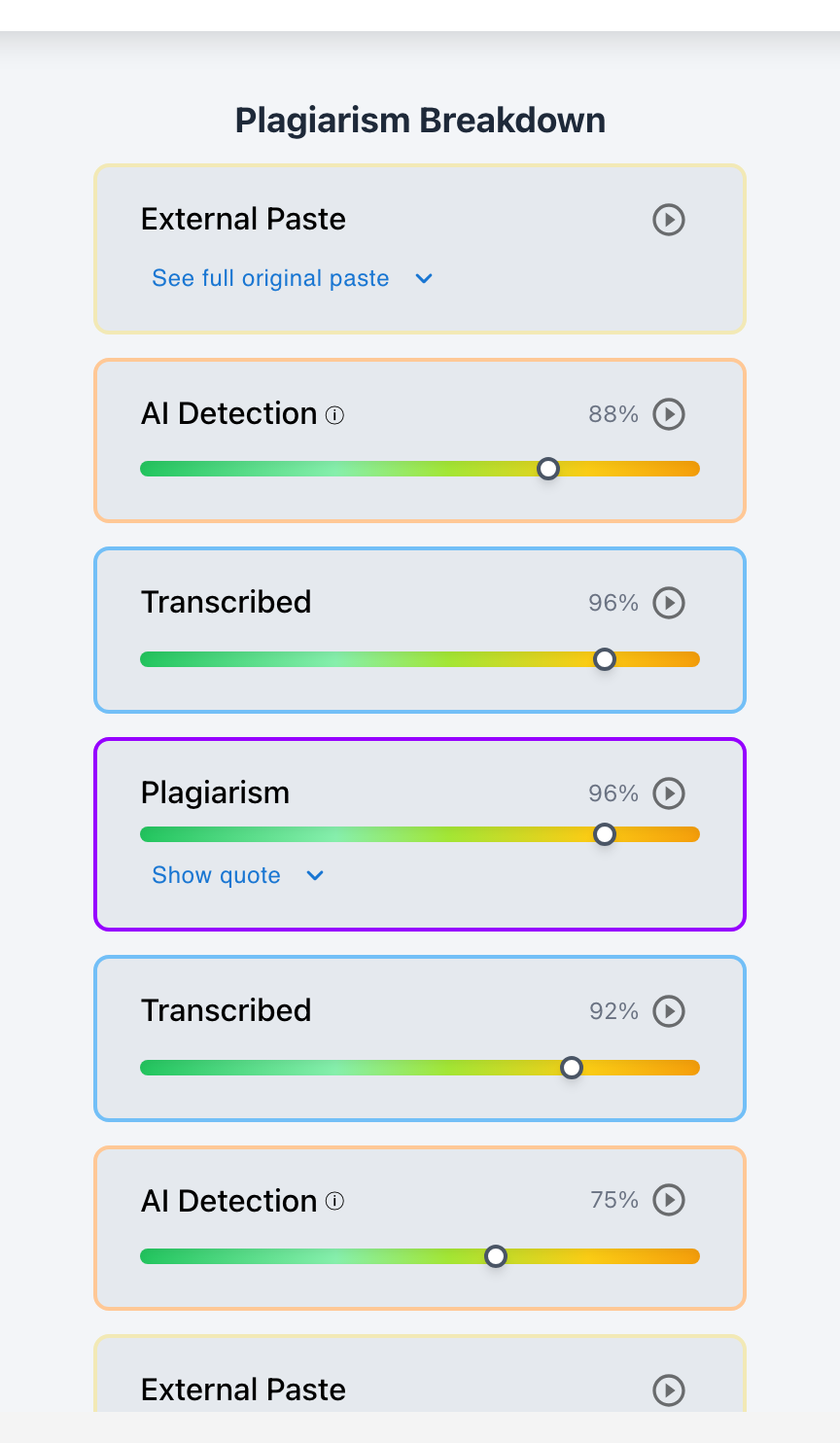
No. A student cannot avoid detection by deliberately copying AI text slowly over multiple hours. While stretching out typing artificially simulates authentic drafting duration, it fails to produce the natural 15% to 30% backspace rate of human self-editing, creates bizarre robotic "burst-and-idle" timing patterns, and leaves the underlying text 100% vulnerable to linguistic AI classifiers.
Some sophisticated students attempt to game writing telemetry by artificially slowing down their copying process: typing a sentence from ChatGPT, setting a 5-minute timer to watch YouTube, typing another sentence, and repeating this over 4 hours. Students assume that matching the 4-hour time benchmark of authentic writing makes the paper undetectable. In reality, simulating human composition requires replicating hundreds of micro-behaviors—and artificial slow-typing creates a distinct telemetry anomaly that Checkmark Plagiarism exposes effortlessly.
Below is a detailed analysis of why slow transcription fails and how multi-signal analysis uncovers simulated drafting.
Checkmark Plagiarism exposes simulated drafting by pairing essay writing playback with AI detection, plagiarism detection, autograding, and integrations with Canvas and Google Classroom.
The 4 Fatal Flaws of the "Slow Copying" Evasion Strategy
1. The Missing Revision Footprint (<2% Edits)
Typing slowly does not generate authentic backspaces. Across 1,500 words, the document still exhibits zero deleted sentences or reworked thesis points.
2. Unnatural "Burst-and-Idle" Keystroke Cadence
Telemetry captures 10 seconds of rapid 80 WPM transcription followed by 6 minutes of complete inactivity—repeated uniformly across the 4 hours.
3. Persistent Neural Linguistic AI Scores
Stretching time does not change the words on the page: AI classifiers still flag low perplexity, uniform burstiness, and formulaic AI discourse markers.
4. Total Failure in Oral Check-Ins
Because the student spent their time waiting out timers rather than researching and thinking, they cannot explain their arguments in a 2-minute conference.
Why Simulated Drafting Is More Work Than Honest Writing
Understanding why faking authentic drafting is mathematically and physically impractical:
- The Micro-Behavior Complexity: Authentic writing involves varying speed across complex vocabulary, micro-pauses at clause boundaries, and spontaneous deletions. Faking these requires deliberate, exhausting acting.
- Linguistic Detectors Don't Track Clocks: Even if a student perfectly mimics human typing duration, static AI classifiers analyze the submitted text and score it 85%+ AI probability.
- The Multi-Signal Trap: When Checkmark correlates high AI probability with a sub-2% backspace rate, the 4-hour duration is recognized as an artificial idle-time simulation.
Read more in how Checkmark writing process analysis works.
Comparison: Authentic Human Drafting vs. Simulated Slow Transcription
Authentic Drafting (4 Hours of Real Thinking)
- Speed: variable 35–50 WPM with natural pacing.
- 22% backspaces with active sentence restructuring.
- High linguistic perplexity; rich authentic voice.
- Student speaks fluently about thesis and citations.
Simulated Slow Transcription (4 Hours of Evasion)
- Speed: 80 WPM bursts + artificial 5-minute pauses.
- <2% backspaces; zero restructured paragraphs.
- Low linguistic perplexity; formulaic AI syntax.
- Student cannot define vocabulary in oral check-in.
A 5-Step Educator Protocol for Auditing Simulated Drafting
Simulated Drafting Investigation Checklist:
- 1. Open the student's submission in Checkmark Playback inside Canvas SpeedGrader.
- 2. Review the Deletion Rate metric: check if backspaces are below 3% despite a multi-hour session.
- 3. Inspect the AI Probability Score: check if neural classifiers flag synthetic vocabulary.
- 4. Watch the 15-second video replay: look for the unnatural "burst-and-idle" timing pattern.
- 5. Hold a 2-minute oral defense: ask the student to explain the development of their thesis.
How Checkmark Plagiarism Powers Anti-Simulation Forensics
Checkmark Plagiarism combines **AI detection, essay writing playback, static AI detection, plagiarism detection, autograding, and Canvas/Google Classroom integrations** to make simulated slow drafting completely transparent and indefensible.
Frequently Asked Questions
Can a student trick writing playback by typing AI text slowly?
No. Typing slowly does not create the 15–30% backspaces of real self-editing, and static AI classifiers still flag the synthetic text structure.
What does 'burst-and-idle' timing mean in document history?
It occurs when a student types a sentence at high speed (80 WPM) from a phone, waits several minutes to burn time, and repeats the pattern without editing.
Why do authentic writers have continuous typing fluctuations?
Because human writers naturally slow down on unfamiliar words, speed up on common phrases, and pause briefly to structure complex thoughts.
Does stretching time lower an essay's AI detector score?
No. AI detectors evaluate the final text arrangement, which remains 100% synthetic regardless of how long the student spent retyping it.
What is a healthy human backspace rate?
Authentic human drafting exhibits a 15% to 30% backspace/edit rate as sentences are drafted, revised, and polished.
How does Checkmark Plagiarism integrate with Canvas LMS?
Checkmark provides certified LTI 1.3 integration, SpeedGrader sidebar embeds, two-way grade passback, and single sign-on (SSO).
What should a teacher do if an essay has a 4-hour duration but 0% edits?
Check the AI probability score and ask the student to explain why complex collegiate prose was typed with zero sentence revisions.
Can students fake realistic backspaces and typos?
Faking hundreds of realistic typos, deletions, and sentence rewrites over 4 hours requires more effort than actually writing the paper honestly.
Does Checkmark track active keystrokes versus idle time?
Yes. Checkmark automatically pauses the active timer during long idle pauses, filtering out inactive periods between typing bursts.
Why is multi-signal proof essential for simulated drafting cases?
Because combining linguistic AI detection with keystroke revision depth exposes the contradiction between the time spent and the lack of editing.
Defeating Sophisticated Evasion with Multi-Signal Truth
Simulating human thought is impossible when evaluated against the full spectrum of cognitive writing telemetry. By combining linguistic AI detection with revision depth analytics in Checkmark Plagiarism, educators ensure that academic integrity is upheld with uncompromising precision.
Checkmark Plagiarism supports this comprehensive approach with AI detection, essay writing playback, static AI detection, plagiarism detection, autograding, and integrations with Canvas and Google Classroom.
See how Checkmark pairs revision depth analytics with multi-signal detection to catch simulated slow AI transcription. View a sample report or request a demonstration.