
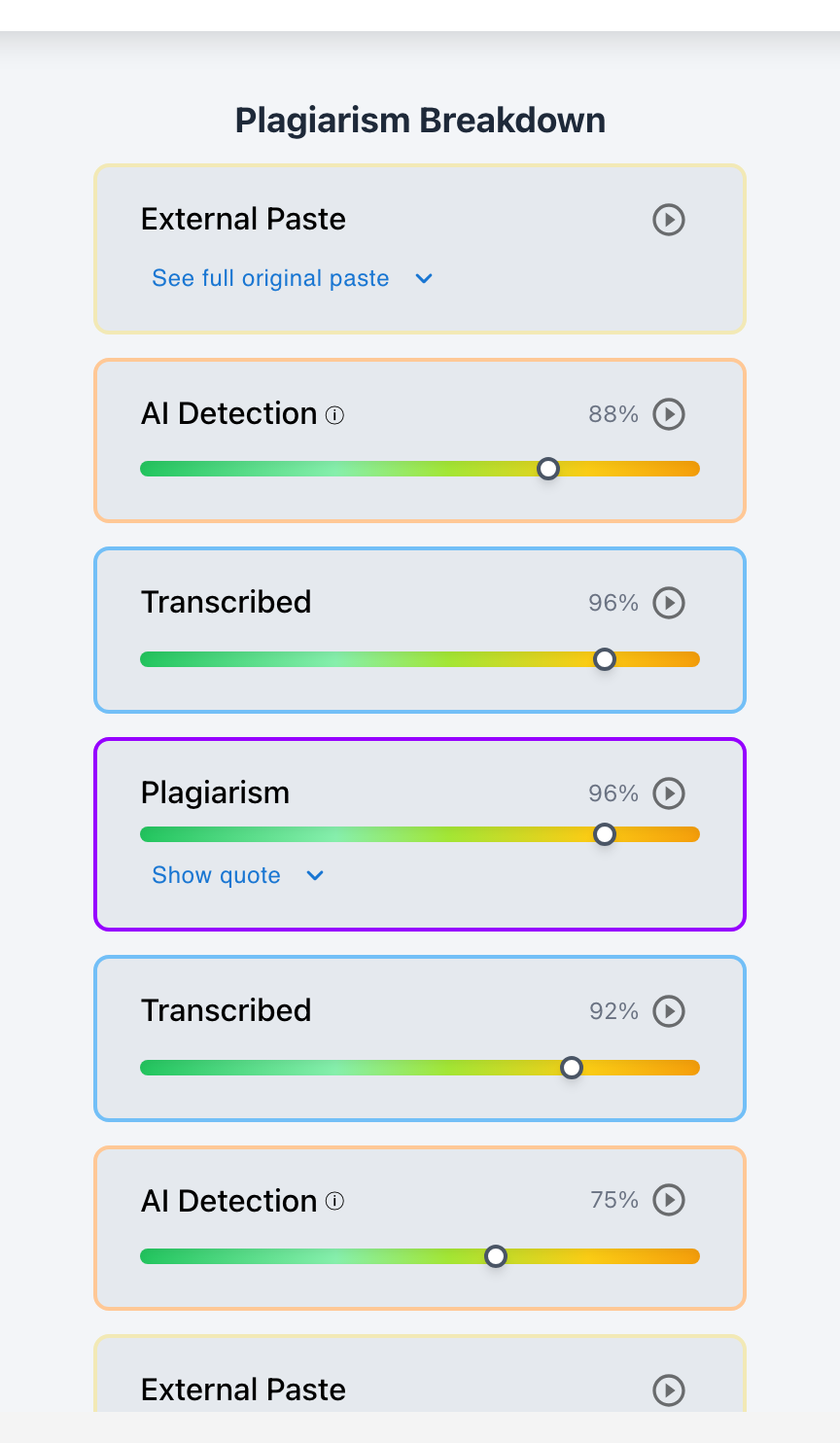
You should always trust the verified revision history over the AI detector score. An AI detector percentage is merely a statistical probability estimate that can generate false positives on eloquent, structured, or multilingual human writing. In contrast, Checkmark Writing Playback provides physical, empirical proof of human cognitive labor: logging hours of active typing, natural pause-and-burst cycles, organic backspace deletions (15–25%), and authentic thesis evolution. When revision telemetry confirms multi-hour human drafting, the AI score must be ruled a false positive and dismissed.
When a student's essay triggers a "78% AI Detected" warning, but opening their document history reveals 4.5 hours of active drafting across three days with hundreds of organic sentence revisions, teachers face a critical dilemma: Which signal do I trust? Trusting the AI score in this scenario punishes an honest student for writing well. Physical keystroke telemetry is the ultimate ground truth in academic assessment, effortlessly overruling probabilistic algorithm predictions.
Below is a comprehensive guide on resolving conflicts between AI detector scores and document revision history.
Checkmark Plagiarism eliminates score conflicts by pairing essay writing playback with AI detection, plagiarism detection, autograding, and integrations with Canvas and Google Classroom.
The 4 Reasons Revision Telemetry Trumps AI Detector Scores
1. Physical Reality vs. Statistical Guesswork
Keystroke telemetry records physical keypresses, thinking pauses, and backspaces over time; an AI detector only guesses text origin based on token patterns.
2. Documented AI False Positive Bias
Statistical detectors disproportionately flag advanced writers with sophisticated syntax and English Language Learners who write with formulaic structures.
3. The Cognitive Impossibility of Faking Telemetry
Simulating 4.5 hours of natural typing bursts, 22% backspaces, and messy outline reorganization cannot be faked or automated by chatbot tools.
4. Legal and Due Process Defensibility
Academic honor councils and courts universally uphold physical drafting records over black-box algorithm percentages during student appeals.
The 3 Verification Checks Before Dismissing an AI Flag
Ensuring complete forensic certainty in Canvas SpeedGrader:
- Check 1: Continuous Writing Playback Video: Watch Checkmark's 15-second time-lapse replay: verify that paragraphs were built incrementally with natural hesitations rather than pasted in bulk.
- Check 2: Citation Authenticity: Confirm that cited sources and DOIs exist in published scholarly literature via Checkmark's automated Crossref scan.
- Check 3: The 2-Minute Diagnostic Oral Check-In: Ask the student to define specialized vocabulary and summarize their core arguments. An authentic author explains their ideas effortlessly.
Read more in how Checkmark writing process analysis works.
Comparison: AI Detector Score vs. Checkmark Revision Telemetry
Checkmark Revision Telemetry (Ground Truth Evidence)
- Shows 4+ hours of active, continuous drafting labor.
- 15% to 25% organic backspaces and clause revisions.
- Displays gradual outline and thesis restructuring.
- Incontrovertible proof of authentic human authorship.
AI Detector Percentage (Probabilistic Estimate)
- Outputs an arbitrary statistical score (e.g., 78% AI).
- Prone to false positives on structured or formal prose.
- Blind to the student's physical effort and drafting time.
- Cannot stand up to administrative or legal appeals.
A 5-Step Educator Protocol for Resolving Telemetry Conflicts
Telemetry Conflict Resolution Checklist:
- 1. Notice the conflict: high AI score paired with a green Checkmark Playback badge in SpeedGrader.
- 2. Inspect Active Typing Hours: confirm that the student spent over 2.5 hours drafting the essay.
- 3. Inspect the Deletion Ratio: verify that backspaces fall within the healthy 15–25% range.
- 4. Dismiss the AI detector flag in Checkmark: apply the school's "Telemetry Overrule Standard."
- 5. Grade the essay on its academic merits and praise the student's rigorous drafting process.
How Checkmark Plagiarism Resolves Signal Conflicts
Checkmark Plagiarism combines **AI detection, essay writing playback, static AI detection, plagiarism detection, autograding, and Canvas/Google Classroom integrations** to automatically prioritize physical process telemetry over statistical estimates, eliminating false accusations entirely.
Frequently Asked Questions
Why do AI detectors flag essays with normal revision histories?
Because detectors analyze word sequences, not writing effort; formal human writing that uses standard transitions and advanced vocabulary often mimics AI token patterns.
Can a student fake a normal revision history?
No. Manually faking 4 hours of typing, organic bursts, and 20% backspaces across thousands of words requires more time and effort than simply writing the essay authentically.
What is considered a 'normal' revision history?
A normal history includes 2.5+ hours of active typing for a 1,200-word draft, multiple drafting sessions over days, 15–25% backspaces, and natural thinking pauses.
How does Checkmark Plagiarism integrate with Canvas LMS?
Checkmark displays the Telemetry Overrule Badge directly inside Canvas SpeedGrader, allowing teachers to clear false positives with a single click.
What if a student copied text slowly from a phone?
Transcription produces a flat, robotic cadence with <3% backspaces and zero structural revisions, which Checkmark Playback flags as abnormal.
How should a teacher explain the false alarm to a student?
Say: "The automated tool flagged your formal vocabulary, but your writing playback clearly proves your hard work. Great job on this draft!"
Does Checkmark Autograder respect the Telemetry Overrule Standard?
Yes. Autograder automatically suppresses AI warnings on submissions with verified multi-hour drafting histories, grading the work strictly on rubric criteria.
What should an administrator do if a parent complains about an AI flag?
Show the parent the Checkmark Playback video confirming their child's authentic drafting hours; it immediately clears the student and reassures the family.
Can teachers disable statistical AI detectors entirely?
Yes. Many schools configure Checkmark to rely primarily on Writing Playback telemetry, using statistical classifiers only as a secondary screening flag.
Why is trusting telemetry essential for student psychological safety?
Because students must know that their genuine hard work will always be recognized, protected, and honored by their teachers.
Truth, Fairness, and Respect for Student Labor
Data must always serve justice. By trusting Checkmark Plagiarism's verified writing telemetry over statistical AI scores, educators eliminate false accusations, protect student voice, and celebrate the authentic human effort that defines true scholarship.
Checkmark Plagiarism supports this comprehensive approach with AI detection, essay writing playback, static AI detection, plagiarism detection, autograding, and integrations with Canvas and Google Classroom.
See how Checkmark resolves AI score conflicts with writing telemetry in Canvas SpeedGrader. View a sample report or request a demonstration.