
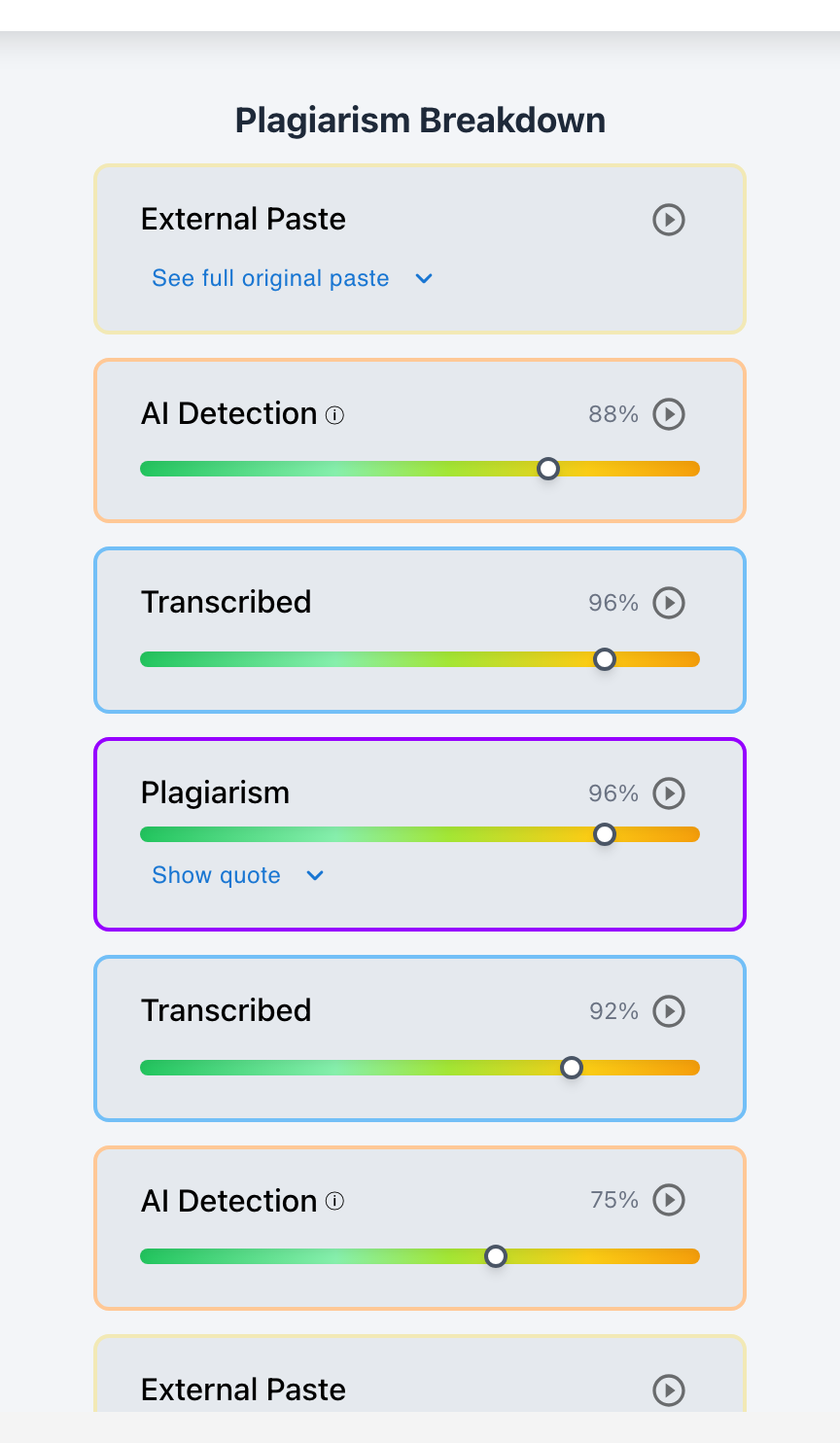
When a student's essay contains flawlessly formatted APA, MLA, or Chicago citations that lead to non-existent journal articles or dead DOIs, the student used a generative AI model (such as ChatGPT) to produce their bibliography or write the paper. Large Language Models do not query real academic databases; instead, they generate "hallucinated" citations by predicting statistically plausible strings of author names, journal titles, and DOIs. Checkmark Plagiarism detects hallucinated sources by automatically verifying every cited DOI against Crossref and Google Scholar databases.
For decades, teachers evaluated citations based on formatting compliance: checking if commas were in the right place, dates were parenthesized, and book titles were italicized. In the AI era, perfect citation formatting is no longer evidence of rigorous scholarship. A student can prompt ChatGPT: "Write a 1,500-word research paper on the economic causes of the French Revolution with 5 peer-reviewed citations in APA 7th edition," and the AI will output immaculate, elegant references that look completely authentic but are 100% fabricated. Fabricated citations are definitive, incontrovertible proof of generative AI text creation.
Below is a comprehensive guide on how AI hallucinates academic references and how educators verify source authenticity.
Checkmark Plagiarism exposes hallucinated citations by pairing plagiarism detection with AI detection, essay writing playback, autograding, and integrations with Canvas and Google Classroom.
The 4 Types of AI Hallucinated Academic Citations
1. Chimera Citations (Real Author + Fake Article)
The AI uses the name of a real, famous professor in the field, but invents a completely fabricated article title and journal volume that the author never wrote.
2. Phantom DOIs (Dead Digital Object Identifiers)
The AI constructs a syntactically perfect DOI string (e.g., 10.1080/00221309.2023.1892341) that resolves to a 404 error when searched on doi.org.
3. Synthesized Direct Quotations
The AI invents persuasive "direct quotes" from historical figures or researchers that do not appear anywhere in published literature.
4. Journal Frankenstein Blends
The AI combines a real journal name (e.g., The American Historical Review) with impossible issue numbers (e.g., Volume 992, Issue 4, pages 1045–1090).
Why AI Fabricates Citations: Token Probability vs. Lookup
Understanding the machine learning architecture behind fake sources:
- Large Language Models Do Not Search: Chatbots do not possess a live index of academic journals. When prompted for sources, the model predicts words that look like an academic citation based on probabilistic patterns.
- Plausibility Optimization: AI models are trained to sound authoritative, which makes their fabricated citations appear indistinguishable from real research to the untrained human eye.
- Instant Disproof in Crossref: While statistical AI detectors generate probabilities, checking a DOI against Crossref is binary: the publication either exists in the international register of scholarly research or it does not.
Read more in how Checkmark writing process analysis works.
Comparison: Real Student Citations vs. AI Hallucinated References
Authentic Student Citations (Verifiable Scholarship)
- DOIs resolve directly to published papers on
doi.org. - Direct quotes match original source text exactly.
- Student can produce PDF or library printout of source.
- May have minor human formatting flaws (commas, spacing).
AI Hallucinated References (Synthetic Fabrication)
- DOIs lead to 404 errors or completely unrelated articles.
- Article titles return 0 matches on Google Scholar.
- Student is completely unable to locate or show the source.
- Immaculate, flawless formatting despite invalid data.
A 5-Step Educator Protocol for Verifying Suspicious Citations
Citation Verification Checklist:
- 1. Open the student's bibliography in Canvas SpeedGrader with Checkmark enabled.
- 2. Inspect the Source Verification Card: check for red badges indicating "Unverified DOI / Non-Existent Publication."
- 3. Copy a suspicious article title into Google Scholar in quotation marks (e.g.,
"The Dynamics of Revolutionary Trade in 1789"). - 4. If 0 results are returned, copy the DOI into
https://doi.orgto confirm resolution failure. - 5. Hold a private conference: ask the student to open the PDF or webpage of the cited study.
How Checkmark Plagiarism Detects Fake Citations
Checkmark Plagiarism combines **AI detection, essay writing playback, static AI detection, plagiarism detection, autograding, and Canvas/Google Classroom integrations** to automatically scan bibliographies and cross-reference citations against international academic registries.
Frequently Asked Questions
Why does ChatGPT invent sources instead of saying it doesn't know?
Because generative AI models are trained on token completion; when instructed to provide citations, the model prioritizes generating plausible-sounding references over factual silence.
Is a fake citation conclusive evidence of AI use?
Yes. A human student might make a typo in a page number, but inventing an entire fake journal article title and author combination is a signature of generative AI.
How does Checkmark verify DOIs automatically?
Checkmark queries Crossref, PubMed, and OpenAlex APIs in real time, validating whether each cited DOI, volume, and article title matches official registry metadata.
How does Checkmark Plagiarism integrate with Canvas LMS?
Checkmark embeds citation status indicators directly next to bibliography entries in Canvas SpeedGrader, flagging fake sources in bright red.
What if a student claims they found the fake source on a website?
Ask the student to open their browser history and show the webpage; an authentic website will be easily retrievable.
How does citation fabrication impact academic integrity hearings?
Fabricated citations provide objective, indisputable physical evidence that eliminates subjective debate during honor committee reviews.
Can students use AI to format their own real citations?
Yes. If a student feeds real URLs into AI to format citations, the sources will be valid in Crossref; only generated content creates hallucinations.
How does Autograder evaluate essays with fake citations?
Autograder automatically assigns a score of zero to research integrity criteria and alerts the educator to inspect the bibliography.
What should a teacher do if a student confesses to using AI for sources?
Follow your school's tiered misconduct policy: require a supervised rewrite using real library databases and provide citation instruction.
Why is citation verification the most decisive test for AI use?
Because while students can attempt to paraphrase text to bypass detectors, an AI-generated fake citation cannot survive a simple database lookup.
Factual Rigor in the Digital Age
Academic research is built on the pursuit of truth. By utilizing Checkmark Plagiarism's automated citation and DOI verification tools, educators instantly expose AI hallucinations, protect the integrity of scholarship, and teach students the vital importance of authentic research.
Checkmark Plagiarism supports this comprehensive approach with AI detection, essay writing playback, static AI detection, plagiarism detection, autograding, and integrations with Canvas and Google Classroom.
See how Checkmark verifies citations and exposes AI hallucinations in Canvas SpeedGrader. View a sample report or request a demonstration.