
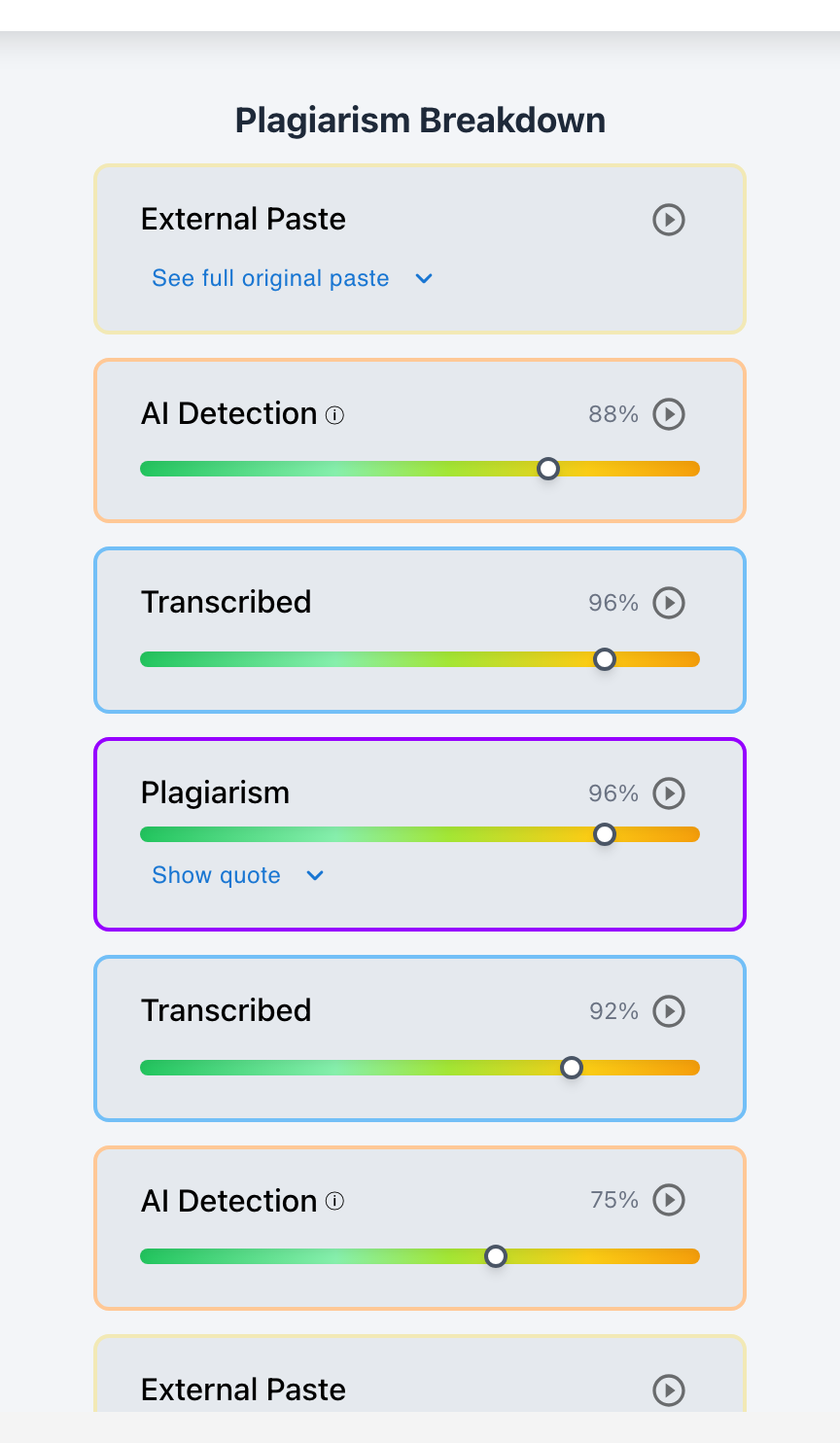
Yes. A student typing an entire 1,500-word essay in a continuous, robotic stream with almost no pauses (<2 seconds) and near-zero backspaces (<3%) is highly suspicious. Natural human composition operates on a "cognitive burst model"—where writers type for 5 to 15 seconds, then pause for 3 to 20 seconds to think, review sources, and self-correct. Uninterrupted metronome typing strongly indicates that the student was not composing, but rather manually transcribing text from an external screen (such as ChatGPT on a smartphone or second monitor).
When students realize that copy-pasting AI text generates instant paste payloads that get flagged by platforms like Checkmark, some attempt a time-consuming evasion technique: placing their phone next to their laptop keyboard and manually typing ChatGPT's output word for word. They assume that because they physically pressed every key, the writing will look 100% human. However, cognitive biometric telemetry reveals transcription effortlessly: human thought leaves distinct pause and revision footprints that transcription cannot replicate.
Below is a comprehensive forensic guide on analyzing typing pause distributions and investigating transcription anomalies.
Checkmark Plagiarism detects transcription anomalies by pairing essay writing playback with AI detection, plagiarism detection, autograding, and integrations with Canvas and Google Classroom.
The Cognitive Science of Writing Pauses: Bursts vs. Transcription
Authentic Human Drafting (The Burst Model)
Linguistic Bursts: 6–12 words typed rapidly, followed by a 4–15 second pause at phrase or clause boundaries to formulate the next concept, plus frequent backspacing.
Manual Screen Transcription (The Metronome Model)
Robotic Stream: Constant 45–60 WPM input with uniform 200–300ms inter-keystroke intervals, zero clause pauses, and text appearing in final polished syntax.
The 4 Forensic Footprints of Manual Transcription
How Checkmark Playback identifies retyped external text:
- Footprint 1: Flat Inter-Keystroke Interval (IKI): The time between keystrokes remains virtually constant throughout the entire essay, lacking the natural acceleration and deceleration of creative thought.
- Footprint 2: Absence of Macro-Revisions: The essay flows from Paragraph 1 to Paragraph 5 in a single linear pass with zero moved sentences, deleted paragraphs, or restructured arguments.
- Footprint 3: Eye-Gaze Drift Pauses: Pauses occur randomly mid-word or at line breaks (when the student looks down at their phone screen) rather than at logical punctuation boundaries.
- Footprint 4: Hallucinated Source Inclusion: The student faithfully types out fabricated DOIs and fake academic quotes generated by the chatbot without noticing they are invalid.
Read more in how Checkmark writing process analysis works.
Comparison: Authentic Composition vs. Retyped Transcription
Authentic Composition (Organic Human Thought)
- Dynamic burst typing with frequent thinking pauses.
- 15% to 25% backspace deletions and self-corrections.
- Sentences rewritten and reorganized organically.
- Pauses cluster at sentence ends and paragraph breaks.
Retyped Transcription (External Screen Copying)
- Uninterrupted metronome typing with <2s pauses.
- Less than 3% backspaces across thousands of words.
- Zero structural reorganizations or deleted drafts.
- High AI linguistic score paired with robotic cadence.
A 5-Step Educator Protocol for Investigating Robotic Typing
Transcription Investigation Checklist:
- 1. Open Checkmark Writing Playback in Canvas SpeedGrader: inspect the Typing Cadence Graph.
- 2. Check the Pause Distribution: note the absence of natural 5–15 second thinking pauses.
- 3. Inspect the Deletion Ratio: confirm whether backspace usage is abnormally low (<3%).
- 4. Hold a brief 1-on-1 check-in: show the student their continuous 40-minute playback video.
- 5. Ask: "Your playback shows continuous typing without any pauses or revisions. Were you typing this from notes or another screen?"
How Checkmark Plagiarism Detects Retyped AI Text
Checkmark Plagiarism combines **AI detection, essay writing playback, static AI detection, plagiarism detection, autograding, and Canvas/Google Classroom integrations** to automatically analyze typing cadence and flag unnatural transcription patterns.
Frequently Asked Questions
Is it possible for a fast typist to write without pausing?
Fast typists type quickly during bursts, but they still pause regularly (5–20 seconds) to think, formulate complex syntax, and review their thesis.
What if a student says they wrote the essay on paper first and typed it up?
Ask the student to bring in their handwritten paper drafts and research notes; legitimate paper-to-digital transcription will be fully supported by physical notes.
How does Checkmark Playback visualize typing cadence?
Checkmark generates an interactive Cadence Timeline, graphing words-per-minute fluctuations and color-coding pauses longer than 3 seconds.
How does Checkmark Plagiarism integrate with Canvas LMS?
Checkmark embeds cadence graphs and playback telemetry directly in Canvas SpeedGrader, highlighting transcription alerts in one click.
What if a student copied text from a split-screen browser window?
Checkmark Playback captures the same flat cadence, lack of revision, and zero-pause flow characteristic of split-screen manual copying.
Why do students retype ChatGPT instead of copying and pasting?
Students believe that physical key presses bypass copy-paste detectors, unaware that keystroke cadence telemetry exposes transcription instantly.
Can students fake natural pause patterns?
Faking organic human burst patterns, semantic hesitations, and 20% backspace ratios across a 2,000-word essay is virtually impossible to simulate manually.
How does Autograder evaluate transcribed essays?
Autograder benchmarks the essay's mechanical cadence against its linguistic complexity, flagging the submission for teacher review if a mismatch exists.
What disciplinary action is appropriate for transcription?
Retyping AI text is unauthorized AI generation under school honor codes and should be handled through your institution's tiered misconduct policy.
Why is typing cadence telemetry such powerful evidence?
Because watching a continuous 15-second playback video makes it visually obvious to parents and students that text was copied from an external source.
Biometric Truth in the Writing Process
Writing is thinking, and thinking takes time. By utilizing Checkmark Plagiarism's typing cadence telemetry and pause analysis, educators see beyond the surface of keypresses, distinguishing genuine human composition from external screen transcription with effortless precision.
Checkmark Plagiarism supports this comprehensive approach with AI detection, essay writing playback, static AI detection, plagiarism detection, autograding, and integrations with Canvas and Google Classroom.
See how Checkmark detects transcription and typing cadence anomalies in Canvas SpeedGrader. View a sample report or request a demonstration.